
Pet Sematary: Looking at Grief through a Paranormal Lens
Whether you’re reading Stephen King’s horror novel, watching Mary Lambert’s Pet Sematary (1989), or Kevin Kolsch and Dennis Widmyer’s 2019 adaptation of the film, one theme undeniably exposes itself through raw truths: grief.
Many people in the world have experienced loss, especially during a time like this. If you haven’t been following the news, roughly 250,000 people worldwide have died from COVID-19 (as of writing on May 4). Meanwhile, in the United States (prior to the global pandemic), an estimated 2.5 million people die annually, leaving an average of five grieving people behind. That’s 12.5 million people experiencing the loss of a human being every year.
However, those are just numbers. You can’t really visualize death or grief through statistics. This isn’t a paint-by-numbers subject. Recently, the New York Times published an opinion piece on mass death, grief, and how images help us to process loss. Regarding current events, Sarah Elizabeth Lewis asks the question, “Where Are the Photos of People Dying From Covid?”
Without going to the link and reading for yourself (although you should do that later), I’m going to pull your attention to the quote: “There is an inverse relationship between high numbers and comprehension: It is much harder to picture tragedy of the kind we are now witnessing than it is to visualize one person in pain, or an image that connects with a familiar aspect of the human condition, what psychologists have termed the ‘identifiable victim effect.’”
Picturing one person’s death is much easier than trying to imagine the hundreds of thousands of Covid-19 victims—unless you saw a photograph. Which begs the question: Is this physical truth kept from us for the sake of retaining the privacies associated with medical facilities, funeral services, and the dead in general? Or is it to keep the public from digesting a situation that is too real?
Whether you’ve ever been in a car accident, witnessed a tragedy, or even outlived someone fighting a battle with cancer, photographs of those events are rarely taken by the ones directly experiencing the matter, from any perspective. Maybe the mental imagery is remembered, maybe it’s suppressed, but the mind finds a way to protect itself from death’s raw truth when avoided, keep it private and often to itself. When you can’t physically see the truth in front of your eyes, it’s easier to step away from the pain, and sometimes horror, that is grief.
When I was 16, my grandfather was beginning to lose his fight with stomach cancer—a battle he fought for nearly 23 years. I had just received a Canon PowerShot camera that Christmas, and without anyone knowing (or so I thought), I snapped a photo of him. Eyes sunken, mouth open, yellowish skin under layers and layers of clothes and blankets, sleeping. It was the last photo ever taken of him. He was my first big loss.
Looking back, I can tell you now that even after he passed, I never deleted the photo. But I've also never taken another photo of that nature since, nor have I felt the desire to. Something about that media—the proof of dying vs. just savoring a memory of when that person was alive—seems more painful, as it finalizes that information and makes it true. (If you’ve ever experienced grief, this is where we can no longer take part in the “Denial” state.)
Did you know that when King finished writing Pet Sematary, he questioned publishing it all together? In an interview with Entertainment Weekly, King said, “I just had the greatest time writing the book until I was done with it. And I read it over, and I said to myself, ‘This is awful. This is really f—ing terrible.’ Not that it was badly written, necessarily. But all that stuff about the death of kids. It was close to me, because my kids lived on that road.”
Death doesn’t have restrictions against people, family, friends, or pets. To ask my reader if he/she has experienced grief at this point seems rather redundant, but in case you are one of the lucky ones, I’m certain you’ve at least witnessed it. And whether you’ve read or watched any of the Pet Sematary adaptations, you know where we’re headed.
(For the sake of this review, we’ll focus on Kolsch and Widmyer’s adaptation of Pet Sematary [2019].)
In the beginning of the movie we see the Creeds, a family of five: Louis (Jason Clarke); Rachel (Amy Siemetz); Ellie (Jeté Laurence); Gage (Lucas Lavoie); and Winston Churchill, also known as “Church” (Ellie’s cat). The family is moving from Boston to rural Ludlow, Maine. Louis has just taken a job working as a doctor at a local college so that Rachel can be a stay-at-home mom in their newly purchased home, located on roughly 50 acres of land.
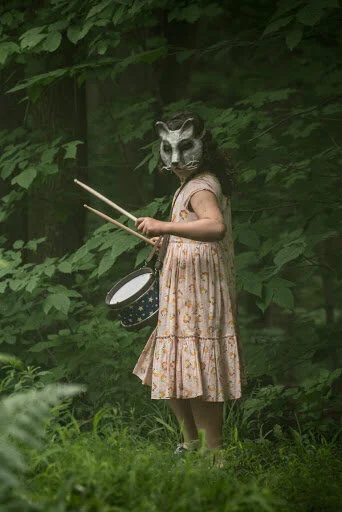
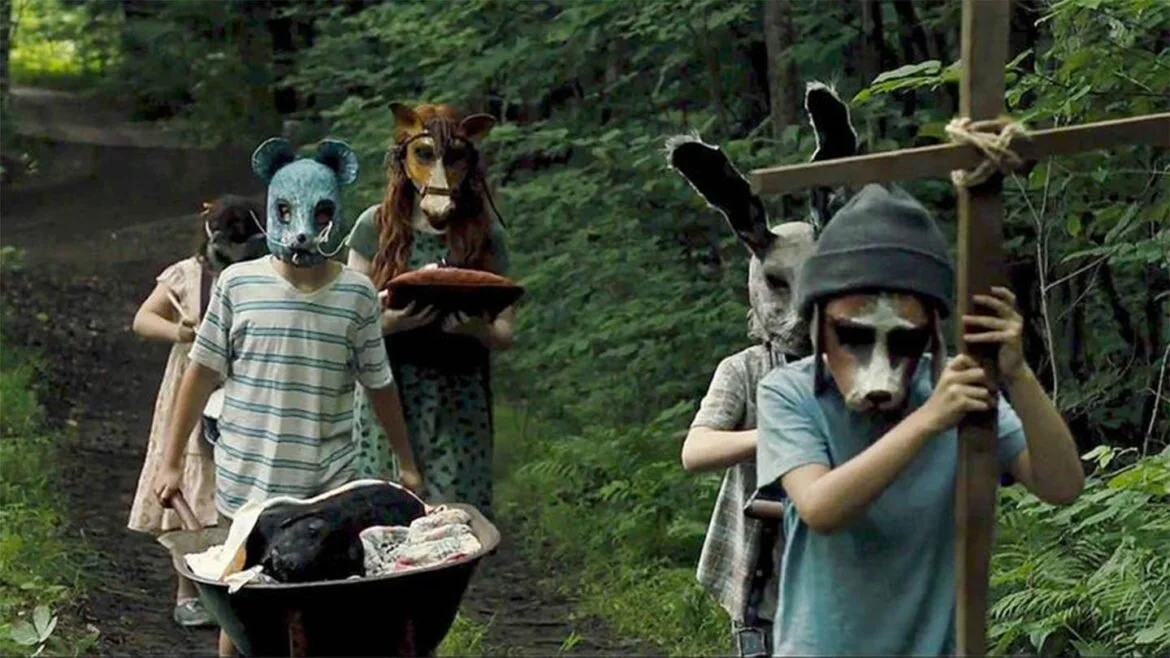
What the family doesn’t know upon arrival, however, is that their property is home to the neighborhood’s pet cemetery. Upon settling in, it doesn’t seem to take long for Ellie to become curious about what resides in the woods. Although, a band of children wearing homemade animal masks transporting a dead dog by wheelbarrow wouldn’t make it hard to guess. When asking her mom about the display of beating drums and marching, Rachel avoids any funereal wording, choosing to tell Ellie that the ceremony “looks like some kind of procession,” further explaining it’s “like a parade, but not for fun.” Still curious after returning home, Ellie sneaks back out to find where the children were going.
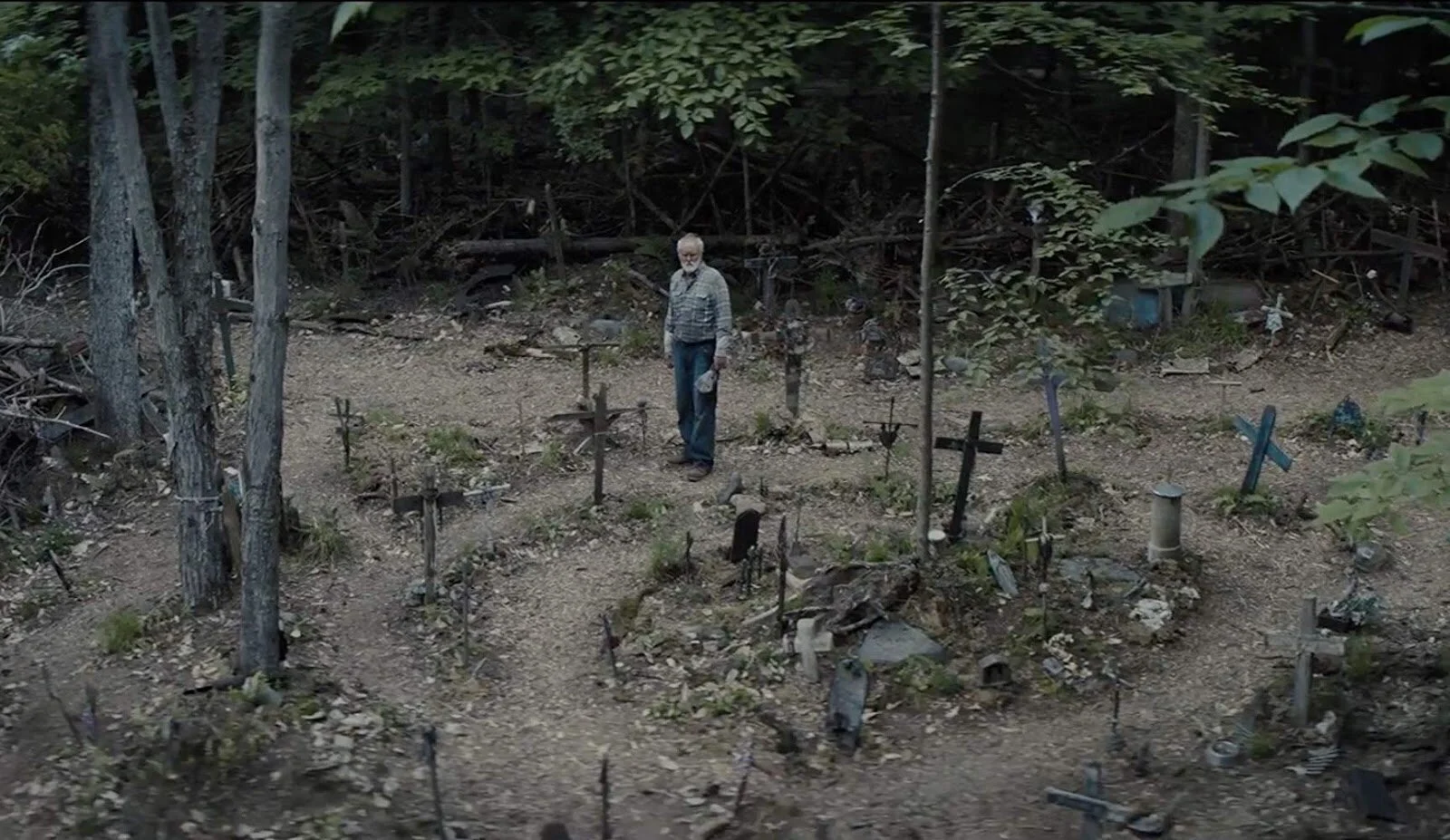
Ellie winds up finding the Pet Sematary on her own. Filled with an almost circular pattern of makeshift crosses and tombstones, the cemetery is surrounded by piles of twisted branches, marsh, and mud, raised high as if to keep something out, or maybe keep something in. Whether it was a child’s curiosity or the sound of the wind, Ellie tries to climb the wicked wall. Grabbing onto what look like tree roots and bits of broken branches, Ellie loses her grip when she hears someone yell at her for what she’s doing. Helping her up, Jud Crandall (John Lithgow)—the neighbor—tells Ellie about his dog being buried in the Pet Sematary, how townsfolk have been burying their pets here for decades, and kindly reminds her that the forest is unsafe for a young girl.
That night, Ellie asks her parents about death, and specifically, if Church is going to die. While Louis is reluctant to give her the truth, Rachel tries to dance around the topic of death again, this time with religion—that all people live long, happy lives, and when they die they go to Heaven, where they continue to watch over their loved ones in peace. However, Louis diagrees: There is nothing after death, just darkness. Having experienced the tragic death of her sister at such a young age, Rachel’s connection to death and the grief she feels over what happened still haunts her to this day, making for a topic she’s obviously uncomfortable with.
It isn’t long after this family conversation that Louis also experiences a traumatic event at work: the death of Victor Pascow (Obssa Ahmed), a student at the university. What’s worse, is although Louis verbalized his disbelief of an afterlife, his deceased patient awakens on the medical table, warning Louis not to cross the barrier. When Louis tries to brush the encounter off, Victor returns to what he believes are his dreams. In them, Louis is led to the Pet Sematary, where he is again warned not to go beyond the barrier and that the ground is “sour.” He wakes up with dried mud on his feet.
Although the Creeds have moved to rural Maine, the highway beside their house sees a number of fast-traveling oil trucks daily. One of them, presumably, hits and kills Church on Halloween. Not portrayed as successfully in the new adaptation, Jud and Louis, by this point, created a father-son-like relationship, with Jud regretfully informing Louis of the news, but assuring him that they would take care of it together.
However, once at the Pet Sematary, Jud can’t resist the power of the ancient Native American burial ground beyond the barrier, and convinces Louis to go farther. Unmoved by his premonitions, Louis follows. The sour ground where Jud instructs Louis to bury Church is described later as being possessed by the wendigo—an evil spirit described to devour mankind, quite literally—and can bring the dead back to life. Of course, Jud doesn’t tell Louis any of this prior to their venture.
The following morning, Louis and Rachel look like fools when they try to explain to Ellie that Church ran away—a lie created after Rachel pleaded Louis to tell Ellie, “Just anything but dead.” From Ellie’s perspective, Church was just outside her window the night before—the same night Jud and Louis buried him—and was now lurking creepily behind the doors of her closet. While he seems normal, a closer encounter with the resurrected Church reveals a strong stench and much more violent behavior.
In circling back, I feel that Rachel’s character is our keeper and protector from the “photograph,” or raw truth: She can’t accept death because she can’t forgive herself. She continues to feel responsible for her sister Zelda’s death, and wishing at times that she were dead prior to her accident instead of suffering every day from spinal meningitis. Because of this, Rachel’s relationship with death is terrifying. Because she is tormented, she never wants her children to feel that way about someone passing either. After all these years, the grief and regret consumes her.
On the contrary, Louis needs proof. He’s convinced he’s gone crazy or falsely mistook the cat for dead, so he visits Jud. As stated earlier, the burial ground is “sour” and has a power very difficult to resist. Jud knew firsthand about the site after he buried his own dog there, which later returned with a temper and eventually bit his mother. He thought this time with Church might be different, and even the tiniest excuse can be a reason to return. But remember: “Sometimes dead is better.”
Meanwhile, I feel that it is the grief felt from within that pulls people there. Ellie doesn’t know what, but something made her want to climb the barrier. Maybe her grief was reminiscent of leaving her former home. The various noises and wind seeming to emanate from and draw you to that place was felt by Louis, too, but in his dream-turned-reality. Rachel, on the other hand, never even bothered to get too close. While the legend states that a wendigo is created when a human resorts to cannibalism for survival, in this story, a wendigo instead becomes a cannibal while possessing the body of the dead after a human succumbs to hopeless grief and gives up their deceased for a chance at life once more.
This all comes together in near perfect timing. What everyone remembers most from this horror story is the sudden, tragic death of one of the Creed children. Growing up, you’re taught that outliving a child is probably the worst possible thing that could happen to you. It completely wrecks the wheel, the order of things, the belief that everyone lives a long and happy life.
In a freak accident occurring on Ellie’s birthday, a distracted truck driver almost hits Gage as he runs towards his sister, already on the road because she’s found Church. (Who is on his second “runaway” story, although Louis had abandoned him out in the woods this time.) As the driver swerves, he manages to miss Gage, but his oil tank breaks from the truck, and like a train car, hits Ellie in the middle of her tracks.
Rachel can’t bear the reality and leaves to live with her parents and Gage, leaving Louis behind with Church and Jud. Having recently experienced a tragic loss myself, I understand that. You see, grief isn’t just a feeling: It is a whole mentality and can even be a physical pain. The worst part? There’s no guidance, no medicine or words you can take to make you feel better. Sure, there’s the five stages: denial, anger, bargaining, depression, and acceptance—however, they’re never experienced in the same order, and some stages might never be felt.
In my opinion, the most immediate feeling after a tragic loss is denial. They were just here. Rachel couldn’t not look for Ellie in her everyday life. Ludow was their home. She needed to be somewhere she wouldn’t expect to see her as easily. I’m sure, while we only see her depression, one can guess the anger she felt about not being able to save Ellie, or the bargaining about all the ways it could have happened differently to prevent her ultimate death.
With Louis left alone with his feelings of depression, he contemplates the power of the burial ground beyond the pet cemetery, and irrationally manages to bargain with himself that if he were to dig up his child, the ground would bring her back. Even seeing her again in the casket doesn’t stop him; he is blind to the raw truth. In his mind, there is a way around death, a solution to the void he feels weighing on his chest. There is a way to cheat death, and maybe this time will be different. While the zombie-like child does return and is somewhat normal, hints of the wendigo creep out every now and again, growing stronger until those who survived are, too, devoured.
I don’t need to tell you exactly how the story ends, because experiencing the fear associated with the thought that you could instantly lose someone so dear, is haunting enough. The horror and scare factors of the possessed Ellie are just cinematic. King knew just how to hit through what society believes might be one of its biggest known tragedies: the death of a young, innocent child. In his book, King has you believing for nearly seven pages that the accident never even happened, that it wasn’t real. He manages to make you physically feel denial without ever having to experience grief. And he’s right; it’s fucking terrible.
In comparison to the 2019 movie, Louis still reaches that grief-induced hysteria where he is convinced Ellie isn’t dead, that the truth isn’t real and he knows a way to bring her back. Even with that physical proof—his “photograph” and memory of the situation—fails when he knows, deep down, there is a solution that could change it all back. A solution any person living with grief wishes for the most: to bring them back. And honestly, how could you stop yourself from at least trying?
Article written by Destiny Johnson
Destiny writes about true crime and thrillers. She likes movies and stories that make you question the world around you, more so than what makes you jump.




In The Buffalo Hunter Hunter, blood carries the violence of colonialism, while a settler’s journal controls whose story survives. This essay examines how Stephen Graham Jones uses vampirism and layered testimony to confront historical erasure.