
We Are the Other: Embracing Transgender Monstrosity in Horror Literature
In 1993, Susan Stryker gave a presentation that would go on to be published as “My Words to Victor Frankenstein above the Village of Chamounix” and credited as one of the foundational texts in the creation of transgender studies as an academic discipline (Keegan 68). In it Stryker likens her experience as a transgender woman to that of the Creature in Mary Shelley’s Frankenstein, a being shunned by its creator as a monster through no fault of its own, forced to fumble blindly through a society that is actively hostile to its existence. However, Stryker does not simply wallow in her despair. Through a number of poetic verses, she channels her pain into a burning rage at the world that rejects her. Through her anger, she accepts the title of monster, declaring: “Rage throws me back at last into this mundane reality in this transfigured flesh that aligns me with the power of my Being. In birthing my rage, my rage has rebirthed me” (Stryker 252).
The experience of being trans, of realizing one’s identity is not what it was declared at birth and undergoing a social or medical transition, unquestionably alters how a person views the world around them. Stryker’s focus on transgender rage is one example of how scholars address the hardships of trans life, but there are also positive aspects of transness to be explored using this same metaphor. The transcendence of boundaries features heavily in the expression of trans monstrosity. We, as trans people, exist as living proof that the categories thought by many to be impenetrable are far easier to abandon than people have been led to believe. By shattering the illusion of gender as two strictly impermeable and clearly-labeled boxes, trans people may avail themselves of an expanded sense of possibility. In Stryker’s words: “as we rise up from the operating tables of our rebirth, we transsexuals are something more, and something other, than the creatures our makers intended us to be” (Stryker 248).
One impact this has is on the affect of transgender people; the intangible, yet visceral forces that exist between individuals as we navigate through the world. Though ephemeral, a person’s affect is found in their demeanor, reactions, and relationships. How an individual carries themselves and interacts with others is unavoidably colored by affect. Affect is a consequence, but also a constant reminder, of a body’s “belonging to a world of encounters.” Indeed, some scholars go so far as to claim bodies are defined by their ability to participate in the exchange or passage of affect (Gregg and Seigworth 2). Trans people’s stitched together selves acquire a monstrous affect, our difference altering our spirits and the bodies they reside in.
Stryker’s piece is a strong example of the empowerment that queer people can find in fully embracing and embodying the monstrous personas society often casts on us. Monstrosity is fearsome in the face of opposition, a furious determination to continue living in spite of the common vitriolic sentiments of those that do not understand. Even in explicitly fictional accounts of monsters, the emotions, sentiments, and affects evoked in the mind are real enough to impact the sensibilities and subjectivity of the reader (MacCormack 534). Therefore by examining two examples from literature, I intend to follow the thread of embracing monstrosity to analyze how it can be utilized in stories with uniquely trans implications.
Monster Theory
Jeffrey Jerome Cohen is credited with coining the term “monster theory” in his 1996 essay “Monster Culture (Seven Theses),” which details seven key features of monsters across their various iterations, delving specifically into the reason for their existence and the meanings that attract our persistent fascination (Weinstock 1). Cohen claims a culture can be understood by examining the monsters it creates; what that culture deems unnatural and frightening brings its morals and values into sharp focus. The seventh thesis, “The Monster Stands at the Threshold… of Becoming,” deserves to be quoted in its entirety:
Monsters are our children. They can be pushed to the farthest margins of geography and discourse, hidden away at the edges of the world and in the forbidden recesses of our mind, but they always return. And when they come back, they bring not just a fuller knowledge of our place in history and the history of knowing our place, but they bear self-knowledge, human knowledge—and a discourse all the more sacred as it arises from the Outside. These monsters ask us how we perceive the world, and how we have misrepresented what we have attempted to place. They ask us to reevaluate our cultural assumptions about race, gender, sexuality, our perception of difference, our tolerance toward its expression. They ask us why we have created them. (Cohen 52)
Monsters are the beings that exist at the fringes of society. They are feared and hated, labeled as unnatural by the masses who deem them evil after little more than a passing glance. Monsters are not considered deserving of basic human rights because they are not seen as human. The Creature in Frankenstein is immediately deemed wicked and deserving of death. In his encounters with humans, they do not wait to determine if he is hostile or dangerous before lashing out and driving him away. This is because the creature’s difference is embodied, it exists in his physical form, worn on his skin for all to see.
As Stryker points out, the same is true of trans people. Even those who pass as their identified gender and can hide their trans status from strangers may still bear surgery scars or anatomy that differs from the cisgender majority. Others exist in a perpetual liminal space of androgyny; what Sonny Nordmarken refers to as “the in-betweenness of genders and the borderlands of oppression” (Nordmarken 38). Our difference is visible to all even when fully clothed. Trans people must navigate the world with an understanding that those who hate us will know we are a target on sight. We have reason to fear rejection for the crime of simply existing. And like the Creature, trans people often cannot rely on the human rights that might otherwise protect us. Our difference frightens people, and is thus deserving of scorn, abuse, or worse.
This embodied difference is what contributes to a range of monstrous affects, including but not limited to Stryker’s transgender rage. The transgender affect discussed previously, the ability to see the brittleness of strict boundaries of classification, is echoed in Cohen’s outline of monster theory. Monsters also resist traditional categorization, and indeed are often defined by it. “They are disturbing hybrids whose externally incoherent bodies resist attempts to include them in any systematic structuration. And so the monster is dangerous, a form suspended between forms that threatens to smash distinctions” (Cohen 40). The danger posed by the monster is not necessarily physical, but ontological. Like trans people, the monster is living proof that the structures society tells us are an insurmountable fact of nature are far easier to transverse, or transcend entirely, than we have been led to believe. Monstrosity therefore provides imagery and metaphor, and by extension a language, with which transgender people can describe our own plight of social ostracism. This language provides the trans person (and/or the monster) with what Harlan Weaver describes as “the affective glue of kinship” (Weaver 124). A desire for kinship is persistently laced through monster theory and transgender artistic expression alike.
Crucially, Cohen’s seventh thesis also makes explicitly clear that monsters are fundamentally human. Society around them may not treat them as such, but that does not change the reality. The very first line of his thesis refers to monsters as “our children,” children which may differ from their parents but not so completely that they become an unrecognizable species. Like queer and trans children, they may be rejected by their family for their difference, but the distinction drawn that deems them an unacceptable type or level of difference is arbitrary. Their “self-knowledge” is still within the realm of “human knowledge.” They are othered but not fundamentally different. It is through stories of monsters that we can see the realities faced by these othered beings reflected back at us.
Monster Girls Don’t Cry and Transmuted
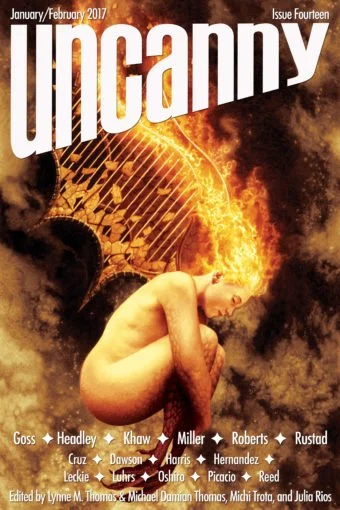
Read “Monster Girls Don’t Cry” in Issue 14 of Uncanny.
Queer and nonbinary author Merc Fenn Wolfmoor’s short story Monster Girls Don’t Cry depicts the contrasting lives of two sisters born with inhuman features. The point of view character, Zaria, painstakingly files down her horns and clips her wings in order to fit into human society, experiencing hardship and rejection when her physical differences are discovered. In contrast, her sister Phoebe is happy to live with her oversized claws and excess teeth in their natural state, even if this means living a life confined to her home. The two girls embody contrasting strategies often taken by those of embodied difference, as well as each strategy’s drawbacks. One assimilates, but endures painful personal maintenance and constant anxiety that her secret will be revealed, while the other accepts and is proud of her difference but must live in isolation and faces violence when discovered.
The sisters were raised by their mother, who herself had the unusual feature of additional mouths on each palm. Zaria observes: “Mama never looked like a monster when you were small. You thought all mamas had mouths in their palms to better kiss bruises and scraped knees and sing lullabies in two different keys” (Wolfmoor). Wolfmoor’s story therefore reflects the underlying message of Cohen’s seventh thesis. The traits we deem as outside the norm are not ingrained biological truths; they are learned values. When viewed without the weight of cultural norms, a child may even find difference to be a positive trait, as Zaria did with her mother’s extra mouths when she was young. Like the sisters in the story, some trans people can easily embrace who they are but suffer the consequences because of their differences, including limited opportunities and threats of violence. Meanwhile, others internalize the hatred they face and go to great lengths to suppress their true selves, forcing themselves to conform in order to move through society without difficulty. But Zaria’s suppression of her monstrosity causes her excessive amounts of stress and anxiety. Her relationships suffer because of her attempts to hide her unusual features, and despite her efforts at conformity, she is still subjected to violence from individuals who believe her difference is something that must be cured. Embracing her monstrosity and finding community are how Zaria ultimately finds happiness in spite of the difficulties she faces. She obtains Weaver’s “affective glue of kinship” and finds love, acceptance, and joy as a result (Weaver 124).
Eve Harms’s novella Transmuted follows Isa, a trans woman who undergoes an experimental feminizing treatment. Though Isa’s body becomes more conventionally feminine at first, the strange procedures eventually lead to much more drastic and decidedly less human changes. Over the course of the story, her skin becomes red, her hair falls out, her limbs stretch until they become unwieldy, and her nose falls off her face. For the purposes of this essay, the most interesting part of Isa’s story comes in the novella’s final chapter. Following the story's climactic events, Harms shows Isa several years later, now a minor celebrity in the body modification industry. We learn that Isa has become a tattoo artist, eventually opening her own shop and gaining enough notoriety to be featured in industry magazines. She has augmented her unusual appearance with piercings and subdermal implants, in addition to covering her red skin in tattoos of demons and classic Hollywood monsters (Harms 139).
Like Zaria deciding to grow out her horns at the end of Wolfmoor’s story, Isa no longer feels the need to hide abnormalities like her lack of a nose, instead choosing to embrace these features (or lack thereof) and further customize her appearance. Up until this point, Isa’s body is described as a continual source of discomfort for her, initially because of the dysphoria caused by her less feminine features, and later because of the fear and confusion of her strange transformations. Even in the immediate aftermath of the procedures, before her newly feminized appearance further morphed into the realm of the inhuman, Isa still expresses unease around how the changes she sees are possible, despite their desirability, and is often preoccupied with how she is being perceived by others. This final chapter is one of the few moments where Isa seems truly comfortable in her skin, going so far as to internally compliment her own body modifications and automatically assume her client’s bewildered stare is born of admiration. That another person may be judgmental or critical of her unusual appearance does not even occur to her, a stark departure from her insecurities earlier in the novella.
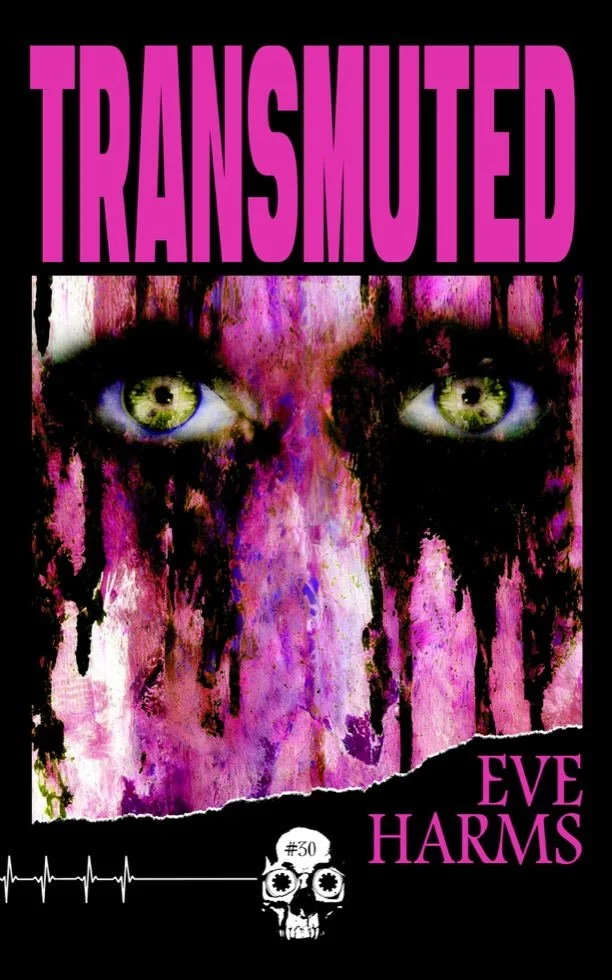
Find Transmuted on eveharms.com.
It should not be considered a coincidence that Isa’s body art of choice consists of various monsters, the archetypical Other. As a trans woman, Isa is othered through both outright transphobia and subtler microaggressions throughout the story. By choosing monsters to decorate her body, she accepts the Other as something worth memorializing. Her tattoos become a statement that the monstrous visage should be looked at and displayed, that monsters are worth being seen. Indeed, given Isa’s feminine presentation throughout the book and her consistent desire to embody traditional femininity, her tattoos even position the monster as something beautiful.
Conclusion
The monster’s roots are as a warning or omen, a sign that a certain place or a certain type of person is dangerous. However, this is not a natural delegation, but an active process that leads to specific types of people being branded as monsters and treated accordingly. Jeffrey Weinstock puts it succinctly when he writes “the monster comes into being the moment it is called a monster” (Weinstock 3). This monsterization is a tool wielded, often strategically, by people or groups in power—whether political, cultural, or religious—as a means to achieve specific sociopolitical ends. Instilling distrust or fear of an othered group has long been used as a tool of social control. The ones in power benefit by disenfranchising, oppressing, or in extreme cases eliminating a group they deem undesirable while simultaneously creating a scapegoat they can direct the average person’s anger toward. In Lloyd Whitesell’s words: “What better way to inspire horror and incite violence against a group of people than to declare them embodiments of the unnatural, the menacing, and the obscene?” (Whitesell 133–134).
But both the stories we tell of monsters and the analyses that result from them have shifted in the tales where the monster is given a voice. Monsters are still an omen, but what they portend and the lessons we can draw from their existence have changed dramatically. Rather than eliciting fear when they reveal themselves, they draw our attention toward the force that created them, be that a bigoted systemic discrimination or the callous disregard for life of one mad scientist. Monsters bring into focus their own constructed nature and offer a reckoning that the mantle of “unnatural” they wear is placed upon them by a specific perspective, not some universal truth. Deeming a difference unacceptable, and shunning those that possess it, is something done in the hopes that the othered will either find a way to assimilate or simply disappear, driven into a nameless dark corner so the masses need not acknowledge our existence. But as Cohen says, monsters always return.
Trans monsters in particular force the people who rejected us to face the fact that we still exist, despite their best efforts, and that far from feeling shame in who we are, we take their harsh words and use them to shine a light on our experiences. In Sonny Nordmarken’s words “we resist dehumanization by making ourselves, our pain, and our complex lives legible. We talk back” (Nordmarken 40). In the fringes of society, the margins we are forced into, we grow into ourselves in a monstrous becoming, developing a sense of self that is not reliant on mainstream approval, and thus one that is far more challenging for those outside ourselves to police and control. Then we speak out and bring into focus our own constructed nature. We position “unnatural” as a thing of beauty and freedom. We strip the term monster of its power by refusing to consider it an insult. Figures of trans monstrosity portend the truth: that there is life outside of the norm. That they can thrive and find joy in “unnatural” bodies. That they still have a voice they can share with the world in defiance of those in power who would silence them. These monsters ensure they will be heard, even in the face of hatred. They are a reminder that no suppression or violence will ever erase them from reality. For even in the face of adversity, monsters always return.
-
Cohen, Jeffrey Jerome. “Monster Culture (Seven Theses).” 1996. Reprinted in The Monster Theory Reader, edited by Jeffrey Andrew Weinstock, University of Minnesota Press, 2020, pp. 37–56.
Gregg, Melissa and Gregory Seigworth. “An Inventory of Shimmers.” The Affect Theory Reader, edited by Melissa Gregg and Gregory Seigworth, Duke University Press, 2010, pp. 1–25.
Harms, Eve. Transmuted. Unnerving Books, 2021.
Keegan, Cáel. “Transgender Studies, or How to Do Things with Trans*.” The Cambridge Companion to Queer Studies, edited by Siobhan Somerville, Cambridge University Press, 2020, pp. 66–78.
MacCormack, Patricia. “Posthuman Teratology.” 2012. Reprinted in The Monster Theory Reader, edited by Jeffrey Andrew Weinstock, University of Minnesota Press, 2020, pp. 522–539.
Nordmarken, Sonny. “Becoming Ever More Monstrous: Feeling Transgender In-Betweenness.” Qualitative Inquiry, vol. 20, no. 1, 2014, pp. 37–50.
Shelley, Mary Wollstonecraft. Frankenstein; or, The Modern Prometheus. 1831. Penguin Classics, 2003.
Stryker, Susan. “My Words to Victor Frankenstein above the Village of Chamounix: Performing Transgender Rage.” 1994. Reprinted in Transgender Studies Reader, edited by Susan Stryker and Stephen Whittle, Routledge, 2006, pp. 244–256.
Weaver, Harlan. “Monster Trans: Diffracting Affect, Reading Rage.” TransGothic in Literature and Culture, edited by Jolene Zigarovich, Routledge, 2018, pp. 119–138.
Whitesell, Lloyd. “Monstrosity as a Queer Aesthetic.” Monstrosity, Identity and Music: Mediating Uncanny Creatures from Frankenstein to Videogames, edited by Alexis Luko and James Wright, Bloomsbury Academic, 2022, pp. 133–148.
Weinstock, Jeffrey Andrew. “Introduction: A Genealogy of Monster Theory.” The Monster Theory Reader, edited by Jeffrey Andrew Weinstock, University of Minnesota Press, 2020, pp. 1–36.
Wolfmoor, Merc Fenn. “Monster Girls Don’t Cry.” Uncanny, vol. 14, 2017.
Article by Alastair Canavan
Alastair Canavan (he/they) is an Irish librarian and independent scholar based in Toronto. He holds a Master of Library and Information Science from the University of Maryland and a Master of Arts in Musicology from McGill University. His research centers folklore and the depiction of monsters in music, media, and literature, and has included intersections with queer and transgender studies and disability studies. His previous work has been published in Music Reference Services Quarterly.
Other Articles You May Enjoy…
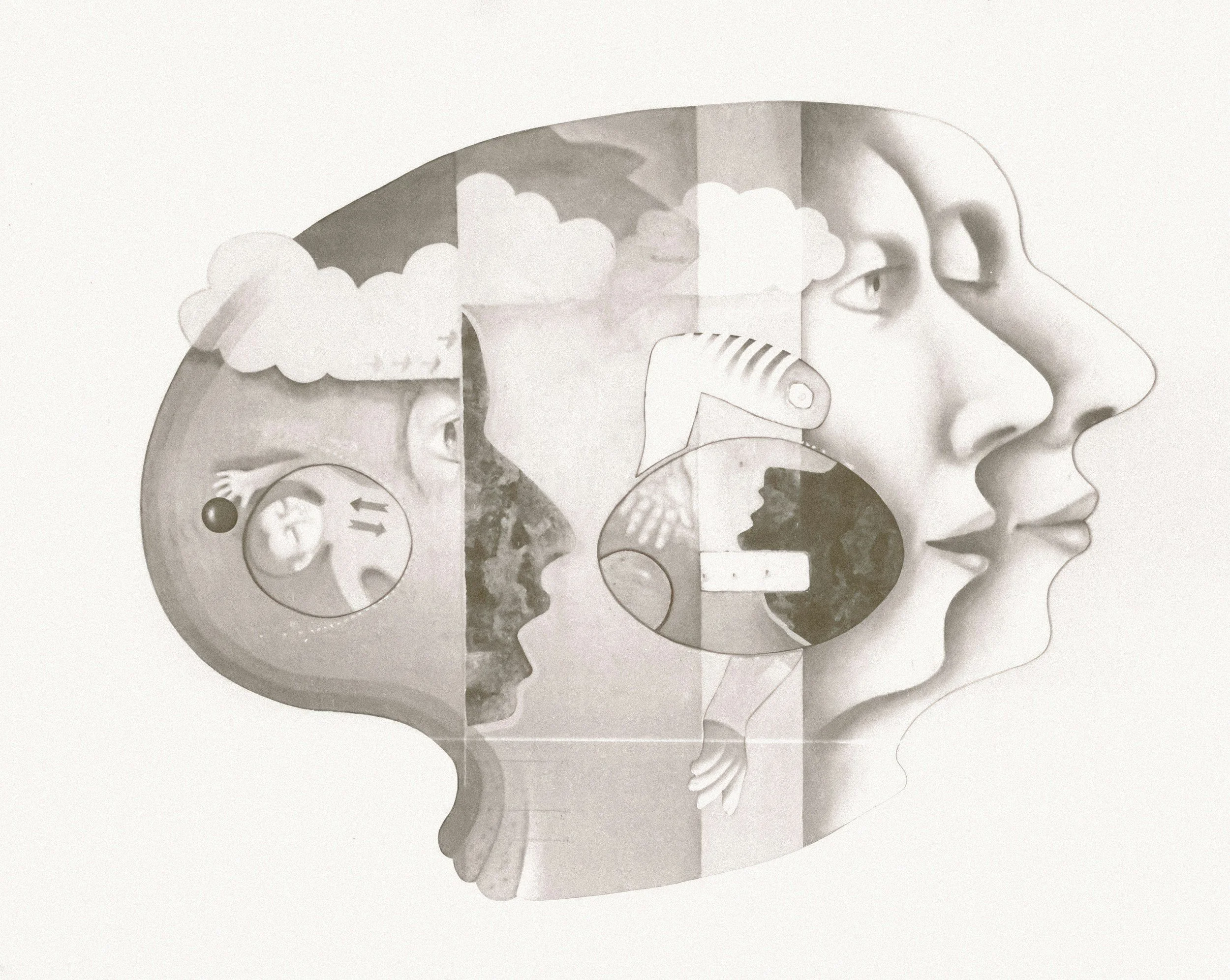
Through a blend of horror studies, philosophical analysis, and aesthetics, Ordinary Horror: The Aesthetics of Deformation from Leopardi to Ferrante by NYU professor of Italian studies Andrea Capra explores undiscussed nuances in contemporary and canonical Italian literature alike.