
Interviews with ‘Ice Cream Man’ Stars Benjamin Byron Davis & Sarah Abbott
Disclaimer: What Sleeps Beneath has been made aware of the criticism that Eli Roth’s 2026 Ice Cream Man has received about its use of generative AI in several scenes. While we maintain a firm anti-AI stance, we believe that, regardless of the decisions made in post-production, the actors we spoke with deserve credit and recognition for their contributions. We present the following interviews with minor edits for clarity.
Benjamin Byron Davis
Noah Welter: I have just a few questions for you. First and foremost, you’ve been in the business for over 30 years and your work ranges from some of the biggest film franchises in the world to a one-man off-Broadway show which you wrote. (Speaking of, I would love to hear about In Absentia if we have time!) But with a catalog of characters and work ranging so widely, what excites you about a new role like The Priest?
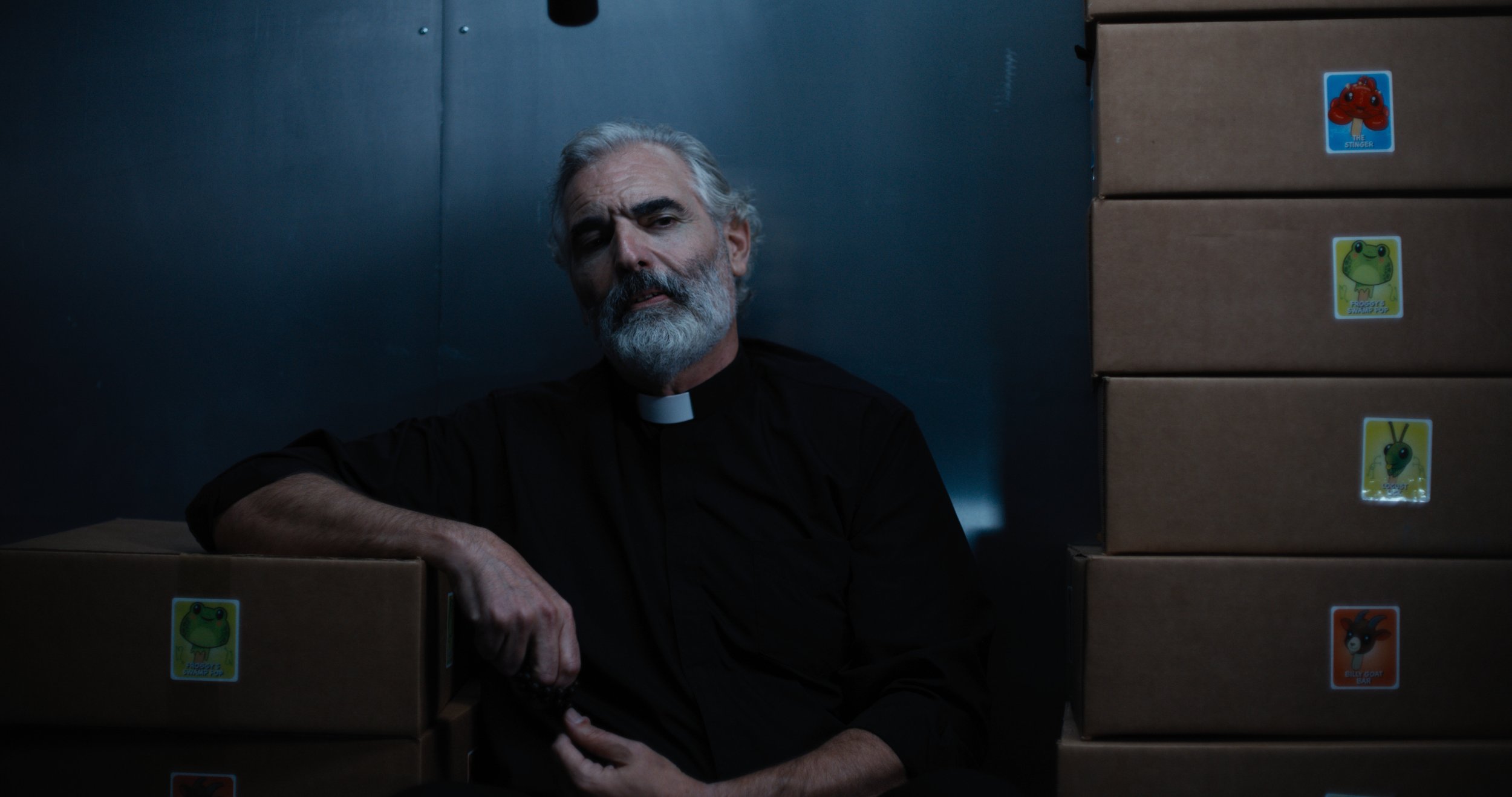
Benjamin Byron Davis as “The Priest” in the horror film, ICE CREAM MAN, from The Horror Section. Photo credit: The Horror Section 2026.
Benjamin Byron Davis: Oh, well that's a wonderful question and I appreciate 30 years. It goes quick, man. I’ll tell you that much. But with a role like this, what jumps out at me? I mean, I love acting. I just love it. And so any opportunity I have to mix it up under any circumstances, I’m delighted. But when Eli sent me this script, I read it not even knowing that there was a role for me in it. And I just loved—I mean, I didn’t know how the hell he was going to get it made—but I thought it was amazing. And I told him so and he said, “What do you think about the priest?” And I said, “What do you mean?” He says, “To play.” And so that’s how I found out I had it. And you know, every role sort of starts as, you know, I hope I get it and then you’re the dog that caught the car, you know, now what do I do with it? But you buckle down and, in this case, you learn a great deal of dialogue and you show up and you don’t know what you’re going to get. And what I got in this case was three just unexpectedly magnificent co-stars to work with—which, I had never worked with actors this young on such a big scene, but Kiori [Mirza Waldman], Charlie [Storey], and Shiloh [O’ Reilly] were so wonderful in the scene that we did and they were really present and great to work with. So, I guess to answer your question, I was just delighted to be able to take on a role like this. And I never really—I’ve had to deal with some exposition before, but I’ve never been “Father Exposition” before. And you know, the keeper of the lore in a horror film is kind of sacred ground. And I know—I’m steeped enough in horror history to recognize where this sort of figure fits in in the pantheon. So I was excited by this challenge and as you know I saw the film for the first time about two weeks ago and I was just so thrilled. I mean I think it is so much fun and Eli pulled it off, you know?
NW: Yeah, it is a blast. I told a bunch of people that it’s the type of movie that you’ll want to sit down with your friends and watch just to see their reaction to it. And that’s what I’m excited for is seeing people’s reactions to it.
BBD: It's the best thing about horror, you know, is that it in a theater, a packed theater in particular, where you're going through this together. I mean, it just popped into my head, but I remember when Child's Play came out and I saw that in the theater in Chicago, and it was just—I almost remember the experience more than I remember the film itself. It is. There is something so great about being scared and thrilled and laughing and screaming alongside a room full of strangers. I'm very excited about it.
NW: Yeah, I totally get that! So. Who Can Kill a Child has been noted as an inspiration for this film. I just watched it this past weekend also, right before Ice Cream Man. And—
BBD: What a double feature. Wow!
NW: Yeah! That movie blew me away. It really is so phenomenal.
BBD: I had never heard of it. I had never seen it. Eli, when I booked, he told me, "watch it." And so I watched it and it's Narciso Ibáñez Serrador, the director, 1976. It’s a—t's a cast I've never seen before, which is another thing that kind of happens with horror, often that these amazing films are made with rather unknown talent. And that film gets under your skin and it ends in such a dramatic shocking way. And I understood, when Eli asked me to watch it, a little bit better what he was going for, which is this sort of juxtaposition of innocence alongside this diabolical, carnal treachery. You know, it is quite a potent mixture. So it was wonderful that he introduced me to that film and I think it helped me understand the potential weight in a film that, in a lot of ways, seems rather breezy.
NW: Actually, to go off of that, what kind of parallels do you see between the two? Because especially with that first, you know, 10 minutes or so of Who Can Kill a Child, it really sets up what you’re about to go into and then it's happy and bright for a little while until you see just the devastation of everything. And actually how did that help inform the characterization that you had within Ice Cream Man?
BBD: I think it helped me understand what I was a part of maybe more than it really helped me play anything. But I think to me, in that film, there's a common thread—one of them—is the use of iconography. Like these tourists feel quite safe because all they can find are children. Like they're worried about their welfare because where are the grown-ups and so understanding over time that things that you thought of as safe are quite dangerous and things that you thought of as dangerous might be your salvation. It's a very unsettling dynamic. And I think Ice Cream Man, if you want to get “high falutin” about it, is exploring all of these figures in a child's life that they trust implicitly. And that trust might be unearned. It might be misplaced. And the figures that you're counting on to tell the truth might be telling lies. and the ones that you're afraid of might actually be a route to some salvation. And then the other side of the coin is it's a hell of a lot of fun to watch the movie and it's really scary and really funny and both things can be true and I think that's one of the great things about the genre is that you can teach a college course on it or you could also shut your brain off and just be like this is madness, which is one of the fun things about some horror films.
NW: So we only have about two minutes left, so I'll leave you with one last question. So, this is your second time working with Eli Roth. I've been in the business for 10 years now. I act, write, direct, all that. And when I find people that I like to work with, I work with them over and over again. So what was your experience with Eli going from a big studio film like Borderlands to this independent horror?
BBD: Well, you know, Eli and I have worked together on multiple things beyond those two, but as far as feature films go, yeah, this is my second feature with him. Borderlands was a challenge for a lot of reasons. Not least of all was COVID. We were at the height of lockdown when we were in Budapest filming that. And the one thing I can say that was the same, at least on set, was how great it is to have a creative partner like Eli Roth. He is such a supportive director and he is, also this actually hasn't come up in any of the interviews today, he's also a pretty spectacular actor as he demonstrates in Ice Cream Man. But I think the thing that is odd is that both projects had parameters and limits—one is an enormous project, but there's so many creative partners that have so many ideas and there was also the unease of of lockdown while Borderlands was being made and that it had a troubled history is pretty well known. But Ice Cream Man is Eli's. It's completely Eli's. There's no other fingers in the pie. There's no responsibilities and there's not a great deal of handwringing going on. Will theaters be reopened? Will the audience from the existing property come and enjoy this property? This is Eli's. And thank goodness it is because it has a spine, it has a character, it has a personality that is all its own and it is, I think, the much better of the two films I've gotten to do with Eli. I think Ice Cream Man is a real crystallization of his artistic interests and his real power as a story teller.
NW: I totally agree. Thank you for taking the time to talk with me. Your performance was incredible. I can't wait to start showing people the film as soon as it comes out.
BBD: You and me both, Noah. I am very excited for this thing to see the light of day.
Sarah Abbott
Noah Welter: First and foremost, thank you for taking some time to talk with me. It's really nice to meet you!
Sarah Abbott: It's very nice to meet you as well. I'm excited.
NW: So I got the chance to watch the movie on, I guess it was Saturday night. My fiancée and I got some ice cream and we sat down and watched it and it was a blast, but you were phenomenal in it.
SA: Oh, thank you so much. And also, I'm very glad that you ate ice cream while you watched Ice Cream Man.
NW: We both had a conversation about it beforehand that if we didn't get ice cream, we probably would have regretted it like a minute in. But anyway! You started performing at a very young age, it’s been like 14 years now, which is about 70% of your life. So what um what stood out about this film to be your next project?
SA: Yeah, I think that I haven't really gotten the chance to work on many horror films, at least not since I was younger. So, I knew that this was going to be very emotionally and physically challenging at times. And that really interested me. And also, like, I knew of Eli Roth and the type of work that he made and I just was like, I filmed my audition and just hoped for the best and I was so ecstatic when I got the news that I got the role.
NW: Yeah, absolutely. So having performed for that long, has your passion changed over time or is the spark that, you know—that started at all with performance—has that remained kind of the same?
SA: Yeah, I mean I grew up a dancer and I thought I was going to be a professional dancer and then once I found acting I really did fall in love with it and there was a time where I did take a break, like you're trying to figure yourself out as a young teenage girl, but I found my way back to it and ever since I've been hooked. So yeah.
NW: You mention dancing and that you were a competition dancer. Um, one of my favorite moments in the entire movie was—to avoid spoilers—when you worm around for a while, I guess is probably the best way to put it. Did your dance experience come into play with that?
SA: 100%. I was like, "Okay, like how can I use this to help me in this scene?" And Eli was great because he was like, "Okay, like let's just see what you can do and then we can always play around or tweak it." But yeah, I definitely found it very helpful.
NW: So, was that a—for lack of a better phrase—a “full send” moment or did you have rehearsals leading up to it or was it just “cameras up, go see what you can do?”
SA: We did rehearse, but it was kind of like a full send moment like, okay, I'm starting somewhere and I have to get somewhere else. And I just played around with it and yeah, it was really fun.
NW: I know just how long those days on set can be. How long were you filming that specific scene? I have to imagine it was like physically tolling, too.
SA: Yeah, we did quite a few takes because you have to get the wider angles and we go close-up on certain things, but yeah, definitely a couple of hours. But worth it!
NW: Jumping off of that and kind of going back to something you said at the beginning with the physicality of something like this, what was, in your opinion, the hardest day, like physically on set or emotionally on set?
SA: Well, there's a couple of scenes near the end of the movie where it kind of gets really crazy. And you know, that day we were filming all day and we had a lot of physical moments in it. A lot of crazy emotional moments and I definitely had to get to a certain headspace to be really open and present. But it was really rewarding coming home and knowing that I showed up and I did my best work. But yeah, that was probably the hardest day.
NW: I actually noted how much of an immense burden you carry at the end of that and how wonderfully you play it. How do you prepare for a moment like that?
SA: Thank you! Um yeah, I think just really understanding the material and really understanding your character, just doing as much work as you can. And I always say, “faith in self, faith in partner, faith in script.” Once you have that, you can fully be open to get to a really emotional headspace. I find music really helps or sometimes I listen to voice notes from my parents, and that just allows me to be very emotionally available, I think, for the scene that I have to do.
NW: Yeah, of course. I know some people don't like to reveal this, but what is the music that you like to listen to? If you don't want to say, it can be your trade secret. Don't worry.
SA: No, I think there's just certain songs I don't even know the names. I just kind of have a playlist and it's just songs that I find that make it very easy for me to associate things. So like, you know, it doesn't really matter what scene I'm doing. I just know I have to be emotionally available and just emotionally so open. So yeah, it depends.
NW: Yeah, I love that. The whole film is a crazy joy ride, honestly. It's so bloody. It's so gory. It's crazy. Do you have a favorite day on set or favorite memory from set or both?
Dinner scene from Ice Cream Man (2026).
SA: Yeah. I think there's this scene where the family is all together just at the dinner table and it was such a fun day on set and obviously we did the scene as it was scripted but then Eli was like, "Okay, let's just improv. Let's have fun with it." And like, as an actor, being told you can improv is like, "Okay, like this is—it's getting fun." So yeah, I think we just felt like a family and I'm excited to see how that translates onto the screen.
NW: I can tell you that for a fact it absolutely translates in that scene. In that scene though, with Eli Roth as your dad who some consider as a sort of father of horror—what was it like acting against him and having him as your dad in the film?
SA: Yeah, he's so wonderful and like, you just feel so comfortable with Eli. Like even between takes he'd sit and talk with me or give me advice or tell me stories. So I felt that, you know, getting to work next to him was wonderful and he was always open to, you know, collaboration and just our ideas. So it just felt like a really safe set. It was great.
NW: Oh, that's wonderful. Yeah, that's something I always strive for anytime that I'm directing anything or any set that I'm on. I always want everything to feel safe. I'll leave you with one final question. Is there anything you'd like to share about the film? Anything that you find interesting? Anything that excited you about it? Anything that you want to share at all?
SA: Yeah, I mean Eli has had this vision and has had for like 20 years. So to be a part of it and just really to help bring it to life was so amazing. I just hope everybody enjoys it and is open to the fun and the goriness because Eli definitely pushed the line on this one in the best way.
Article by Noah Welter
Noah J. Welter is a Pittsburgh based bartender and film artist. His cocktail creations have been featured throughout the world in a multitude of bars and immersive events. Noah takes a distinctly unique approach to the creation of his cocktails by combining his love for film and cocktail culture, historically linking them together. To find more of his work, drink and otherwise, you can visit www.noahjwelter.com.
Other Articles You May Enjoy…


Filmmaker Bari Kang discusses Itch!, from its practical gore and zombie influences to filming in his own NYC store and directing his daughter.