
'Beyond the Drumlins' Composer Johnny Tomasiello: An Interview
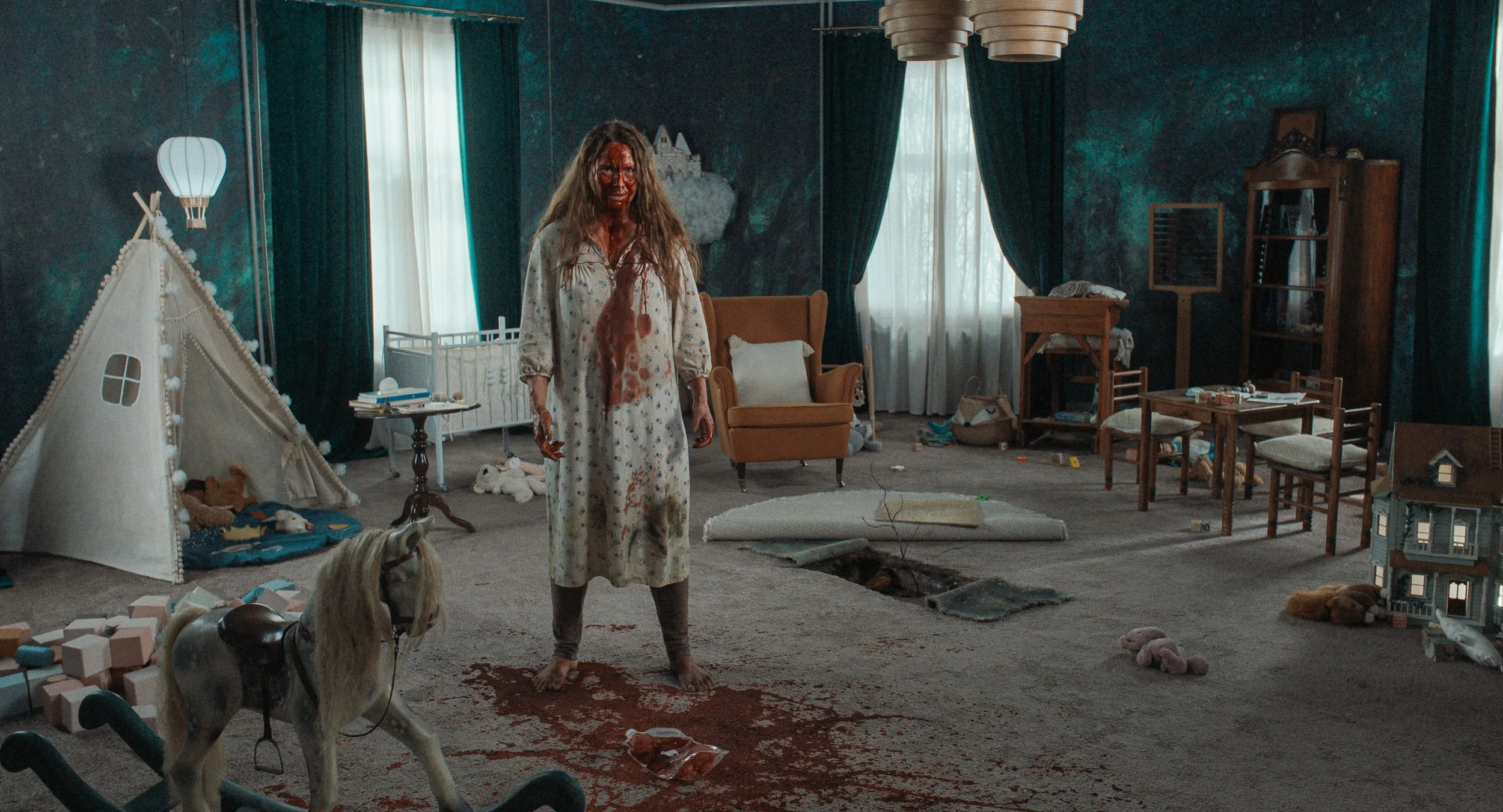
Of all the great films that came out of 2025’s “Thriller Picture Show” by the Pittsburgh Moving Picture Festival, one of my favorites was a folk/cosmic horror feature called Beyond the Drumlins, directed by Daniel W. Bowhers and co-written by Bowhers and Michael Kowalski, who also played the film’s lead character. The film follows Jonathan Rust (Kowalski), an archaeology professor who, along with his small dig team, uncovers a mystery that threatens their very reality. It’s a film that checks a lot of boxes for me, including that ever-present dread that comes with the best ancient, otherworldly secrets.
One of the most important parts of creating that anxiety-inducing atmosphere is, of course, the score. I had the opportunity to meet with Beyond the Drumlins’s composer, Johnny Tomasiello, an artist based in New York City, who gave me a deeper look into his incredible and experimental process for scoring the film.
Artist, Filmmaker, Scientist
Johnny: My name is Johnny Tomasiello. I'm an interdisciplinary artist based in New York City, and I have a background in fine art and psychophysics doing research on heart rate variability—biofeedback initially—working at the Robert Wood Johnson Foundation. I know Dan Bowhers, the director of [Beyond the Drumlins], from also being a visual effects artist. We’ve known each other for quite some time and he invited me to collaborate on the music for several of his projects, the most recent being Drumlins.
Since I’ve been working on a system that translates brainwaves to music as a dynamic real-time compositional performance system, I had pitched the system to Dan as a way to score his film. I said, why don't I take an initial cut of the film and just record the score all in one go as my brainwaves react in real time to the film, without having seen any of it previously.
Ande: That was actually going to be my first question: Had you seen the cut beforehand or how many times did you watch the movie? With that initial runthrough—recording your brainwaves as you watch the film—how much of that session made it to the final cut?
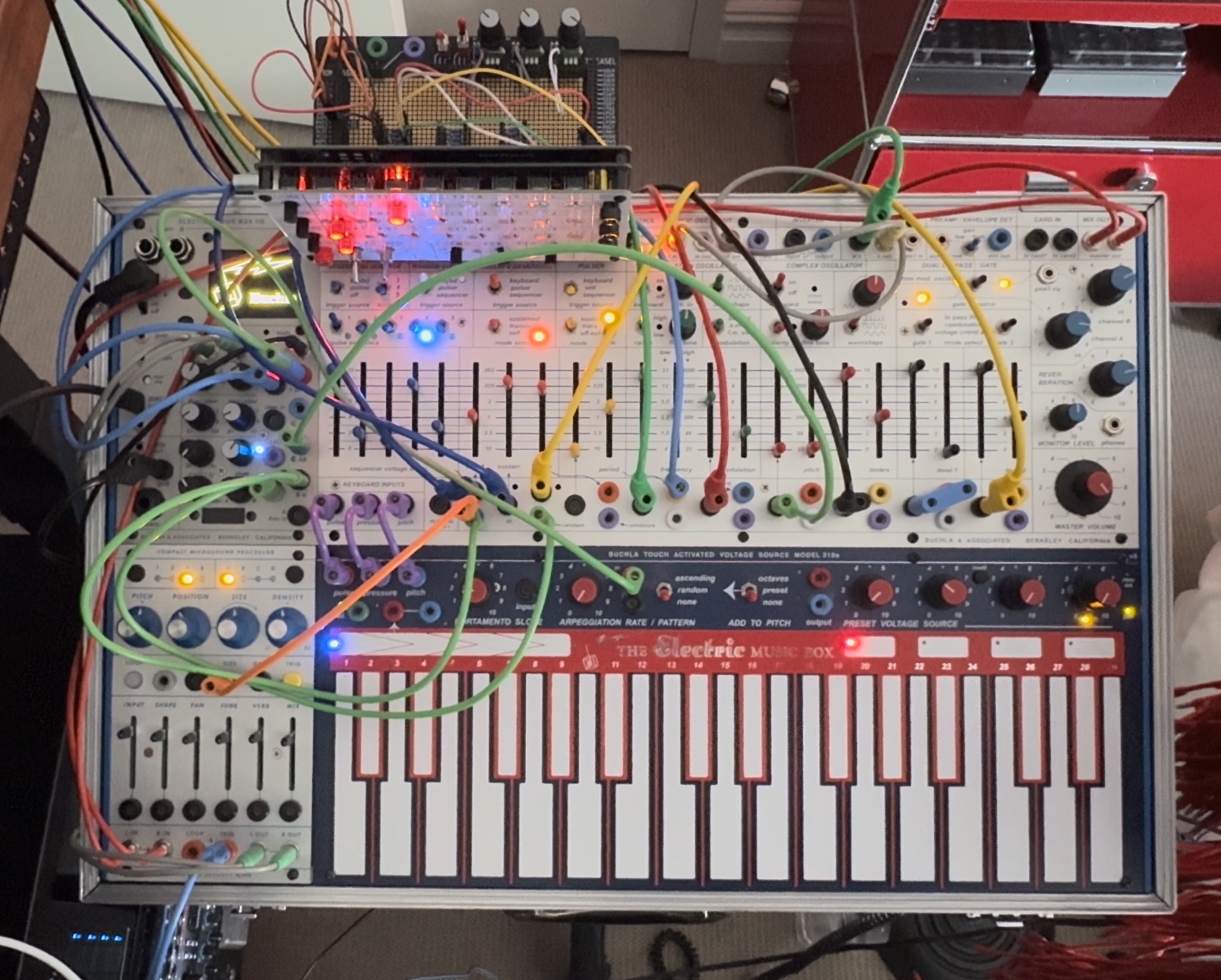
Buchla Music Box analog synthesizer, image courtesy Johnny Tomasiello.
JT: Initially, I did it once—that was sort of the parameter that I had described to Dan. So I said, let me do it this way, and then you can lay it over picture, and you can decide—because I knew that it would be too populous to have music over every single moment of the film, but that first impression was analogous to how my brainwaves were responding to the film.
I said, let's do it this way, and then if you find there are moments where it's appropriate to have background music, we’ll start there. So that would be the skeleton of the audio and the sound for that initial cut. And then from there, we could build on that frame. If there was something specific that he wanted to achieve with the music or attention or mood or whatever else, we could discuss that afterwards. But that was very much the beginning of how that worked.
AT: You mentioned it being probably too populous to have your entire brainwaves laid over the entirety of the film, but Beyond the Drumlins does have a lot of music but because it's got a bit of a lower-key vibe, it kind of can just sit in the background and the volume can come up or down or whatever. But when I watched it originally, I didn't really notice it, which in the case of scores is normally a very good thing that it kind of just blends into the film as you experience it. Then after my conversation with Dan, I went back and watched it again and noticed that there are a lot of moments where that music is almost ever-present and it’s so ethereal and fascinating.
When you're thinking about the process and how you're translating this biofeedback into music, I'm just imagining static on a television and you can make it sound however you want by manipulating the tone and type of wave you’re translating it to, and so on. So what's the process of creating these very musical sounds from raw data?
JT: Well, there's a number of ways to do it. I mean, you can, of course, take some kind of fixed translation you set up ahead of time where you say, you know, X=1, if you want to do it that way. But the way I approached it is—and just a little background on how brainwaves work: There is a range of brainwave frequencies from slowest to fastest. The slowest being the strongest when you are in a deep sleep or very deep meditation, for instance, going all the way up to the fastest brainwaves where you would be excited. Not necessarily positively or negatively. I mean, you could be annoyed, you could be happy. It doesn't distinguish between that, but it's sort of these states of focus. Alpha, being directly in the center, has shown therapeutic uses for treatment of PTSD, of memory and issues and brain injury, for instance.
So since my ultimate goal with my project is to develop those therapeutic applications, I designed the feedback, which is the music, to respond to those brainwave states. So if you are in a higher brainwave state, let's say gamma, for instance, which is the highest frequency, that’s not an inherently bad thing, it's just not conducive to alpha wave training. So I designed it to respond in a way that the feedback reflects that. And that's the cue for the user, not necessarily me, anyone who's using the system. It's a cue for them to refocus and bring their attention back to something that would be optimal for alpha wave training.
Now you can lean into these rules and intentionally move between brainwave states with enough practice. So I could say I want a brighter sound or different pitches and I could, with focus, be able to control that to an extent. And also, if you're not focusing or intentionally trying to move the feedback, you can, in this instance, let just what you're experiencing or what you're watching or what you're hearing sort of do that for you. And I did a combination of those things for the feedback and the music for the film.
AT: So is that similar to binaural beats and trying to use music as a way to focus your brainwaves into a certain frequency, from, say, gamma or delta waves to alpha?
JT: Well, it's all about reciprocal influence. So basically, you would have something external that you'd focus on and that would help you change your brainwaves or your heart rate or whatever. But in the case of a feedback loop, whether it's biofeedback, neurofeedback, whatever you're working with, what happens is that feedback is based on the readings, the live real-time physiological readings that you're taking. And then you're in turn focusing on that and you're trying to change your internal physiology in some way. So it becomes a loop.
AT: I see. So—and you might not have the data to answer this—but with the score that you created for the film, do you anticipate that it might have the potential to guide the viewer into brainwave states that either you felt yourself or that you are hoping to experience the film through, more than a traditionally recorded score, or is that a little too far of a stretch?
JT: It's hard to say. I mean, there would be, I'd have to make a lot of assumptions there but it's fun to think about. I guess my idea behind the project generally is that if you were to say emotional states based on experience might be quite similar for anyone, even though the individual experiences, if you weigh that based on opinion or how you think you should respond, might be different. For instance, we all might experience grief in the same way where, you know, at first you deny and then you get angry and so on. But what you're grieving over might be different for everybody or the intensity of the grief you feel. But the process is the same. That might be one assumption we have to make.
Famously, Kurt Vonnegut gave a lecture on the shapes of stories. So you could say that a character started out and they lost something—there’s an emotional arc there, and then when they get it back, you have your happy ending. But no matter what their “something” was, anyone can relate to the emotional arc, the journey. Those emotions, you could say, are universal. So I like the idea of thinking about it in that way and maybe tapping into what is universally understood by people on an emotional or visceral level.
AT: So the therapeutic angle that the system is being built for—what does that look like in practice? Are you looking to treat behavioral issues and disorders or would it be part of physical training, psychological disorders…
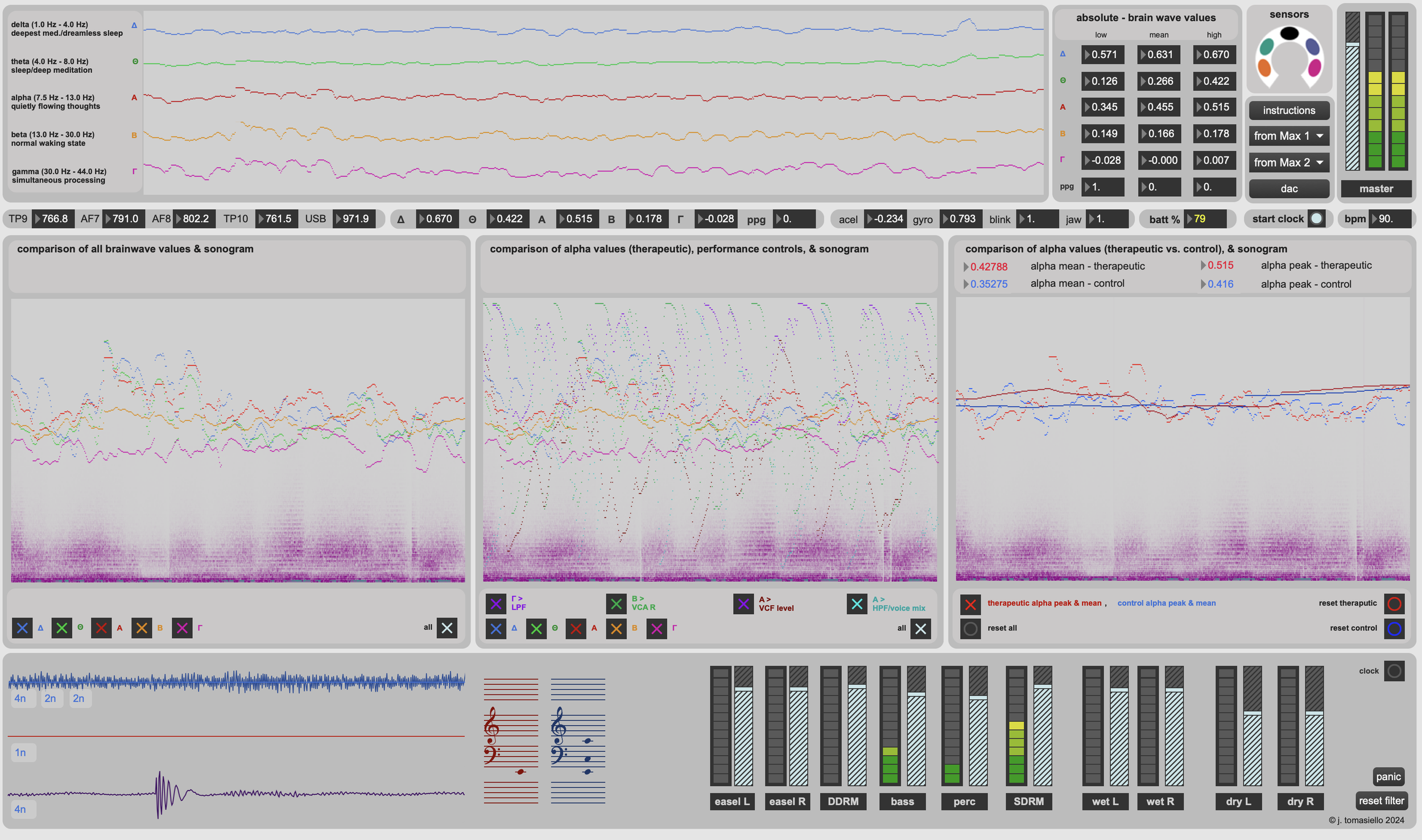
Deriving Synchonry: A Real Time Interactive Brainwave-to-Music Translation Performance System (software facing DSP only performance). Image courtesy Johnny Tomasiello
JT: Well, as a therapy, it has shown promise treating PTSD. That has been something that they've been working with for quite some time. Then also memory problems or brain injuries. And again, it's just a tool, like one of many tools that you can use, let's say. And since it's not a psychopharmacological solution, I'm particularly interested in that. Not that there's anything wrong with psychopharmacology. It's just, again, it's like another tool. There's something interesting to me about understanding how a thing works and seeing if you can modify it or influence it in some subtle way. Think of using breathing exercises, for instance, to lower your heart rate. I mean, that's something that's quite simple and anybody can do it. But for anyone who has asthma or anxiety or anything like that, it's a significant tool to have access to. It can make quite a bit of difference to them even if it's something minor. It’s a comfort, a bit of self-therapy, but it’s that kind of understanding of systems that I find really interesting.
AT: Are the things you’re talking about things that could live on an app in your phone and that you could do at home, like those self-therapy tools you mentioned, or would this be specialized care you get at the doctor?
JT: Eventually you could! I mean, there are already over-the-counter, consumer-grade tools that you can use, but I don't know how sophisticated they are in terms of responding to the changes. It's still quite new, even though the technology has been around for 50 years or more. There's still quite a lot, I think, to explore and discover, especially because now it seems we have access to these things at home or in our pockets on our phones in a way that we’ve never had before. I mean, just a short time ago when I was doing the heart rate research, I had to use an EKG machine that was the size of a very large refrigerator. And there was just no such thing as having it on your Apple Watch at all times or even having access to that dataset. You needed to apply for grant money just to have access to this machine. So even though some of this technology is not brand new, the access to it is new and so it gives people the opportunity to speculate and let's see what happens and experiment or even play, just see what happens. And it can lead to something eventually.
AT: Circling back to the movie once again, were there any particular moments in the film, if you remember going back to that first session, that really stood out as interesting to you and how your brain was reacting to what you saw on screen? In other words, were there any specific scenes or situations the characters found themselves in where you noticed your brain reacting or shifting into different frames of mind?
JT: Well, I did approach the film in three acts. And for each act, I used different instrumentation for the music. I thought it would just lend itself better to the film. So for the first act, I designed all the DSP and coded it myself. So it was all software-based. In the second act, I used hardware—a synthesizer that is actually a clone, I guess you could say, of the Yamaha CS-80, which is the synthesizer that Vangelis used for Blade Runner. So it sort of has that, to my mind, very beautiful, haunting sound. And for the last act, I used a Buchla Music Easel, which is one of several very early examples of an analog synthesizer that is quite experimental in nature. So I thought stacking it that way would be the most interesting. And I had them all running at the same time, but I would just bring them up or down and just fade between them so that was really the only intervention that I did.
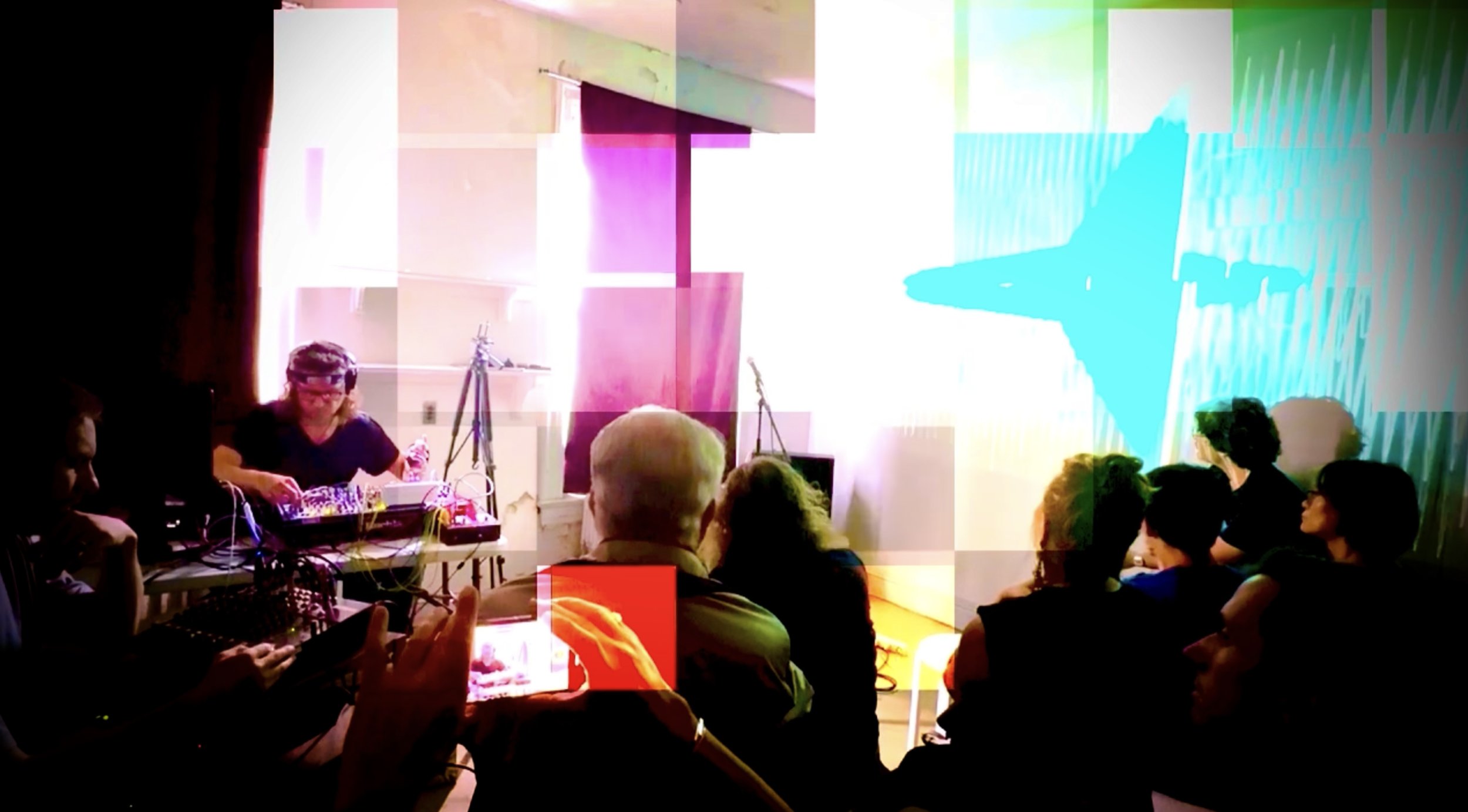
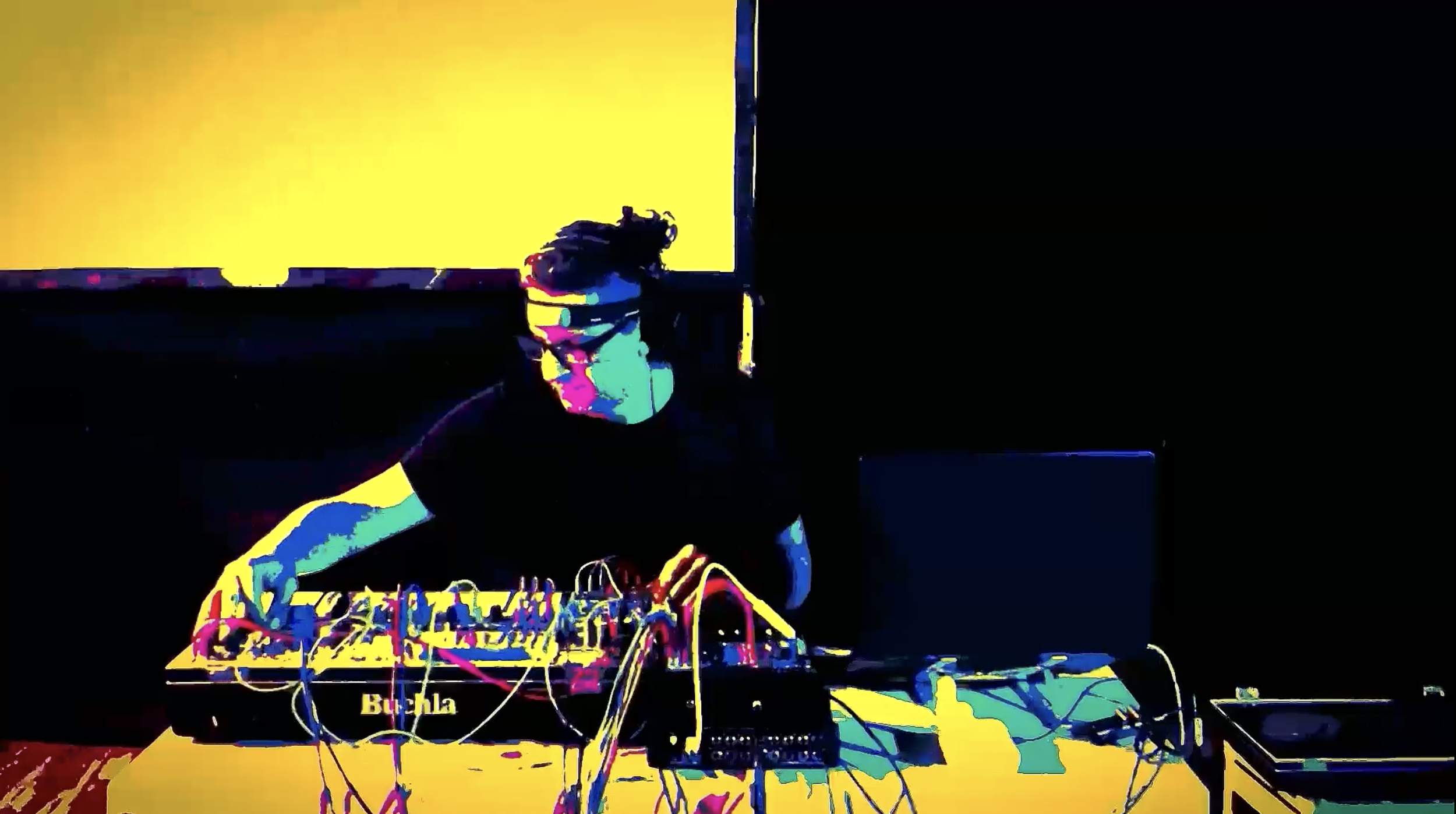
Tomasiello performing at Harvestworks in 2025. Image courtesy Johnny Tomasiello.
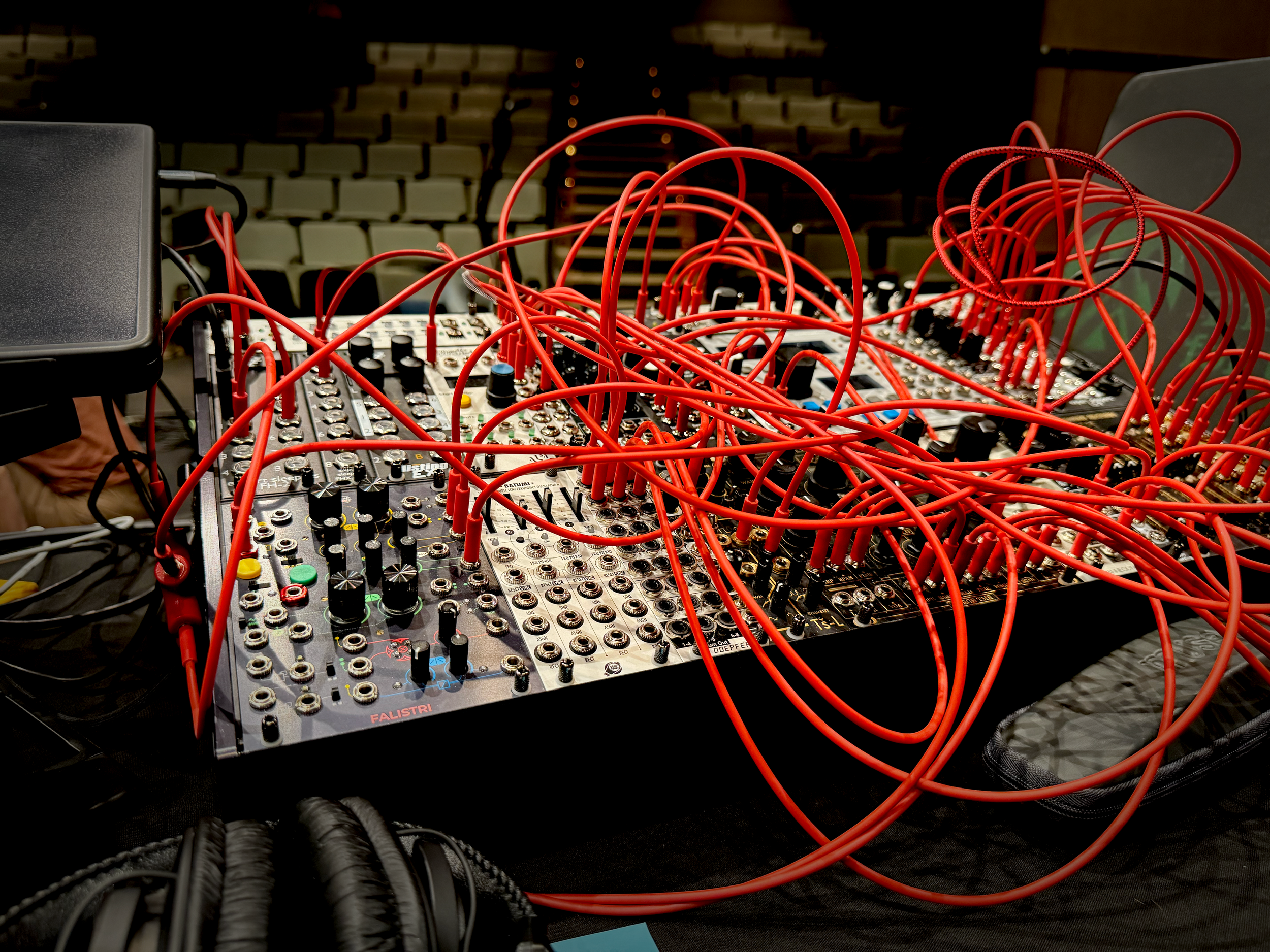
Johnny’s setup at Banff Musicians in Residence in Alberta, Canada. Image courtesy Johnny Tomasiello.
In my other work, I do talk quite a bit about artist intervention where you can have the system running by itself and you don't touch it, you just sit there, breathing exercises, eyes closed, whatever you want to do. But then if I want to move and change something, that would be considered an intervention, where it now becomes part of a more complex reciprocal feedback loop. And it doesn't sound more complex, but in terms of data analysis, one simple action can add a lot of dimensions that you now have to consider. But for the purposes of this project, I felt that it was appropriate.
AT: I love that—both the method and the philosophy. And you can see that when you're watching the film or when you're listening to the score, you can see how the story develops and as the characters move deeper into the forest and find their site, you really feel a shift in the score and how it's being used.
JT: That's exactly right. So the scenes early on at the dinner table was where I was just starting to understand how this was going to play out as an idea and I was very pleased with that part of the score, which was just the very beginning as I'm recording it, and as I'm watching it. And then when it moved into the forest, again, I was very pleased. I said, okay, so now I'm excited to see where this is going to go and how it's going to end up. And even as I finished it and played it back for some people, just jumping around to different points, you know, “this is what I'm working on. This is what I did.” And every time I grabbed something, I was just, I was happy with how it turned out. I was, I don’t want to say surprised, but I was just very pleased with how well it seemed to match.
AT: I think it's a great film to have this experiment. Some films might not benefit from this kind of score, like an action thriller or a jump-scare-heavy horror movie, when you have pounding beats and chase scenes or whatever, but for a folk horror movie, or even almost cosmic horror, in some ways, it really fits. So it’s interesting that that's the project that he brought to you as you were playing with these ideas.
Were there any significant challenges that you felt during the process or that maybe you didn't anticipate? Or was it pretty smooth sailing once you realized what you were going to do for it?
JT: Well, once I had the cut, it was just a matter of...watching it through. I knew the system had worked, I've been working on it for many years and refining it and building it, lecturing on and touring with it so i knew it would work, I just wanted to make sure that it was something that Dan was going to be happy with, you know, as excited as I was, because of course I can say that this music represents, to some extent, my experience of watching the film, but as a director and an editor and whatever role you have putting a film together, you might not want a specific reaction at this time, or maybe you need to hold something back from the audience. The storytelling aspect is a whole other layer, which is more intentional, I think, than, you know, a system that you just let react as you go through it. So yeah, I was just eager to see how well it was going to work for Dan.
AT: Do you have plans or a desire to do more film scores? I mean, I know your primary goal is the research and to see the therapeutic side through, but seeing how well it translates, is that something that you would like to see in more films and a technique that you would use again?
JT: Absolutely! I would love to do more scores with the system. And just as an artist or researcher or artist-researcher, it's an opportunity for me to examine what the musical feedback is and how people respond to it because I can set up rules that might be the most optimal I can come up with at the time. But if the people listening to it don't recognize it as being appropriate or matching the subject matter, it's just a layer that I can't get to on my own. I really need to be able to engage with other people, either using the system themselves or get their feedback to what the musical score does for them.
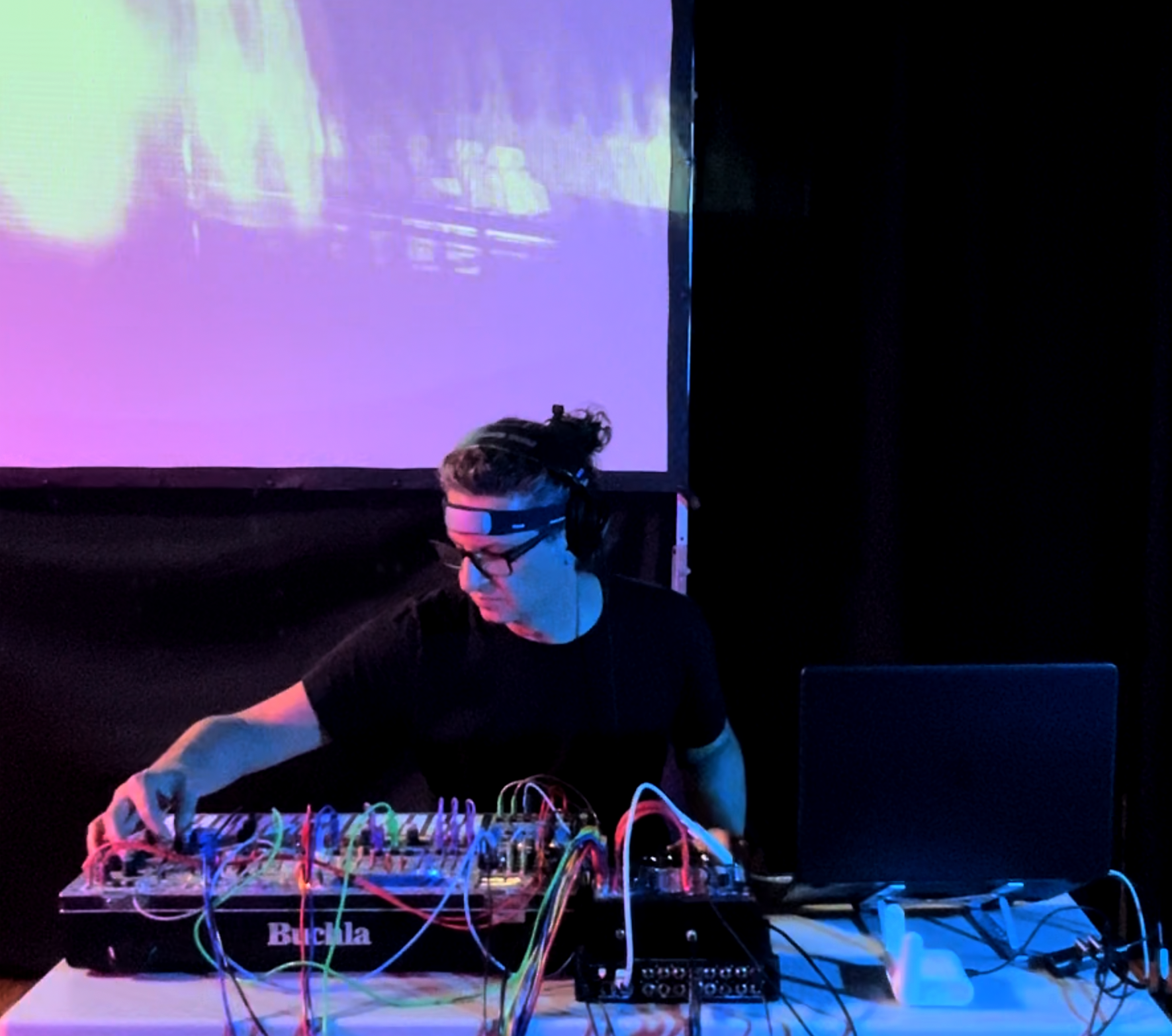
Johnny performs at the Northeast Electro-Music Festival in 2024. Image courtesy Johnny Tomasiello.
I just got back from a music residency. I don't know if we talked about that. I was in residence at Banff in Canada. And there were lots of different people doing lots of different stuff. Some people were doing installations. Some were doing more traditional music structured songwriting. Everything was very interesting and they were all very kind, it was an amazing experience. But for me, the most important thing was, again, it gave me access to other musicians directly which is not the same as my friend coming over where I say “what do you think of this?” It's more like these are, to one degree or another, professional musicians so to hear their thought process and their expectations as musicians, not just as audience members. But again, audience member impressions are equally important as feedback for me, you know? How am I going to devise this system to work? I can change the type of feedback it gives me, but you don't want to step on the data. That's bad data science. So I don't want to take the math and work backwards and say, okay, how can I make it do this thing that I want? It's more about seeing that this is a strong concept that this is mapped to this particular type of feedback for a specific reason. And that reason has to lead to the most therapeutic use case. Now, whether or not that's optimal for the composition, you know, again, it's subjective. So that particular part is subjective. So I need other people's feedback for that.
AT: The strides that we're seeing, even just measuring brainwaves has, like you said, it's been around for some time, but finding ways like this to harness that and to utilize it in art is just endlessly fascinating to me so thank you for your work and all the research that you're doing! So what's next for you? What are you working on now?
JT: Well I do have a show in Brooklyn. I have a gallery opening where I'm collaborating with two other artists and a dancer, so I'm going to be building a reciprocal feedback system where the dancer is going to be generating her own sound and music for a gallery installation. I've given her music that I wrote, and she's choreographing to that, but then we're going to take that music away from her and we're going to substitute sensors that she'll be wearing that I built a whole system around that's going to actually play string instruments—literal string instruments at her feet—that will be part of the installation where I have mechanical exciters that will vibrate the strings magnetically and she’ll be changing the pitch on that depending on her movements and sensor placement.
And the last thing that I have coming up is another artist’s residency where I’m going to go to Italy for a month and use my brainwave system to generate visuals which is another component which we obviously didn’t use for the film but it’s going to influence traditional oil paintings which I’m going to be doing and I’ll record those sessions and the recording and the playback of the visuals projected on top of the finished canvas will become part of the work. So it’ll be a 2D painting but with an element of animation based on the projection, so it will be an exploration of time in two dimensions, I guess you could say.
Article by Ande Thomas
Ande loves the intersection of sci-fi and horror, where our understanding of the natural world clashes with our fear of the new and unknown. He is an independent member of the Society for Cinema and Media Studies and a supporting member of the Horror Writers Association. He writes about monsters and foreign horror and can also be found over on Letterboxd.
Other Articles You May Enjoy…

Filmmaker Bari Kang discusses Itch!, from its practical gore and zombie influences to filming in his own NYC store and directing his daughter.