
Women In Horror: rebecca shapass Interview
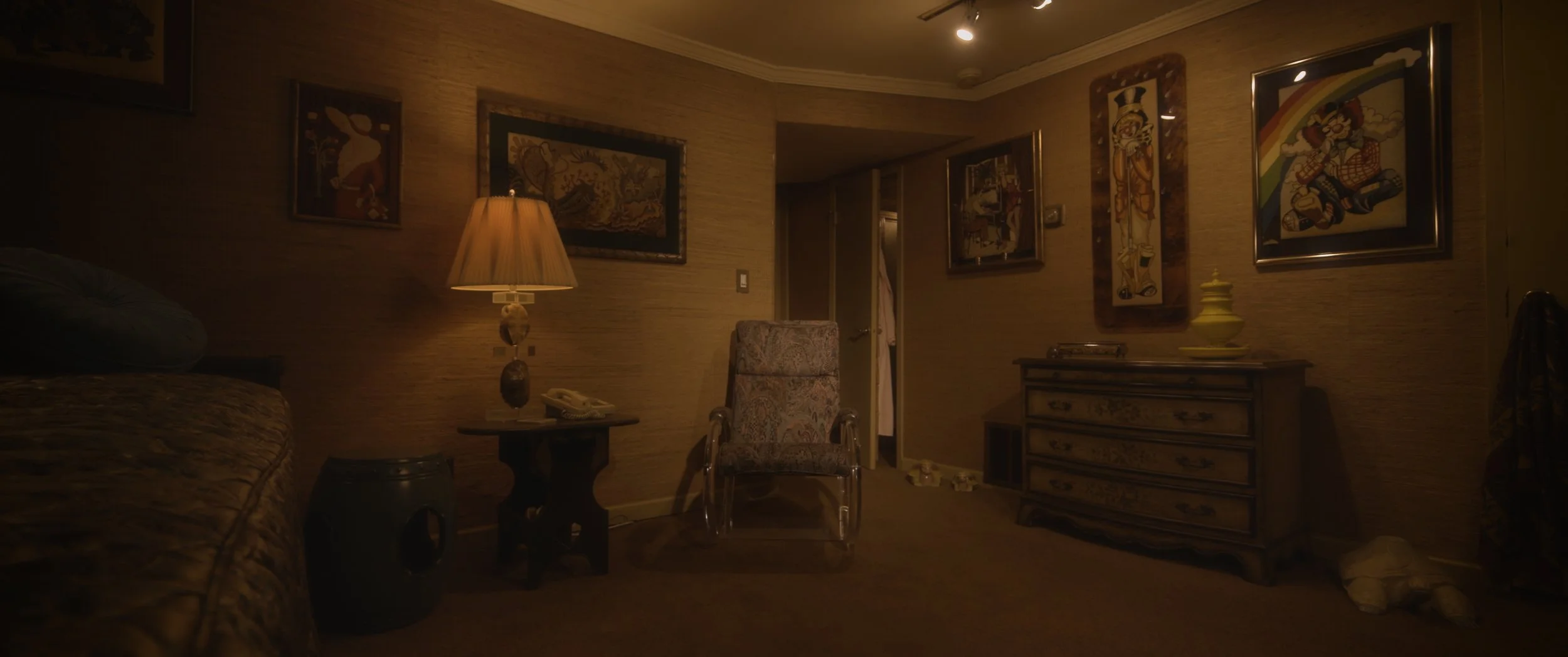
Still from tempus fugit, Image courtesy rebecca shapass
I recently sat down with rebecca shapass to discuss her newest film tempus fugit which debuted at the Mattress Factory in Pittsburgh, PA on June 28, 2025 and ran through August 9, 2026. A New York native and recent Carnegie Mellon University MFA alum, shapass has screened her work previously at venues such as the Ann Arbor Film Festival, Smack Mellon, Knockdown Center, and the Motel/X Lisbon International Horror Festival, among others. Her work contrasts factual documentary with uncanny moments of everyday life, posing the question of what lies beyond our understanding. This installation and screening at the Mattress Factory is her first solo exhibition.
In tempus fugit, shapass combines shots of three primary locations—a cryogenics facility, a pile of writhing worms, and a house filled with items left behind by the previous owner—while incorporating elements of horror and experimental cinema. And while her work brings together a range of influences, shapass was eager to discuss her work from a horror perspective with What Sleeps Beneath. Our conversation covers a wide range of topics in contemporary horror, including slow cinema, ghosts as metaphors, whether identity exists in the brain or the spirit, and the ambivalence of decay and preservation.
Julia Betts: How did your interest in horror begin? What are your horror influences as a filmmaker?
rebecca shapass: Horror was something really around me growing up. My stepsisters are super into horror, but it never was a primary part of my identity until I started working with the Romero archive [at the University of Pittsburgh]. My interest in horror came out of that project. Romero is such an independent filmmaker in a certain way. I love his anti-Hollywood, DIY philosophy, and the engagement with his local community by putting them in his films. And this very hands-on, down and dirty sort of filmmaking that I feel a kinship to.
I’m a huge Cronenberg fan. There were elements of tempus fugit that we shot that had a lot more body horror to it, very Cronenberg-inspired, but they wound up not being in the film. I also think Jordan Peele specifically in terms of the magical realism of the film, things are very pedestrian and commonplace until they’re not, highlighting the horror of the everyday. There is an almost over-the-top exploration of horrors, whether it be social horror, personal horror, or horror involving technology, which is very Cronenberg.
Horror can talk to social, personal, and political issues. It can be this sort of “Trojan Horse” genre where it presents an idea that a general audience might not want to deeply engage with in a more palatable way. Experimental film can also be quite alienating to an audience who is expecting more linearity or something more visually familiar. Coming from an interest in archiving, there’s a fascination in my work in darkness and themes of death, rot, decay, and preservation. And I found the horror genre allows me to explore that in a copacetic visual language.
JB: I was really interested in your use of stillness and movement in tempus fugit. There’s still, frozen shots of the house and then this literal freezing of the body in the cryonics facility. The stillness is contrasted with moments of movement like the writhing worms. What are your thoughts about stillness and motion in tempus fugit?
rs: The house mirrored the concept of cryonics or the idea of frozenness. The house became a proxy for a body in a lot of ways for me. I was thinking about it as a time capsule—it was left perfectly intact, as though someone had just left—a moment frozen in time. These slight animations, or moments of movement. Moments where I’d see something and wonder Did I really see that? That’s where the haunting would take place. In the stillness, any movement would become overpronounced. The house would be in a plane of silence, then suddenly, the phone would ring as though someone still lived there, and it would slice through the stillness of the space. It was very jarring, uncomfortable, and eerie. It was the same with the sink dripping, noticing the drip and feeling like the house was still “on,” though nobody was home. The turtle feels like it’s watching or very alive, even though it’s still. I was trying to explore the haunting of the space through the ways the house still presented a sense of liveness in the objects left behind. Honestly, a lot of these things came out of my own experiences of going to the house and grieving the loss of this person in the space.
In the cryonics facility, I really wanted to film with more of these snaking movements to create a bit of contrast between the two spaces. Because even though we don’t literally see what’s happening, there is a lot of activity that occurs in the lab when someone is brought in to be frozen and put in stasis. I wanted to highlight a little bit of the feeling of nobody there. It feels empty, but actually, there is potential life there, as cryonicists believe.
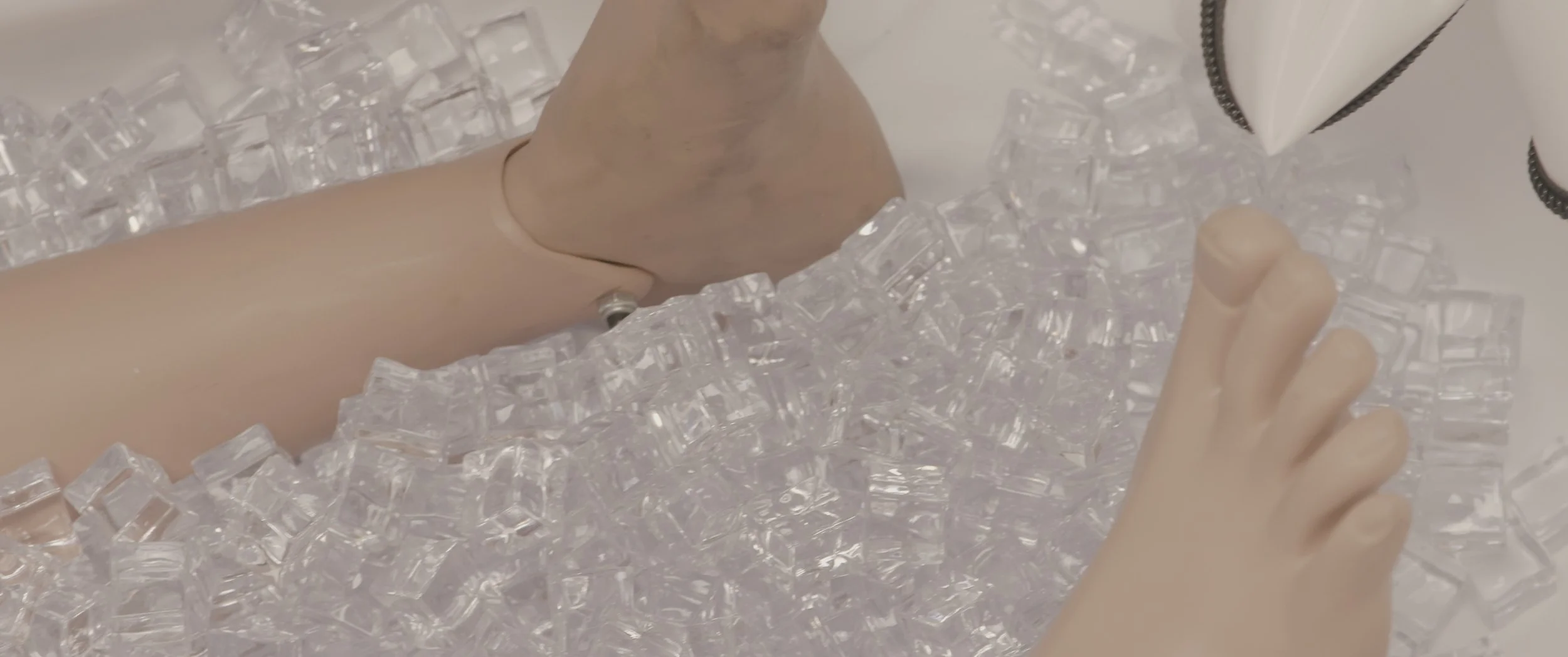
Still from tempus fugit, Image courtesy rebecca shapass
JB: There was a profound sense of emptiness and fullness throughout tempus fugit. The house is filled with these objects, but the person is missing. I thought about if the traces the body leaves behind contain that person and where the Self begins and ends. And you’re saying the same thing about the cryonics facility, where there’s a potential for activity, but no one there. Both places made me question where the Self resides within the physical body. Is that something you’re thinking about?
RS: Definitely. I was thinking a lot about that question of where we reside. Is it somatic? Physical? Is it in the brain? Is it in a spirit? Where do we live?
The field of cryonics firmly believes we reside in the brain. Your sense of selfhood, who you are, resides in your brain. I was thinking a lot about the brain because the person who lived in the house—my grandmother—had dementia and was deteriorating in terms of selfhood for some time. That’s also where the interest in the brain and zombies comes from in no more room in hell.
But at the same time, I was researching spiritualism, seances, and welcoming spirits back, which has nothing to do with the brain. It’s much more about essence, soul, and energy. That was more of what I felt in the house. So there’s a tension because I don’t have a firm position on where we live as entities.
Where do we live? And, what constitutes our personhood or our essence? Because even if you could free somebody and extract the information in their brain, there still remains the question: If they were revived in another body or in a computer system or in some other matter, would they have the same essence? Would they have the same mannerisms? Would they feel the same even if they had all of the memories of the person? Those sorts of questions. Who is the person really and what makes them who they are?
JB: What was your experience working at your grandmother’s house and the cryogenics lab? What did the process look and feel like for you?
RS: Working at my grandmother’s house was a very slow process. We shot the film over the course of about a year, and we shot it like a documentary with some of these kinds of special shots. For example, I wanted a scene where the joint is floating in the kitchen. We shot that as a scene. It was filmed all at one time, but then a lot of the other stuff was not filmed all at one time. We would shoot a wide of the living room with the TV on and then I’d say, “I feel like there needs to be a secondary action in this scene.” So we would go back and then film the painting of the Twin Towers dripping. Then I’d say, “there’s not enough tension, let’s go back and pick up some shots of the turtles.” It was very much collaged together from a series of encounters with the house that were, in 20% of the cases, shot as a scene. And then, more often than not, they were shot as scenarios, as I would call them. For example, the sink is dripping. From there I would say, “how can we heighten the drama of the drip?” I thought about things I had encountered in the house, like the news on or the commercial playing or this feeling of half-awakeness.
The cryonics facility was much different. We just went for a few days, and I was forthright in that we were filming a documentary and we shot it as such. Though I think they were quite surprised when we showed up with a tripod dolly, wheeling the camera around, creating these really extravagant dolly shots. We did traditional interviews with the founders and the CEO of the cryonics facility much more like a traditional documentary approach. We shot interviews and we shot B-roll. I had seen photos and videos of the facility online, so I had ideas of what I wanted to film, but it was a shorter encounter.
The worms were also shot maybe in two days, but they were my worms. It was something I was living with all the time, feeding these worms my compost, looking at them, interacting with them, and watching them decompose.
Then, the last element of the film is the interview with Stan Marlan, which I conducted in Pittsburgh, where he lived. And the shots over that are this smoky, dry ice, alchemical thing.
It was shot very piecemeal, which is my studio practice. I work on something, edit a scene, and think, what would go well with this? What’s lacking here? What could support this? How can I introduce a new concept? The films unfurl as explorations. I respond to the footage and material at every turn.
JB: The dripping of the objects in the house contrasts with the cryonics facility which freezes the body. There’s anxiety in holding onto the objects or the cryogenic freezing, contrasted against the objects melting and losing their structural integrity. Can you discuss your thoughts about holding on versus letting go?
RS: The house was a psychological space of not wanting to let go for a really long time. Also, an emblem of the clerical reality of when someone dies, what you have to do with their stuff. I’ve always thought of the house as an archive. Since my work is rooted in the archival, how can I explore this place as a living archive once the creator of the space is no longer here? I had been working a lot in No Room in Hell with the ideas of the zombie archive, or reanimation of the archive, so I was furthering that idea in this space. In a lot of ways, I felt like I was doing these seances or rituals, trying to revive this person’s presence. I was looking for signs or confirmation of a haunting, wanting that to present itself to me and prove to my rational, realist side that my more spiritual, wondrous side was right.
I remember one night we were sitting in the driveway ready to leave the house, and a light in the window flickered, and I was like, See? See? It’s happening. I think this film is a lot of my working through letting go and my own questions about life, death, mortality, and the alchemical.
The alchemical is a really big influence on me in terms of the history of medicine. Early medicine has a lot of ties to alchemy, the idea of turning lead into gold. Stan corrects that in his interview, explaining how Jungian psychoanalysts believe that when we talk about the alchemical it’s not actually about physically turning lead into gold. It’s taking lead inside and turning it to gold. A transformation of the self, a psychological transformation, a changing of ways rather than a literal transformation of lead into gold. Certainly, cryonics has a lot of ties to the alchemical. But alchemy, in the end—even in cryonics—is a transfer. I don’t know if a cryonicist would agree with me.
Everything is always in a state of transformation. Even in the stillness, there’s change. As much as this film is influenced by horror cinema, it’s also influenced by slow cinema and the devotional act of looking at something. The first three months before we started shooting, I made a series of 35 millimeter slides of the house that were studies of the space. And that’s where I began collecting the dripping, ringing, and creaking.
Thinking of the film as a suburban horror film, there is a desire to freeze a bygone era, this kind of American dreaming. I thought about that a lot with the Twin Towers painting that was in my grandmother’s house. I grew up in New York and the house is on Staten Island. A lot of folks who passed away in 9/11 were firefighters or police officers from Staten Island. So there’s this thread there that’s more personal to me and less embedded in the film. I kept thinking, how strange for you to keep this hanging in your house. Of course, the painting she had was from the ’70s and had a different meaning before the events of 9/11. This was New York as a center of American power and wealth. In the film, the painting is very yellow. It yellowed over years of her smoking in the house. Then my dad cleaned it and we realized it’s actually not a depressing, sad image. It’s a very blue, bright landscape of the New York City skyline.
As we descend further into this chapter of American fascism, it was important for me to think about these desires to freeze the past, which also does not really support a better future. What does it mean to freeze a bunch of people to come back later? Perhaps the “natural” cycle of life to death is what makes way for a new idea, a new carrying of the torch, a new possibility. If everything just stays frozen, that’s unideal, in my opinion.
JB: No, I think that’s true. But then there’s this desperation simultaneously for things to stay the same.
RS: Yeah. The oozing is the ugliness of the attempt to preserve something, it leaks out and contaminates everything around it.
JB: I’m curious about your experience at the Mattress Factory during your residency and how it might have affected your art making process. The Mattress Factory doesn’t have marked times when the film would begin and end. People might arrive and enter the film at any point. Were you considering that while making the film?
RS: I think this question comes up a lot with video work. I try to make works I feel could be entered at any time. Though I do kind of have this proclivity for working in a beginning, middle, end type of manner. It was a big question about how that was going to work in the space. But I came to the conclusion that the life and death cycle of the house was a conceptual underpinning. And, if you wanted to see the beginning, middle, and end and sit there for the emotional arc, that was fine. But also, you can enter the house, so to speak, at any point and encounter some facet of it, some strange happening of the space.
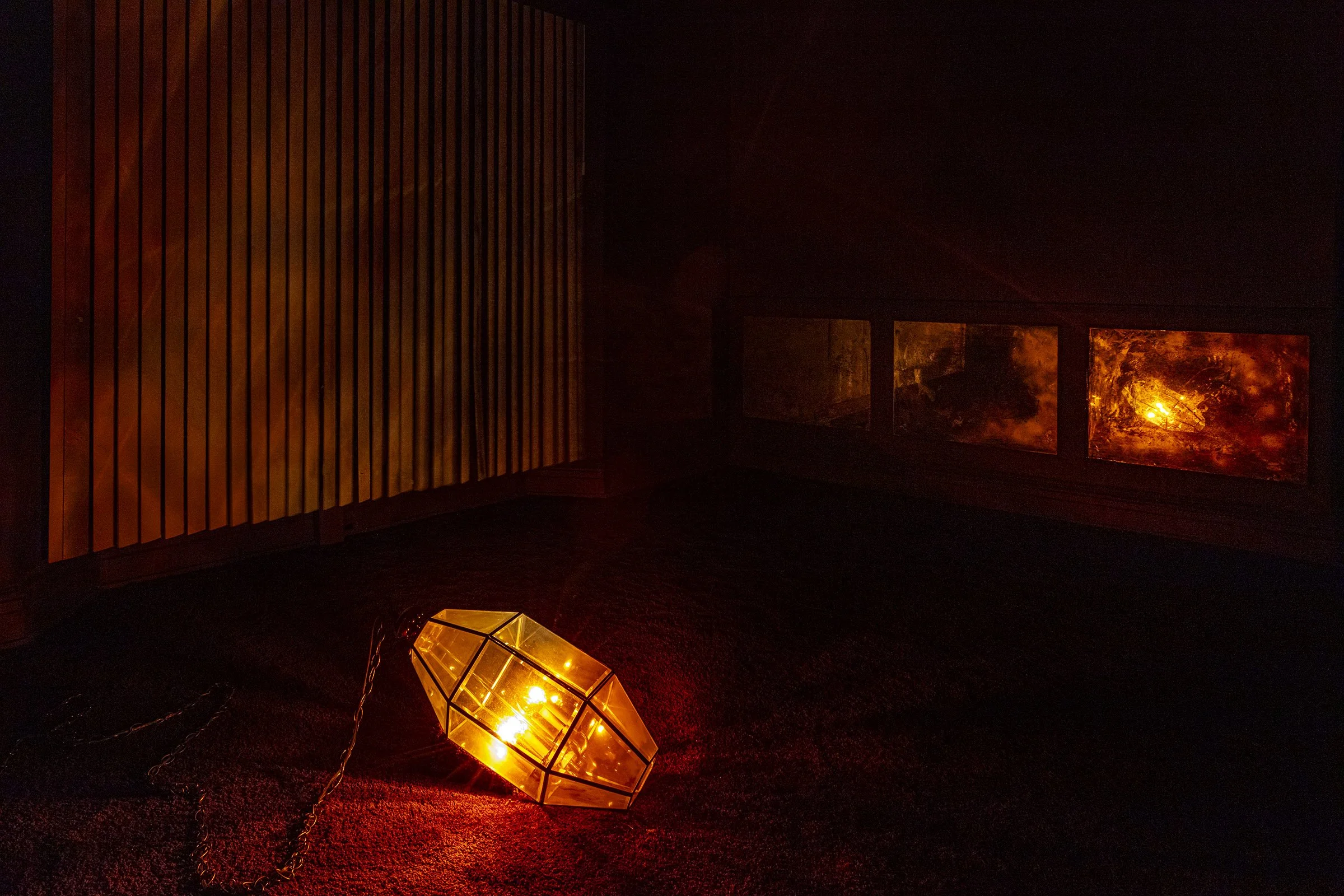
Installation view of tempus fugit at the Mattress Factory. Image courtesy rebecca shapass.
JB: And then, in addition to the film, you made an installation as part of the exhibition at the Mattress Factory too. How do you think the installation relates to the film?
RS: I wanted the installation to feel like you were entering a place someone had just left or was in the process of being cleaned out. I thought a lot about the difference between making artwork and making a set. And I think of the installation more as a set, the way one does production design on a film.
The light in the first room is synced to the film, not its sound. But if there are lighting gags that are happening in the film—so if a light flickers or the TV flickers, or when the garage opens and the light flicks on and off, it is doing that in the first room with the light.
I was thinking a lot about the ghost light being left at the end of a theatrical show. In a theater, at the end of the day, a technician will place a ghost light on the stage. It’s a safety precaution so people can see the way. But there’s also a myth of how the light keeps ghosts away at night. I wanted my ghost light to invite ghosts in or be a flickering haunted fixture. And maybe when you first encounter it, you don’t realize it’s synced to the film. But then when you exit the space, you have more of a sense that its movements are tied to this other space.
I thought of that space as a lobby or a waiting room for the film, also as a seance or phantasmagoria show. You would travel through the dark into the phantasmagoria where you would see ghosts, demons, and devils. When you go into the space, it’s dark and you can’t really see much and maybe that creates an anxiety in you as a viewer, almost like a haunted house, but not exactly.
JB: You’ve said that you do things piecemeal in your making process. You used montage in both no more room in hell and tempus fugit, thinking about these connections between past and present. tempus fugit has a more personal narrative that’s also weaved into it. What would you say about how the two films consider time?
RS: I think non-linearity is a really important part of my work, even if there is a feeling of a linear storyline happening. I’m interested in working in a hauntological framework, a framework that fundamentally considers the past and future as points for informing how we see, live, and construct the present. Working in a linear way doesn’t make sense for me. Instead, I bring these elements of past and future to interact with the present as a way of forming narrative or forming feeling. Both films really strive to create the feeling of watching a horror film, though they aren’t stereotypically horror genre work. I’m interested in what horror can do to the body. I think of my montaging as a way of bringing the past, present, and future all into conversation.
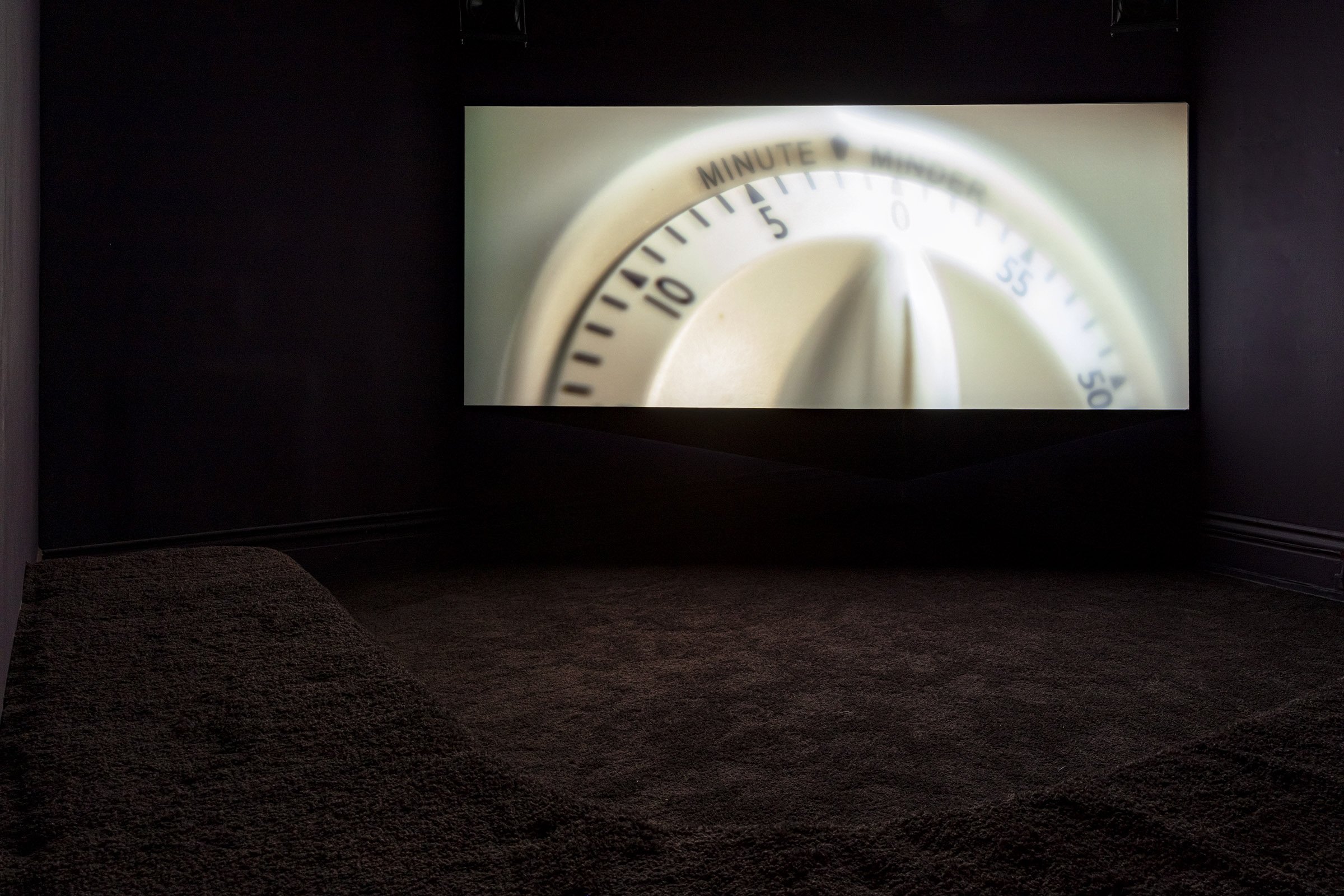
Installation view of tempus fugit at the Mattress Factory. Image courtesy rebecca shapass.
JB: Both films also delve into classic horror monsters. In no more room in hell you’re working with zombies and in tempus fugit there’s haunted house imagery. How do the ghost and the zombie compare as metaphors to you?
RS: I love the zombie as an archetypal character in that it is a creaturely monster. There’s a lot of films in the zombie imaginary, which all have different qualities making them specific regionally, or specific to different myths, like the Haitian zombie, East Asian zombie, or American zombie. The American zombie is an over-consuming creature that is a reflection of us. It’s not the Blob, it’s not Mothman, it’s not an alien. A zombie is a former human. And that’s what makes them scary is that their kinship to us is so close. The zombie is the living dead. It’s the dead forced to live and walk.
The ghost is objectively dead. The ghost’s body, the physicality of it, is no longer with us. And I was thinking a lot about the difference between a poltergeist, a noisy ghost, versus how other types of hauntings manifest. My friend, Jean-Jacques Martinod—who is a wonderful filmmaker—told me two years ago at a film festival “the ghost may be the monster of the 21st century,” meaning the haunting of our past is the true marker of our time. And that’s how I approach the ghost in this. The past is haunting me.
But also the idea that there are these frozen people with a potential to come back. Are those people [in the cryogenics facility] ghosts? No, because they’re not considered dead. They’re considered patients who are in stasis, awaiting their revival. They don’t get to be ghosts. Is my grandmother a ghost? I don’t really know. I haven’t come to any firm conclusion about that.
The idea of the ghost and the way it interacts with technology in certain forms of cinema is really interesting. And that’s why I brought up Poltergeist, because that film kind of takes off from a place of phantasmagoria, which is a pre-cinematic form of magic lantern play where there’s a projection of demons, spirits, and ghosts. In phantasmagoria, the projectionist is an illusionist and sort of conducting these seances. I think about seances that happened in the late 1800s and early 1900s. Women were usually the mediums channeling the dead. There’s footage of a woman conducting a seance in the film. It’s these interstitials of her hands moving over her face. I wanted to call back to that in some way because I felt like her, like I was trying to conduct a seance.
One big part of hauntings, and I think this is a big part of my next project, is its relationship to electricity. In Poltergeist, Carol Anne is in the TV. That was my visual reference for the TV. The ghost is making its presence known through the moving of the chairs, the flickering of the TV, and electrical activity. That comes from a long lineage of people who believed in the day of seances and early encounters of the telephone that we can call the dead. I think in time we’ve become so rational and scientific—well, maybe not concurrently. [laughs]
JB: Not everyone. [laughs]
RS: Not everyone. But I think there’s been this massive leaning towards the rational and scientific, which is great and important. But also in that there’s real wonder lost. And I think that’s what I like about the cryonicists: this belief that the early Victorian mediums and spiritualists had that you can bring someone back. It’s not a new idea, right? The belief you maybe channel someone or bring them back, feels very akin to the idea of uploading someone’s mind to a computer. Another electrical kind of strata.
JB: Definitely. You mentioned Poltergeist and Romero earlier. What Sleeps Beneath normally focuses on theatrical releases. Do you want to say anything more about Poltergeist or any other ghost or zombie movies?
RS: I can say the films I thought about in terms of a suburban horror film and the construction of this piece were very much Poltergeist, and though not really a horror film, the way Edward Scissorhands is shot, in that he is a “monster;” he is the Other invading the suburban sphere. But rather than rejecting him, eventually they embrace him. But in Poltergeist, the narrative is so important to me. The whole underpinning of the film is there’s a suburban developer who builds the housing plan over an old cemetery, which causes the haunting. This is kind of like White middle class suburban obliviousness, or not obliviousness, but lack of caring. And the family who is the subject of Poltergeist does not know that’s what the developer has done. They come to learn this at the end, but they’re complicit.
JB: Complicity was actually something I wanted to ask you about too. In no more room in hell, a lot of it is from the viewpoint of a car and you’re hearing about the zombie outbreak, but the film also says “They’re us. That’s all.” close to the end. It reminded me of the way we try to distance ourselves from our culpability, like hearing about the outbreak on the radio station, but also “they’re us.” Is culpability something you’re exploring in no more room in hell? Is complicity also an influence in tempus fugit?
RS: I think that’s a great question. Thank you. With the newscast in the car in no more room in hell, the broadcasts are all reenactments from Romero films and they’re read by Rick Sebak, a famous Pittsburgh independent journalist, who has a show and releases great videos. And I think something Romero does that is really interesting to me is his use of the TV and radio in his films as kind of this central nervous system of the public and how the radio becomes a place of panic. There’s broadcasts of the news alerting the characters how to respond to the outbreak. I was thinking a lot about this essay by Brian Massumi called “Fear (The Spectrum Said).” In the essay, he talks about the color rating system for panic or alerts that was created after 9/11, how there’s this mediation of the American nervous system through the news and social media. I wanted the radio in no more room in hell to function as it does in Romero’s films, as this constant groaning, aggressive, alarming entity. But then in tempus fugit, it takes on a different mode in which I really related to the TV in my grandmother’s house as something telling me she was there. She always had the TV on. It was really sort of the presence. And so it takes on a bit of a different meaning in that film
In terms of complicity, it’s hard because, while there is like the general sense of complicity, the car in no more room in hell was inspired by the autonomous vehicle. So, in a way, the cast of the news is being received by no one. It is being received by an autonomous, self-driving vehicle roving around the city in the post-apocalyptic landscape of a zombie outbreak. The car is left wandering.
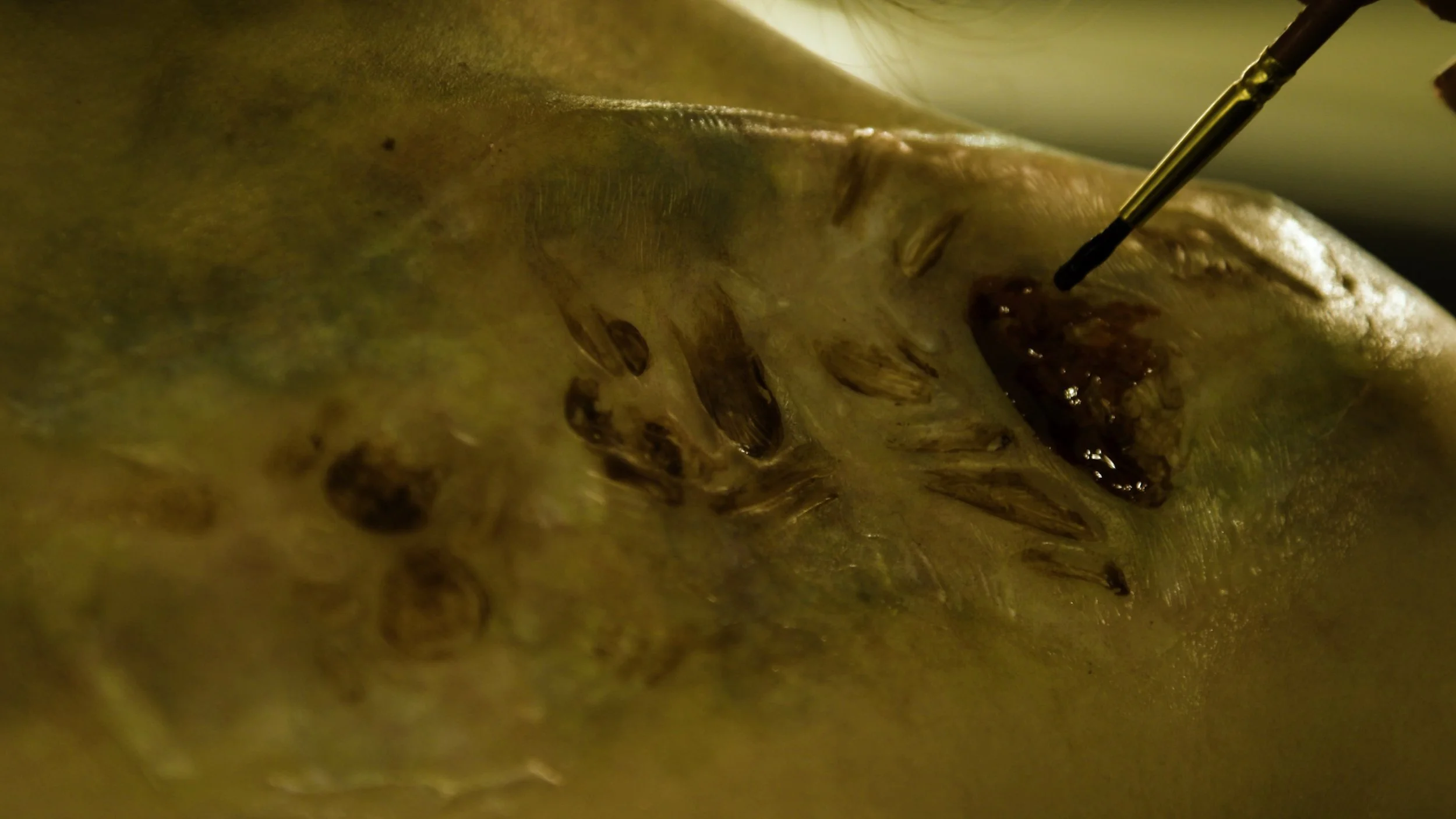
Still from no more room in hell.
On a separate but very related note, my ideas around complicity in that film came out of being at Carnegie Mellon University and doing my graduate degree at CMU and thinking so much about how the technologies developed in terms of autonomous driving and various weapons contracts. Autonomous driving technologies were developed partially at CMU and at Stanford on a Department of Defense contract. And so I hesitate to say we are all complicit, because I think that’s true to an extent. But it’s also people who are in power, funding and receiving the money for these sorts of projects who are truly the most complicit.
There is this zombification of the general public. Yes. But I think overall I was less focused on the traditional zombie narrative of maybe pointing blame, like Dawn of the Dead’s backdrop of “you middle class, white, capitalist walking around the mall.” I was less interested in the zombification of people, and more interested in the zombie as an over-consuming entity, whether it’s the zombie consuming people, natural resources, or data. I felt like it maybe was too easy to say, “look at you on your phone, zombie,” or “look at you, complicit zombie.”
What happens when the car is a roving zombie, but the reality is it is consuming you? It is looking at your body as a data point. I was thinking about that in relation to the history of Pittsburgh as a place that has been really extracted from the land and the labor of people. What does it mean for a technology to come into that space and again extract from the land and the bodies in the space?
I don’t know if I thought about complicity a lot in tempus fugit. I thought about my desire to keep the space like that forever and how impractical it was.
JB: My last question I wanted to ask you about what’s next for your work? You mentioned your interest in electricity.
RS: I’m looking forward to making some publishing projects that live within the context of these two works. I think a lot about how all this research I do around cinema and its production and other films in relation to my work, or seances and spiritualism are not in the works themselves. The works kind of live separately from those things. They’re informed by it, of course, but it’s not totally embedded. So I’m working on some publication projects highlighting the research and various rabbit holes that have informed the work.
I am interested in further exploring my ideas around electricity as a material of haunting and exploring how it mediates our daily lives. And that’s something that comes from some older works of mine, like a film called ROYGBIV, which is about street lighting in Pittsburgh, and a film and a series of slides called “a protracted amphitheater,” in which I photograph overhead electrical grids. So I’ll be continuing that work separate from those publications.
Article written by Julia Betts
Julia Betts is a nationally recognized visual artist. Her work explores vulnerability, often addressing how the mind and body respond under duress. Julia is a lifelong horror fan. Her favorite movies include Invasion of The Body Snatchers, The Thing, Rosemary’s Baby, and Carrie. You can view her work and learn more about Julia at https://www.juliabetts.com/
Other Articles You May Enjoy…

Filmmaker Bari Kang discusses Itch!, from its practical gore and zombie influences to filming in his own NYC store and directing his daughter.