Sundance 2021: We're All Going to the World's Fair, Coming Home in the Dark, Censor
In my final recap post of the 2021 Sundance Film Festival, I wanted to highlight three films that really impressed me, including two that hadn’t even been on my radar prior to the event. Each of these films uses simple premises to extract their gut-punch messages and they each do so in a different way. These three couldn’t be more different from each other, except that I can’t wait to see all of them a second time.
We’re All Going to the World’s Fair
We’re All Going to the World’s Fair is the first narrative film from writer/director Jane Schoenbrun and stars Anna Cobb as Casey, who is trying to take part in the “World’s Fair Challenge,” which appears to be a loosely formed alternate reality game (ARG) that combines the alluring excitement of slumber party staples like Ouija boards and “Bloody Mary” with the more modern viral legends like Slenderman. After Casey performs a small ritual in front of her camera, the legend promises that Casey will be irreparably changed, and she will begin living out her own personal horror film.

The film is one of several at this year’s Sundance Film Festival to embrace the influence of social media on its characters, as the majority of the film is shown via Casey’s own video updates and her web browsing. The opening scene reminds me a great deal of Bo Burnham’s Eighth Grade (2018) as Casey awkwardly tries to conjure confidence in starting her vlog. Whereas Eighth Grade quickly falls back into more standard methods of filming, World’s Fair rarely draws back from Casey’s online persona, giving us less of a view into her coming-of-age story as it does her coming-of-virtual-maturity tale.
Early on, as she impatiently waits for the World’s Fair Challenge to start changing her, Casey spends her time looking up video updates from other players and scrolling through possible symptoms she should be mindful of. Before long, Casey is messaged by a fellow player who goes by the name “JLB.” JLB urges Casey to continue making videos, “just so I know you’re okay.” As she advances through the game, and as her videos become more erratic, JLB becomes increasingly concerned about Casey and her participation in the challenge. Without wanting to get too close to any spoilers, World’s Fair plays with its theme in a genuinely intelligent and unique way, and though I don’t necessarily agree with one particular decision, I still felt the impact and that’s all I could ask of it.
I’m really excited that this brand of “tech-horror” is maturing into a valuable narrative tool. We’ve reached the point where it can’t be written off as a gimmick any longer. There are a lot of possibilities for drawing attention, not only to the subject being filmed, but to the object doing the filming. A movie like We’re All Going to the World’s Fair couldn’t exist without this new kind of fourth wall interaction because it is the only way the audience is able to embody both the viewer and voyeur. And that is a topic that needs to be tabled for a later date.
Coming Home in the Dark
Yet another debut feature, this time from director James Ashcroft, Coming Home in the Dark is an intense road thriller set in the New Zealand outback. The unfortunately nicknamed Hoaggie (Erik Thomson) is on a picnic with his family, when Mandrake and Tubs, a pair of drifters, kidnap them for their car. Tubs, played by Matthias Luafutu, is silent and stone-faced, while Mandrake, played by a gruff Daniel Gillies in a career-best performance, gives the duo its personality. Set to a great score and dynamic camerawork, Coming Home in the Dark amps up the tension early and rarely gives viewers a moment to let their guard down.
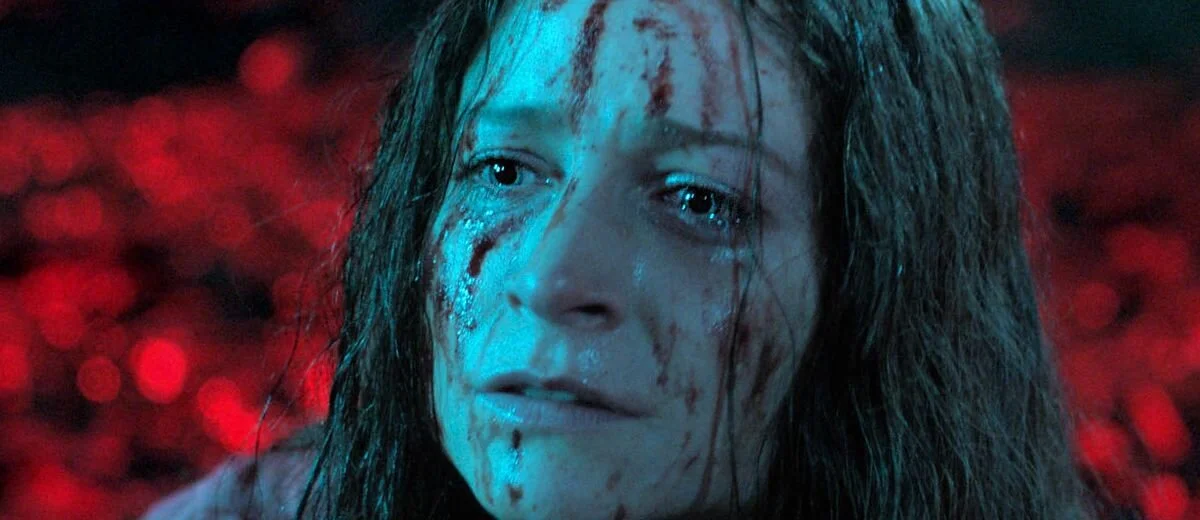
The fulcrum around which the story pivots is a bone-chilling line delivered by Mandrake early in the film when he says to Hoaggie, “Looking back on this moment, you’ll wish you had done something.” Indeed, much of the plot has to do with inaction—with the negative space between the decisions we think matter. Ashcroft deftly uses this theme as the driving force between both scene and act, folding the film onto itself in satisfying, and terrifying, ways.
The standout performance is clearly Gillies. His chilling portrayal of Mandrake, the kind of playful villain that lends a true sense of unpredictability, really defines the film for me. Combined with a camera that seems to take on the personality of whomever it is framing, Coming Home is able to successfully keep viewers off balance for its duration, never letting us get comfortable in our seats. Though the plot becomes just a tad muddied toward the end, the journey is well worth the destination.
Censor
The very first film I screened at the festival, and the very last I’ll be highlighting here, is Prano Bailey-Bond’s debut, Censor. As I said in my festival preview, Censor is a film that draws us back to the “video nasty” era in Great Britain and the descent of film censor Enid into conspiracy and madness. Enid, played by Niamh Algar, who gives everything to the role, is haunted by the childhood disappearance of her sister, and seems to let a sense of guilt drive the righteousness she feels toward her work.
While it would be easy to write Censor off as a love letter to the kind of over-the-top horror that Enid is meant to be censoring—and it is—the brilliance of the film lies in its excellent commentary on the contradictory nature of the moral panic. By putting so much emphasis on banning these low-budget, low-quality video nasties, they amplified the public’s interest in them. By insisting that they would cause moral corruption and crime, corruption and crime then occurred because criminals had a ready defense for their actions: “Video nasties made me do it.” These contradictions are peppered throughout the film and begin adding up, not only to an homage to the videos themselves, but as an overwhelming condemnation of the culture that surrounded them, as well.
Rich with references and terrific sound editing, as well as some truly striking video editing and lighting—especially in the final act—Bailey-Bond’s film is a fitting tribute to a genre that, though it has a cult following, is still maligned for its baseness. Though the plot feels thin for a large portion of the film, Censor more than makes up for it in its style.
Article written by Ande thomas
Ande loves the intersection of sci-fi and horror, where our understanding of the natural world clashes with our fear of the new and unknown. He writes about monsters and foreign horror and can also be found over on Letterboxd.

In The Buffalo Hunter Hunter, blood carries the violence of colonialism, while a settler’s journal controls whose story survives. This essay examines how Stephen Graham Jones uses vampirism and layered testimony to confront historical erasure.