
‘Blacktail’ Is a Revenge Story That Refuses to Let You Enjoy It
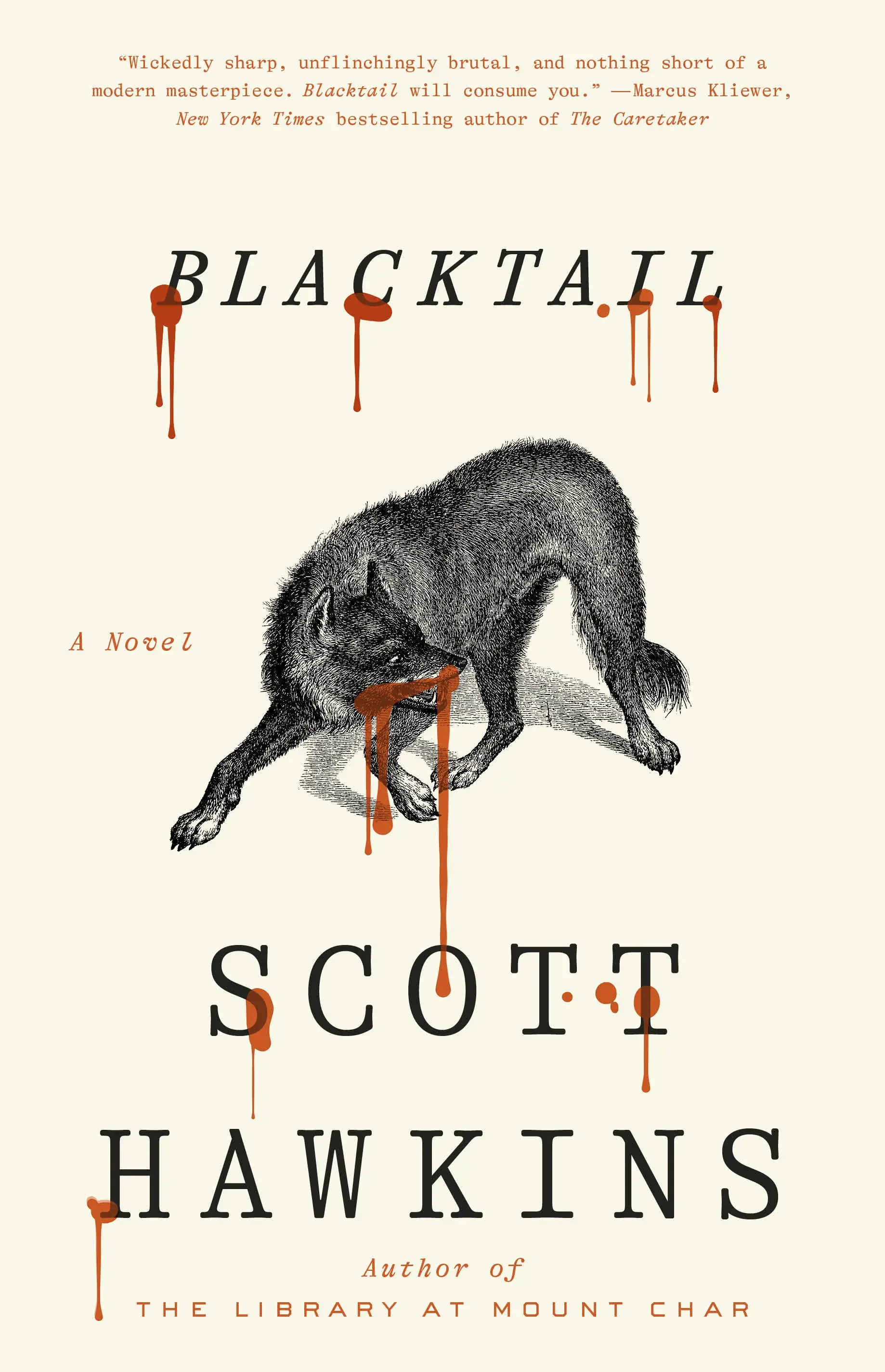
Scott Hawkins hands you a wolf-dog with every reason in the world to burn it all down, then spends the book asking what happens once he actually can.
Content Warning: This review discusses a novel containing sustained and graphic violence against animals, including the killing of a domesticated pregnant dog and her unborn litter, animal death caused by humans and by other animals, and depictions of confinement, abandonment, neglect, and detailed injury. Readers sensitive to animal harm should approach the book with caution.
Revenge asks very little of the reader. Establish a wound. Point the wounded party toward whoever made it. We handle the rest quickly because the arithmetic feels good, and we have been practicing it since we were old enough to be treated unfairly. Scott Hawkins gives you that arithmetic early in Blacktail, then spends the rest of the book taking the calculator apart on the table in front of you.
Nothing in here quips. Nobody learns anything about friendship. If your associations with talking animals run toward warm fables, adjust now. This reads like scripture assembled by creatures who have decided the species killing them is out of excuses.
Blacktail is a wolf-dog, and the hybrid part is not trivia. He lives in northern woods that shrink every season, devout in his way, loyal to a Forest God who has not been especially responsive lately. His mate is a house dog. She is pregnant. When humans kill her, Blacktail goes to the house, and what he does there travels.
It reaches Old Kitty Mother, an ancient feline witch with a proposal. The Forest God is sleeping. He could be woken. A woken Forest God might do to humanity roughly what humanity has been doing to everything else. Blacktail has already run out of forest. He does not need much persuading.
Blacktail Keeps Its Animals “Animal”
The most impressive decision in the novel is also one of its quietest. Hawkins never lets Blacktail become a person in a fur suit. He stays territorial, instinct-driven, and difficult to like, measuring the world in scent, hunger, and threat, running on loyalties that owe nothing to human ethics. The rest of the cast works the same way. A lynx does not reason like a dog. A cat does not reason like either of them—and the cats know it.
That discipline is what makes the human material land. Everything we do to animals shows up stripped of the vocabulary we use to soften it. A road is not infrastructure but a fast river that kills. A collar can mean restraint rather than care. Breeding, ownership, and development are things done to a body, not hallmarks of civilization. Nobody out there can be talked into treating these as concepts rather than events. Our justifications do not exist in the woods, and Hawkins is wise enough not to fill that hole with a speech.
The animals suffer, at length and in detail. Some of you should stop right here and pick a different book, and I mean that with no condescension in it at all. Animals die badly and the camera does not move. My read is that the violence is doing work rather than shopping for a reaction, because the argument depends on cruelty landing on creatures that cannot contextualize it, cannot consent to it, and cannot place themselves on the winning side of it.
Soften that and the book turns into a pleasant fantasy about woodland kingdoms. Hawkins rarely lingers long enough for the violence to feel appetitive, which is the line worth watching.
Revenge Becomes Myth
The escalation surprised me by feeling inevitable. Grief stays private for about as long as grief ever stays private. Then other animals hear about the wolf-dog who walked into a human house, the telling changes in transit, and by the fourth retelling he has stopped being somebody with a dead mate and started being a figure. Followers attach themselves. One community decides he is a sign, another decides he is a threat to an arrangement that was working fine for them, and he bends toward whatever they need him to be. The legend builds through rumor rather than prophecy. The cosmic scale gets gossiped into existence.
The structure is episodic and I understand why some readers will call it repetitive. He travels, meets a community, absorbs its theology, and violence occurs. Repeat. For me that is the point. Each stop adds a different religion, a different fear, and a different memory of what humans did. It has the texture of folklore assembling itself while you watch, and folklore is repetitive by design. If you want a tight plot where every gear meshes, this will feel like wandering.
The ecological accusation is blunt. Humans are the plague, the animals say so out loud and often, and Hawkins lets them. The harder question is what the wronged become once they are the ones holding the weapon, and that is where his blood stops being a fun detail. Blacktail is not pure wilderness rising against the domesticated world. He is what happened where the two touched. There is dog in him. He loved a house dog without reservation or apology. But he wants a reckoning that cannot tell the difference between the species that built the kennel and everything the kennel produced. Collective punishment makes no such distinctions. Extend that logic far enough and his mate sits inside the blast radius, along with barn cats, farm dogs and other creatures whose existence got tangled up in ours, along with a fair portion of Blacktail himself. The novel keeps putting animals in front of him whose prospects under a successful revolution look grim.
So he floats. Victim, avenger, revolutionary, prophet, cult object, weapon. The book resists settling on any one of those roles. I kept waiting for the scene where somebody delivers the thesis and settles the argument. It never showed up, and that absence is one of the strongest things here. Hawkins is not asking whether humanity has it coming. He is asking whether righteous anger stays righteous once it can destroy everything it hates.
The cost shows up in the middle stretch. Early Blacktail is unbearable in a good way—all confusion and scent and a grief shaped like an animal's grief instead of ours. As the mythology accumulates, that closeness thins and he becomes a position in a theological argument. Watching him become a symbol distances us from the wounded creature we met in the beginning, and I felt the trade happening in real time. Probably deliberate, since the book is about a living thing turning into a story. Deliberate or not, some of the early grip does not survive the climb.
The humor is necessary and I will fight about it. Relentless misery becomes numbing, and a reader who has been flattened for eighty pages cannot feel the eighty-first. Hawkins keeps letting the pressure out through strange comedy, most of it from animal societies whose belief systems look ridiculous in the exact way real belief systems look ridiculous from outside. The jokes put the voltage back into the horror. They also make the animal world feel populated. These creatures have politics, rivalries, and stupid opinions about their neighbors. That just makes what happens to them worse.
Blacktail is for readers who want horror to argue with them and who can afford the entry fee. If graphic animal death is a hard limit for you, believe yourself and skip this one. No negotiation. If it is not, you get a revenge narrative that treats revenge as a moral problem instead of merely a delivery system for satisfaction. Grief buys you sympathy. Power buys you scrutiny. Somewhere between the two, Blacktail stops being someone to root for and becomes something to watch very carefully, and the woods keep shrinking either way.
Article by Luna Gray
Luna Gray is a horror critic, author of No House Is Empty, and senior staff writer at iHorror. She covers cult, indie, folk, queer, and streaming horror, with a particular interest in the strange stories that linger long after the credits roll. Her work can be found at her Substack.

Other Articles You May Enjoy…
Rebekah Faubion’s adult horror debut delivers the bloodshed promised by its “good for her” premise, then asks whether justified anger can become permission to control and punish. Its inherited-trauma metaphor is stronger than its softened final reckoning, but that moral tension gives the revenge story weight.