
Merry Creepmas! Figures from Folklore to Keep Your Christmas Creepy
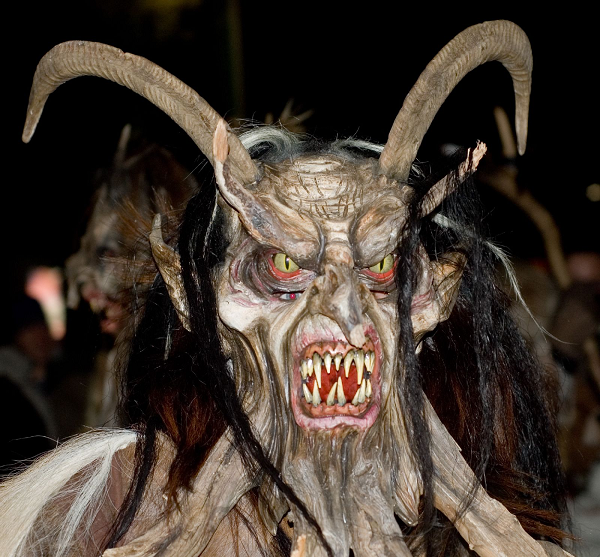
If you’re like me at all, Halloween is your favorite holiday, and by the time Christmas rolls around, you’re more than a little tired of what feels like the same 10 holiday songs on repeat from the end of October to the end of December. This can definitely be a downer on the Christmas spirit.
But what if I told you there was another option? A spooky side to Christmas?
After all, even the seasonal classic “It’s the Most Wonderful Time of the Year” by Andy Williams mentions there’ll be “scary ghost stories.” Though this likely refers to the Victorian Christmas ghost story tradition (A Christmas Carol by Charles Dickens, anyone?), the tendency to keep Christmas creepy extends much further, into monstrous folklore figures that come alive during the holiday season.
Krampus
The visual and moral counterpoint to St. Nicholas during Christmas, Krampus is often depicted as a bipedal half-goat, half-demon whose purpose is to punish bad children. (In contrast and like the commonly known story goes, St. Nicholas gives gifts to good children.) The Krampus tradition can be found from Austria to Slovenia, and in more recent years, you may have seen Krampus-themed events in your own city.
On Krampusnacht, which occurs every Dec. 5, Krampus walks the streets, providing fun and good-natured fear wherever he walks. Traditionally, those in Krampus costume have props such as a switch, a basket on the back and bells.
Perchta
Arising from the Alpine regions of the world, Perchta is often depicted as a beautiful young woman or an old woman with one large foot. During the 12 days of Christmas, she gives the gift of a silver coin in the shoes of good children and servants, but visited a terror even worse than Krampus to misbehaving kids: On Folklore Thursday, Dee Dee Chainey writes that when it comes to bad kids, Perchta will cut open their bellies, taking out their innards and filling them with stones and straw.
Even today, some still dress up as Perchta, followed by a gaggle of perchten, who in turn also bear bells, similar to Krampus.
Grýla & Leppalúði, the Yule Lads and Jólakötturinn the Yule Cat
I’ll be the first person to admit I have an incredibly soft spot for Icelandic folklore and stories. (And the very concept of a Yule Cat is just one of the reasons why.)
Grýla and Leppalúði, cannibal trolls who are also parents to the Yule Lads, mostly preyed on children, or so the story goes. Descriptions of Grýla tend to stay monstrous, ranging from her having 300 heads and three eyes on each head to having horns like a goat. Grýla and Leppalúði also own Jólakötturinn, or what is known as the Yule Cat. As the story goes, Grýla sweeps down from the mountains on Christmas and boils bad kids alive.
There are said to be 13 Yule Lads, who visit children on the 13 nights leading up to Christmas. When they visit, children put one of their shoes on a windowsill. Good kids get candy! Bad kids get rotten potatoes.
As for Jólakötturinn, he’s a black cat said to walk the country on Christmas Eve, with an appetite for those not wearing at least one new item of clothing. An offering of new clothes should also be made to the cat, or else he might decide the offenders look mighty tasty.
Le Père Fouettard
Known in English as Father Whipper, Père Fouettard also functionally follows in the tradition of punishing bad kids around Christmas. Fouettard is often depicted as a dishevelled figure in black robes, with a black or red beard and a sort of whip to punish bad kids. This tradition is mostly found in northern and eastern France.
Mari Lwyd
You’ve probably seen the picture of a horse skull with Christmas ornaments in its eye sockets, mounted on a pole with an obscuring piece of cloth attached, making the rounds on Twitter, if not Facebook.
A tradition arising from Wales, the Mari Lwyd, which translates to Grey Mare, is also decorated with colorful reins and bells. The person bearing the horse skull is hidden under the sheet, and, in a procession, a group will wander a village from house to house, challenging occupants to an exchange of insults in Welsh.
Once verses have been exchanged, the procession is admitted inside and the festivities continue on to the next house. Though the tradition is often associated with Christmas, the practice itself is pre-Christian.
What I love most about these kinds of stories is the abrupt, stark reminder we receive when figures like Krampus come into view: The Christmas tradition, once known as Yule, is far older and far stranger than we might otherwise assume. And though I have seen Pittsburgh celebrate its own Krampusnacht—and I do believe we have a Mari Lwyd around here somewhere—I highly suggest reading about these traditions in their original contexts.
The image of a horse skull with ornaments in its eye sockets is a haunting one, but the stories and traditions are even more so. Folklore is culture and lived experience. All you have to do is go looking.
Article Written by Laura Kemmerer
Laura tuned into horror with an interest in what these movies and books can tell us about ourselves and what societies fear. She is most interested in horror focused around the supernatural, folklore, the occult, Gothic themes, haunted media, landscape as a character, and hauntology (focusing on lost or broken futures).


Filmmaker Bari Kang discusses Itch!, from its practical gore and zombie influences to filming in his own NYC store and directing his daughter.