
The Mainstream Horror Protagonist – A Guide to Writing a Horror Screenplay
Studio Hollywood movies are sometimes like the “yacht rock” of narrative filmmaking. Star-driven, shiny, safe, highly produced and you’re not sure if it’s cool, but if you have a soft spot for Duran Duran—it makes you happier on a miserably wet Tuesday.
On the other hand, horror is casually perceived as the realm of no stars, dark, edgy, barely produced and of a certain taste—you’re lucky if you get anywhere near an uplifting catharsis.
So, what happens when you mash these two worlds together perfectly? You get Aliens: Special Edition.
There’s more than one way to structure a story—particularly horror with its detailed sub-genres—and deviating from them without skill is likely to cause problems and will disappoint an audience… more on that later.
Even though Aliens (SE) is a horror sequel and follows the original narrative beats closely to its predecessor Alien—it’s bigger, quicker, has more monsters and a great new “end of level” boss. It’s what we have come to expect from a typical sequel approach. However, there is something else going on that’s also…very Hollywood.
Aliens (SE) has much more in common with the conventional narrative structures of 70s and 80s mainstream hit movies like Kramer vs Kramer (1979), Tootsie (1982) and Rocky (1976) than you might think.
As a starting point, it has all the Hollywood “go-to” favorites:
i. A central relationship that we care about (Ripley and Newt).
ii. The protagonist follows the classic hero path of gaining confidence and learning to care.
iii. A clearly heroic character arc—a movie star lead role.
(and I have to credit Donna Michelle Anderson’s book, Write It, Pitch It, Sell Your Screenplay: A Hollywood Buyer's Insider Guide to Getting Your Script Past the Gatekeepers for inspiring my approach—there’s something else at the core)
iv. A simple one-word theme that binds the protagonist’s narrative and journey. That is at first rejected, embraced, put to the test, prepared to sacrifice for it and leading to redemption. The theme is relatable, universal and easy to understand.
What is this magical word? The answer for Aliens is “motherhood.”
How to Satisfy an Audience with a Protagonist
Aliens (SE) has a straightforward, logical progression of a specific torture tailored to be inflicted on the main character through multiple scenes.
Ellen Ripley has previously rejected motherhood as a result of “work commitments” that (let’s say) went poorly, then embraced it “looking after the child survivor,” then that new behavior is put to the test by fighting another mother, “that bitch,” showing she’s prepared to sacrifice her life and resulting in a “mommy” redemption.
Let’s look at a short script excerpt—the first scene that highlights the “rejected.” It happens very early on page six in a 105-page screenplay. It’s one of the first things we find out about Ripley—from the Final draft - 09.23.85.
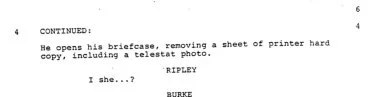
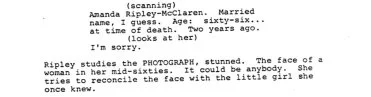
You can argue this isn’t necessarily a conscious rejection, but guilt—but her work has taken her away from mothering, deep into outer space and requiring a period of hypersleep. It wasn’t a quick commute to get back home in an emergency, Ellen. It’s a form of abandonment, and whether or not you see that as a past sin, it’s definitely very unfair. Added with the company not believing her and losing her job, it’s a fantastic technique to get you on Ripley’s side and rooting for her. Aliens (SE) goes further with the torture and gives Ripley a thematically connected problem of conscience. They have lost contact with the colony; families have settled there and they want her to come along to help. What will she do?
Side Note: In the screenplay (Final draft - 09.23.85) and included in expanded “Special Edition,” you don’t question Ripley going back into the nest. In the Theatrical version, this critical information about her daughter dying is missing (below), therefore we are just left with somewhat of a question mark based on Ripley’s previous behavior and comments in the script. The line below is revised in the film—but it still has the same clear meaning.

In (SE) she has lost a child—so we don’t question it at all when she goes back to rescue Newt—it makes compelling emotional sense. In the theatrical version we get Ripley, who won’t go back for some of the still-living marines, but promises to not abandon Newt and the promise is the motivation. This “daughter” scene omission weakens the narrative—but that’s studio cuts for you.
So, the thematic spine of Aliens (SE) and Ellen Ripley’s Journey is:
1. Rejected (motherhood) because of work commitments;
2. Connected problem of conscience (to go and rescue the “families” or not) that forces her forward;
3. Embraced (motherhood);
4. (Motherhood) put to the test;
5. Prepared to sacrifice (for motherhood) leading to a one on one… battle of the mothers; and
6. Heroic redemption (I am a good mother).
How Hollywood is that?! There is a relatable anxiety that runs through the story and is redeemed at the end. By employing this approach, you can at least answer the dreaded question, “Why should we care?”
How to Disappoint an Audience with a Protagonist
Aliens (SE) might be from the 80s, but remains today as a horror benchmark of a robust emotional and thematic engine for a mass audience. Now, let’s look at a more contemporary mainstream horror example, Jurassic World (2015). This film is definitely inspired by Aliens and has Bryce Dallas Howard’s role (Claire Dearing) as their female lead. Claire (like Ripley) has the most emotional growth in the film, but is she the real protagonist or is Chris Pratt’s Owen Grady, who is introduced as late as 18 minutes in?
First, I have no problem with Jurassic World (it’s Jurassic Park 4); it has all the challenges of following the successful and unsuccessful ideas present in three other films. It must have been a never-ending checklist. It has to have velociraptors, a T-Rex, and kids in peril. It must breathe new life into the property, be able to sell related merchandise, be a potential theme park attraction (the irony!) and be family appropriate for a restaurant tie-in. Aliens didn’t have “Happy Meal” problems.
Here are the character arcs side by side:
|
|
Ellen Ripley—Active Protagonist
|
Claire Dearing—Passive Protagonist
|
|
1. Rejects |
(Motherhood) because of work commitments |
(Aunthood) because of work commitments |
|
2. Connected Problem of Conscience |
(To go and rescue the ‘families’ or not) that forces her forward to face her nightmares. |
(To go and rescue the families or not) After people die, she orders a controlled, selective shut down of the park. |
|
3. Embraces |
(Motherhood) Provides comfort and care for Newt. A promise is made to Newt. Ripley takes the wrist locator for her and puts it on Newt’s wrist. “I’m not going to leave you, Newt,” and makes a sincere “cross my heart and hope to die” promise. |
(Aunthood) Not really. Her nephews are deep in the park isolated. The team of rangers can’t go in. Claire claims, “She is going to have to do it herself.” Then immediately begs Owen, “I need you” to help rescue the boys. Owen drives Claire into the park. Owen immediately takes over the search and essentially tells Claire what to do for the rest of the movie. |
|
4. Put to the Test |
(Motherhood) Newt falls down the ventilation shaft and is taken by a xenomorph to the nest. Ripley arms herself for a suicide mission—alone. |
(Aunthood) Not really. The boys, Claire and Owen magically meet up. Claire picks up a gun and saves Owen at 1 hour 22 mins, and gets a kiss as a reward. Seconds later, Owen tells her what to do and is back in charge. Later Claire gets to drive away in a van with the boys in the back to escape chasing raptors. They survive. Then Owen immediately tells her what to do. |
|
5. Prepared to Sacrifice |
(For motherhood) going into the nest… and runs into another ‘mother.’ Gets away with Newt and then has to battle “the Queen” again. |
(For aunthood) The gang gets surrounded by raptors. Big “super dinosaur” turns up—Indominus Rex. Claire orders IT guy Larry via walkie talkie to open the doors to the T-Rex enclosure and lures it with the “Claire with a flare” dash—running away in heels. Watches the other dinosaurs tag-team the big super dinosaur to death. |
|
6. Heroic Redemption |
Sends Queen packing. Rescue complete. Newt loves her (I am a good mother) |
She doesn’t do much after that—but Owen still tells her what to do. (I guess I’m an okay aunt—my nephews didn’t die) |


This dual protagonist balancing act of Claire and Owen clearly makes her less capable next to Owen’s super switched-on military male. Her character is played for laughs, a fashion-conscious company woman out of her depth that still needs to be saved by a man. Claire Dearing is essentially a comedic role that isn’t funny—a charmless damsel in distress in a family horror movie with nothing to really “root for” in her character. While capable, Owen has no character arc at all. Its players are all hollow.
As Claire Dearing is not tested in the right way, it weakens any feelings of heroism or redemption towards her. The narrative decision was made to not outshine her potential mate and expose Owen as a cardboard cut-out hero. Once she asks for help from Grady, he then takes over and she never questions him over anything again. Her arc is simply that she didn’t get her nephews killed and she got a “capable” boyfriend to boot… The End.
Ellen Ripley, at the end, has no capable anyone to call on. It becomes a “final girl” fight against a monster that dies twice. Both are horror staples that boost the steps four, five, and six (above). Aliens (SE) keeps true to its genre conventions and the heroic redemption arc is fully earned but also perfectly appropriate.
Ripley’s emotional redemption, for a mainstream horror, is as flawless as you get—so you can get your uplifting wet Tuesday night catharsis from the dark side!
Our Works in Progress
At some point, somebody has to feel they can approach a star with new “untested” material and pitch your story confidently. We can’t be naïve about the need to attract and secure top on-screen talent and how that leads to financing and production.
There’s a deep desire for actors, once they become above-the-title stars, to continue to appear heroic in order to hold onto that public perception and also the significant economic power that it affords (and honestly who can blame them!). The well-established Jurassic Park universe doesn’t have to work too hard to attract box office talent. It doesn’t want character arcs—just acting “heroic” amongst large scale spectacle will do. Those movies have “Happy Meal” problems.
Ideally, you have to know the “final color” of your story. What emotion are you leaving the audience with? You can go for a down feeling ending—maybe full of hopeless despair or ambiguous mystery—if that’s the best ending (both classic ones for a horror) then logically structure your protagonist’s journey from the end back to the beginning.
However, if you decide to go big on “heroic redemption,” following these “Ripley beats” closely will make your protagonist more palatable to the commercial machine and will leave your readers with a sense of satisfaction and completeness… and while you are thinking about that:
Do you also have an overwhelming desire to listen to some Duran Duran?
If you are interested in my other horror screenwriting articles on the site, click the links below:
• Monsters vs. Ghosts: A Guide to Writing a Horror Screenplay
• Writing the Feature-Length Ghost story: Six Observations
And for a larger breakdown of how these elements fit into a complete narrative, see our guide to horror story structure.
Article written by Arran Crawley
Arran Crawley currently has two ghost story screenplays on the Film Festival circuit, so far, they have won 4 awards and placed in several finals. These include wins at ‘Best Short Screenplay’ at the Ethereal Horror Fest 2022 and ‘Best Dark Drama Feature Screenplay’ at Austin After Dark – Fall 2022. Ever since he relocated to Canada in 2015, Arran has worked with emerging filmmakers, several film festivals (including Vancouver Asian Film Festival) and is the former Program Coordinator at the Calgary Film Centre. You can follow his progress on Instagram - arrancrawley

Filmmaker Bari Kang discusses Itch!, from its practical gore and zombie influences to filming in his own NYC store and directing his daughter.