
Writing the Feature-Length Ghost Story: Six Observations
When I left England, I wondered what I would hold onto and what would fall away. Strangely, my love of the British ghost story came with me and it never quite left. There always seems to be a ghost “of sorts” in my screenwriting.
This article is based on the influence and style of the traditional British ghost story. I am here to pass on what I have learned through exploring that genre, but you will find some of these concepts apply to the ghost stories of other cultures as well. Take what you will.
1. Themes
The ghost story is a form of horror loved by those who don’t love horror. Maybe it’s because there’s that feeling of a complex narrative puzzle to be enjoyed. Maybe for its avoidance of gore and sex—although repressed sexuality is often there—or maybe it’s simply a preference for chills over kills. We could argue whether it’s horror-adjacent or proper horror, but most certainly, the ghost story is just scary and clever enough to be taken seriously.
The default preferences of the ghost story are to make it atmospheric, mysterious, and most importantly, short.
Consequently, with this narrow scope and specific genre markers, an original ghost story is fiendishly difficult to execute, especially as a feature-length screenplay.
Popular theme choices include…
A. A defining memory
B. A wish fulfilment dream righting a regret
C. A sense of place frozen in time
D. A sense of impending madness
E. The antiquity of the past
F. A warning from the future
G. Something about this world is doomed to repeat
H. The slow undoing of the rational and logical
I. Repressed sexuality
J. Childhood trauma
2. The World
The ghost movie presents a fascinating world. Sometimes the locals know its power, fear it, and respect the rules. Other times, only a collection of secretive characters know what’s really going on. Naturally, your protagonist will be tempted to go against any advice and transgress to awaken/worsen the darkness. The landscape/setting is also a character within the story and is usually unstable, decaying, and dread-inducing. This world is one of a lingering, nagging, and constantly troubling sense of doubt. Either something is missing or something is there that shouldn’t be.
The default preferences of the ghost world are to make it unsettling, isolated, and have a rural feel.
Popular world choices include:
A. Dark nostalgia
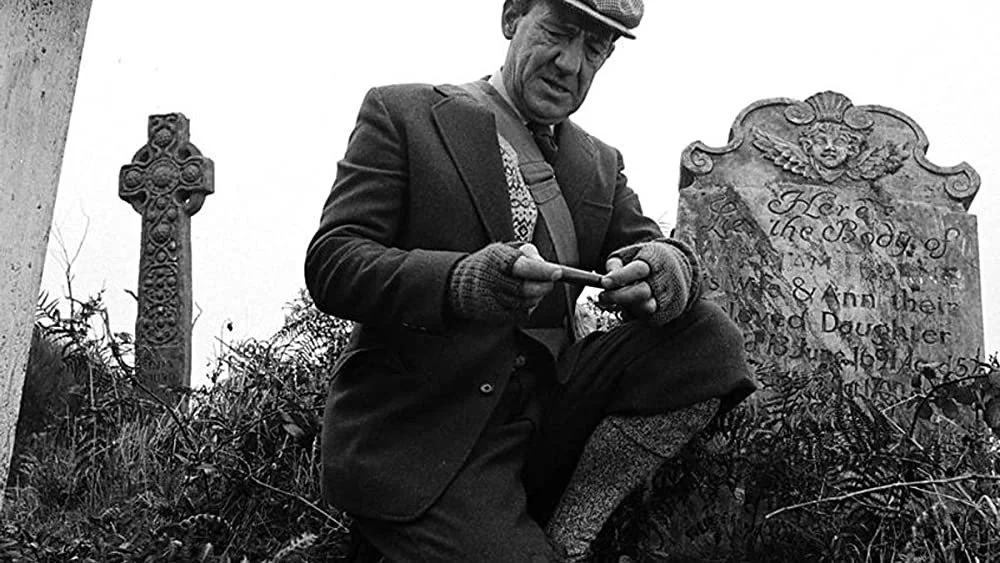
Whistle and I’ll Come to You (1968) is set in the transitional English coast.
Image courtesy of IMDb.com
B. A sense of melancholy, sadness, loss, and beautifully poetic
C. “Socially crippled” people constantly fearing embarrassment and shame
D. The winter, the cold, the damp—nature’s seasonal death—before the resurrection of spring
E. Decaying Places—ruins and “forgotten” abandoned places with dark primal and dangerous histories
F. Dreamlike quality—Uncanny, vague, dim, hazy, shadowy, misty and faint
G. A “transitional” location—an elemental boundary or threshold, e.g. where the land meets the sea
3. The Motivated Ghost
Ok, this is all very well, but what about the ghost itself? The spirit can be malevolent or not—but it always brings an unsettling mystery. A chatty ghost won’t do. A spectre droning on about their death and woes could veer into comedy or a family film feel. The key question is what does it want? The ghost’s aim is often to finish things left undone in life—an incompleteness that must be made whole. This motivation is often the engine (the narrative drive) of the story, so choose wisely, my friend.
Popular choices include:
A. To be saved from damnation
B. To save someone else
C. To be redeemed
D. Revenge for the circumstances of death
E. A curse that must be lifted or enforced
F. To undo/release the pain
G. A task that needs to be accomplished to “cross over”
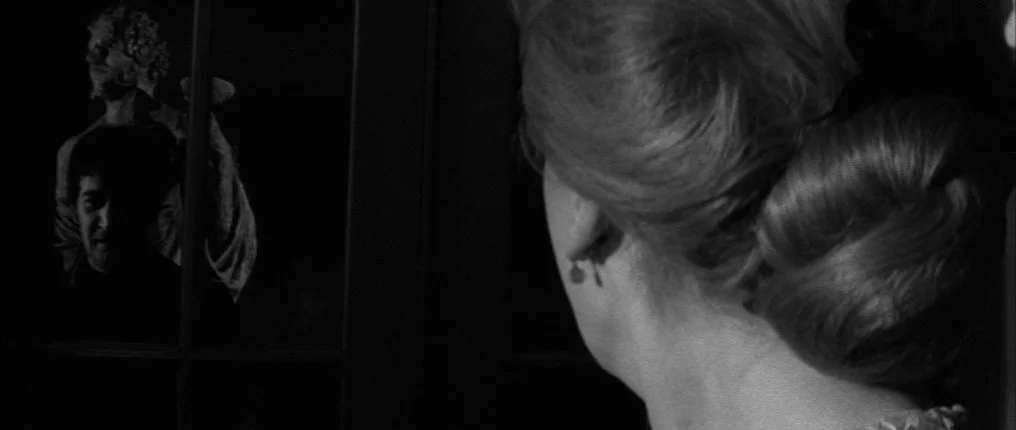
The ghosts in The Innocents (1961) as a dark reflection of the protagonist. Image courtesy of film-grab.com
It is better if the ghost presents a physical threat of some description. They can even spread their malice to anyone who gets in the way—even the innocent. The big challenge of the ghost story is the nature of the spirit’s destructive power and exactly how that is terrifying to the protagonist. Therefore, it helps if the “presence” is a warped dark mirror of the protagonist.
4. The Protagonist
Goals aren’t always important narrative drivers—the focus is on reacting to the mystery. The ghost, and its mystery, are often the engine of the story. Therefore, the protagonist is complex, tortured, and mainly “passive,” reacting to the unfolding dread and terror. They are haunted and controlled by it. Not your average story hero, often a stranger in this land, slowly losing to their warped dark reflection. They often fear embarrassment and repress their emotions—there’s a social politeness “veneer” to their behaviour. They fear their privacy is being threatened—an introvert that’s distanced from social society in some way.
The ghost often represents their secret pain, buried deep—the power is in the silence and subtext. Therefore, they don’t usually act heroically until maybe the end when they just can’t take it anymore.
5. The Hero’s Journey
The main character experiences a slow blurring of the lines between the dream world, the waking imagination, and mundane reality.
Arriving during a mental crisis and hinting at the possibility of an unknown reality (one that stretches beyond the laws of nature and challenges the belief system of the protagonist) the standard pattern begins of gradual unease, building to dread, then longer glimpses of the terror and finally we must decide how the ghost will attack—if they will at all. As Robert Macfarlane wrote in The Guardian in 2015:
“Horror specialises in confrontation and aggression; the eerie in intimation and aggregation."
Therefore, the audience/reader will start to question the mystery. Are we dealing with “dirty fingerprints” left behind from a past sin or maybe a soul-crushing regret? Hence the motivation of the darkness and/or the protagonist’s dark secret is absolutely critical to keep those narrative plates spinning in the air. Ultimately, the key to the protagonist’s journey is that in some way they are actually haunting themselves.
Sure enough, the seeping evil will grow stronger. It won’t be ignored or denied, lurking in the dark corners of the room, a shadowy parallel bleeding more and more into rational reality. This dark insomnia will increase and intensify, doomed to keep them from a restful sleep (literally). This is the playground of the ghost story and will take up the majority of the tale.
If second acts are where screenplays go to die, your ghost, though already dead, is sadly no exception to the pressure of keeping the middle part building and engaging. Introducing the ghost should be done as late as possible or the terror could peak by the midpoint and never recover.
Another complication that can kill your story is that often, at the heart of a ghost story is perhaps the trickiest of all character motivations to show on-screen: somebody is keeping a dark secret, for good reason, and is struggling hard to keep it hidden despite terrific outside pressure. If you have internal angst driving the main tension of a feature, then how the secret is handled, slowly hinted at, externalized, and finally revealed is critical to the story’s success. Let’s say, you have my sympathies, dear author.
6. The Ending
Simply, explain a little—but not a lot. Your five main endings for the main character, regarding the haunting at least, are:
A. It’s real
B. It’s imagined
C. It’s ambiguous / who knows
D. I’m mad
E. I’m dead
Once the unknown/dark secret is revealed, the eeriness vanishes with it and most importantly, the tale doesn’t have to make sense as long as the journey is absorbing, fascinating and emotional.
In the tradition of the ghost story, it is often the telling of the tale which is more important than any final reveal. It’s not about the plot and it’s not meant to be picked apart like a whodunnit. There are ghost story movies driven by goals, stakes, and urgency but to the direct detriment of the uncanny. The stories we are referring to here are about a character’s fate and not necessarily the fate of the story world. Therefore, strong endings feel poetic. They can be reassuringly cathartic or leave us with a sense of the enduring unknown or maybe the idea of a tragedy condemned to repeat for all eternity. Nice and lingering, but often not neat and tidy.
Though it is explored through the distinct atmosphere of a place that has a deep and troubled history, the ghost story is more a collection of universal moods and emotions that, at its core, is an exploration of humanity and meaning. In the end, you have to feel something that’s deeply human and relatable over any scary setting because…
… Sometimes the dead tell us how to be alive, and I think that’s the point of the ghost story screenplay.
If you’re interested in furthering your understanding of writing a screenplay, check out our guide to the horror structure paradigm.
Article written by Arran Crawley
Arran Crawley currently has two ghost story screenplays on the Film Festival circuit, so far, they have won four awards and placed in several finals. These include wins at “Best Short Screenplay” at the Ethereal Horror Fest 2022 and “Best Dark Drama Feature Screenplay” at Austin After Dark – Fall 2022. Ever since he relocated to Canada in 2015, Arran has worked with emerging filmmakers, several film festivals (including Vancouver Asian Film Festival) and is the former Program Coordinator at the Calgary Film Centre.
You can follow his progress on Instagram - arrancrawley

Filmmaker Bari Kang discusses Itch!, from its practical gore and zombie influences to filming in his own NYC store and directing his daughter.