The Intersection of the Supernatural and Early Cinema: An Interview with Murray Leeder
As the pandemic continued to rage throughout the Yule season, the call for resurrecting the tradition of the Christmas ghost story continued to grow. But as the darkest winter in years looms ahead of us, the spectrality of the season is thrown in stark relief. The need to stay home, paired with winter’s chill, may take us on a turn toward reading ghost stories, and in turn, these stories may help us process trauma, grief, and loss.
Murray Leeder, a Research Affiliate at the University of Manitoba and with a Ph.D. from Carleton University, specializes in researching the intersection of the supernatural and early cinema. Leeder’s previous works include Horror Film: A Critical Introduction, a must-read for those new to horror and genre vets alike; The Modern Supernatural and the Beginnings of Cinema, which examines the importance of the nineteenth-century supernatural and how it relates to early cinema; and Halloween, an installation for the Devil’s Advocates series, which goes into deep dives of a variety of iconic horror films. Leeder has also authored articles for journals such as Horror Studies, the Journal of Popular Film and Television, and the Journal of Popular Culture, among others.
While media like The Haunting of series has introduced viewers and pop culture that ghost stories function on several levels at once, Leeder takes these ideas further, highlighting critical themes that are often found in the genre, the types of ghost stories, and what “hauntings” may actually entail.
What initially drew you to horror? What motivated you to pursue horror studies? (A specific film, book, or director's work?)
As a child I gravitated towards monsters and ghost stories and the like. I have an old library discard copy of Christopher Maynard’s World of the Unknown: Ghosts that now sits on my son’s bookshelf. The Real Ghostbusters was my favourite Saturday morning cartoon series as a child. Dracula became my favourite book, and as a teen I consumed classic horror ravenously; I’d tape films off of cable in the middle of the night and then watch them later. I loved The X-Files. I liked vampires a lot; I read J. Gordon Melton’s The Vampire Book until it fell apart. I also worked for a time in a historical village in Calgary, Heritage Park, which had a lot of haunting lore about its houses; I never experienced anything and even though I don’t believe in ghosts, my fascination grew about why people do believe.
Sometime towards the end of my undergrad, I don’t remember writing that much about horror, but somewhere along the line I found a VHS copy of The Legend of Hell House (1973) and when I did my Film Studies M.A. at Carleton University, I used it as the starting point for a project about haunted house films under the supervision of Dr. André Loiselle. My subsequent Ph.D. research wasn’t particularly about horror, but about the supernatural in early cinema. At the time I was more productive as a fiction writer too, alternating between fantasy and horror. I felt like these were genres where the theoretical ideas I was being exposed to could be put on the page relatively directly.
In your research, what themes have you found ghost stories to be centered around most?
Ghost stories always seem to me to be about one, or usually more, of a couple of things simultaneously. One is the past, especially a traumatic past, and how it filters through to the present in hidden ways. Another is the gulf between self and other, especially as wrought by communication technologies. Another is everything that is around us, those uncomfortable social realities which we have trained ourselves not to see (I always like to think of Ghost (1991) as a film about homelessness, for example).
Are there different kinds of ghost stories? (What comes to mind here is the idea of a house that might haunt itself, not necessarily a house that is haunted.)
Oh, definitely, and that’s one of the great things that The Haunting (1963) manages to adapt from Shirley Jackson’s novel … the idea that it’s not so much that the house is a neutral location that happens to contain ghosts, it’s that the place itself is haunted. Comic/romantic ghost stories are often about a ghost as an individual whom we often follow and identify with, while other kinds of ghost stories efface individuality. One of the things that interested me so much about The Legend of Hell House is how it blurs those categories: On one level the house is haunted by the ghost of Emeric Belasco and only him, but also his spirit has expanded to the point where it’s definitionally inseparable from the house itself.
You mentioned a long-standing interest in ghost stories and hauntings. Has the way people interact with and think of ghost stories and hauntings changed over the years?
(Ex. the story of a haunted villa in ancient Greece may very well have vastly different cultural coding than a story like The Haunting of Hill House.)
Yes, very much so, though there is a certain amount of continuity too. You may be alluding to the story Pliny the Younger tells about a Greek philosopher who decides to investigate a haunted house in Athens, ends up seeing an apparition, following it and discerning that it wants its body recovered and properly buried. The hauntings cease after burial rites are attended to. In a lot of ways, it’s all there: improper burial creates a haunting, a living detective investigates the dead, the dead communicate through difficulty, a happy ending when the ghost is put to rest.
In many ways, however, the ghost story has changed a lot. It’s become a lot more psychological in character the last few centuries—this is something Terry Castle has written wonderfully about—since we have come to conceive of our minds as places, “haunted” by thoughts and ideas and images. Haunted spaces are inner spaces for us in a way that was much less the case centuries ago.
What is the intersection point between the supernatural and early cinema? Has your research in supernatural subjects resulted in any surprising connections to film?
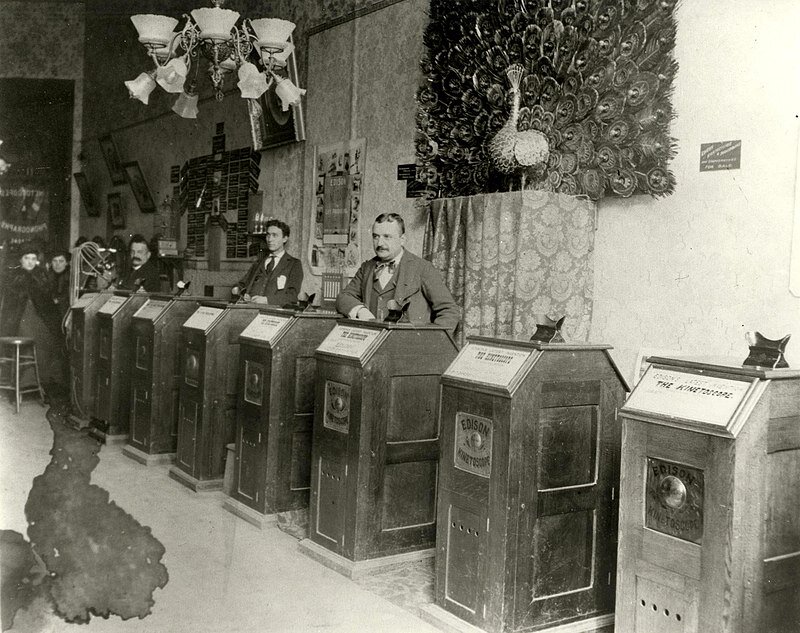
San Francisco Kinetoscope parlor c.1894–95. Image source Wikipedia
What interested me in my Ph.D. research and the subsequent book The Modern Supernatural and the Beginnings of Cinema, is how earlier supernatural media—especially of projected light—ported over into early cinema. Supernatural scenarios were popular with early trick filmmakers in part because the technology motivated them (the potential for double exposures, disappearances, substitutions, etc.) and partly because audiences understood them, they had been prepared for by centuries of earlier media. In addition, I was interested in cinema’s ghostliness (that thing that is fundamentally there and not there, present and past at once, etc.) as a problematic in early film theory that mostly went underground and then re-emerged with the “spectral turn” in the 1990s and beyond.
One of the favourite topics—one I’m still dealing with—is how the spiritualist movement practically dealt with film. As early as 1896, the British spiritualist and journalist W.T. Stead was roping the new medium into spiritualism’s rhetorical arsenal, speaking about “The Kinetiscope (sic) of Nature” and “The Kinetiscope of the Mind”—essentially using film media as a metaphor for how the supernatural might work. Yet the spiritualists didn’t really make films themselves and often perceived them as a threat; I’ve done a lot of research on the anti-spiritualist films of the 1910s and 1920s and how the spiritualist press dealt with them, as well as more positive depictions, mostly in the 1920s.
What are your future research plans? (Any books, conferences, etc.?)
Thanks to COVID-19, conference plans are in abeyance, alas, and we will see what happens next on that front. I have a couple of projects on the go. I spent years studying supernatural topics in the silent era, and I’m looking forward to getting some of that research out in a couple of ways, both articles and chapters and also an online database I’m assembling on the supernatural in silent film—once I started digging, there’s far more there than I ever dreamed.
I am also working on a project on Indigeneity and horror, which I was going to speak about at the Society for Cinema and Media Studies (SCMS) conference that didn’t happen this year. I am planning to co-edit a special journal issue on the topic. Indigenous horror is a fascinating and growing era and I hope to help expand conversation about it.
Finally, I’ve circulated a CFP on Bob Dylan on Film.
This interview has been edited for length and clarity.
Interview by Laura Kemmerer
Laura tuned into horror with an interest in what these movies and books can tell us about ourselves and what societies fear. She is most interested in horror focused around the supernatural, folklore, the occult, Gothic themes, haunted media, landscape as a character, and hauntology (focusing on lost or broken futures).

Filmmaker Bari Kang discusses Itch!, from its practical gore and zombie influences to filming in his own NYC store and directing his daughter.