
Christmas Ghost Stories: Looking at Dickens’ A Christmas Carol
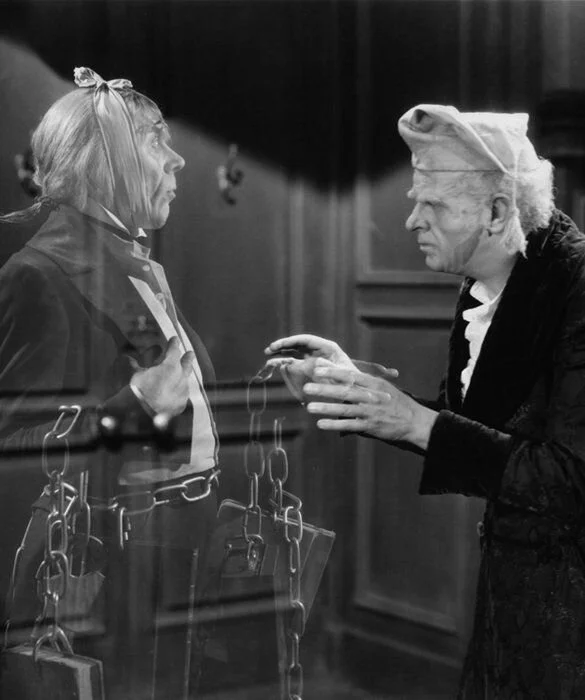
A Christmas Carol (1938) image via IMDB
Of all the Christmas stories and ghost tales, one combination of the two that instantly comes to mind is Charles Dickens’ A Christmas Carol. While the novella was written in 1843, this timeless classic has been adapted into film over three dozen times. Although not all movies share the same style or Victorian-era authenticity, they all aim to capture the story’s zeitgeist––or “spirit of the age.”
When I was a child, my favorite adaptation of the popular holiday story was the 1983 American animated movie, Mickey’s Christmas Carol. I feel like the story successfully made me look at how I treated my younger brother and even my parents, because through its story line, it forced me to make a connection and remember my own past events, look at the present and debate how my decisions could affect my future and others’. While the ghosts in the adaptation failed to scare me––seeing a familiar character take on a change of wardrobe and color––I remember the message being understandable, even for such a young and developing individual.
As I got older, I was introduced to other versions of the story including Clive Donner’s (1984) and Robert Zemeckis’ (2009) adaptations. It wasn’t until last year, however, that I was introduced to a more dark and sinister take on the story in Nick Murphy’s adaptation, which featured as an FX Original Movie. Plagued with more images of death and cruelty, Murphy’s is the closest version I’ve found in relation to the horror genre, vs. its typical drama-focused counterparts.
A Christmas Horror Classic
Although this adaptation didn’t really scare me––I think partially robbed of its factors due to the mass retelling of the classic––I found that some of its choices in dehumanization and spooky special effects to be a genuine attempt at recreating the tale through a horror lens.
At its core, the classic tale recounts the life of Ebenezer Scrooge, an old greedy businessman who embodies an utter distaste for people and the Christmas holiday. As for Scrooge’s cold personality, he denies invitation to his own nephew’s dinner—his nephew is the son of his late sister— refuses to donate to charity, and struggles to give his underpaid clerk, Bob Cratchit, off for the holiday.
To warn of what fate lies ahead for Scrooge should his selfish behavior continue, seven years after his death, prior business partner Jacob Marley comes to Scrooge as a ghost dressed in chains, warning that Scrooge will soon be met by three Christmas ghosts––Past, Present, and Yet to Come––as a type of reckoning for his actions. Marley says that while it is too late for him, Scrooge still has the chance to redeem himself. In disbelief, Scrooge plays off the encounter as a hallucination or a bad dream. However, Marley’s warning is deemed true when the first ghost of the night arrives, the Ghost of Christmas Past, who takes Scrooge back to scenes of his childhood. Met with happy memories and sad, Scrooge demands they return to the present.
Moving along in chronological order, the Ghost of Christmas Present wades Scrooge through a collection of families enjoying the holiday together. Most notably, the duo visits Bob Cratchit’s family dinner and is introduced to one of the story’s most iconic characters, Tiny Tim, Cratchit’s young but terribly ill son, who will inevitably die unless Scrooge changes his monstrously selfish ways. Finally, the Ghost of Christmas Yet to Come takes Scrooge on a trip to the future, where he is shown his own funeral, scarcely attended and empty of grief—a most lonely and unsettling image. The ghost takes it a step further and also reveals the death of Tiny Tim. In realizing the harshness of his actions and realization that no one cares for him, Scrooge pleads to the ghost that he’ll change his ways if it’ll really alter the fate of Tim and himself.
Awoken the next day as a changed man, Scrooge makes donations to charities, sends food to the Cratchit family, increases Bob’s salary and ends up spending Christmas Day with his nephew. By the story’s end, we can assume that Scrooge now embodies the spirit of Christmas, spreading kindness, love, compassion and generosity.
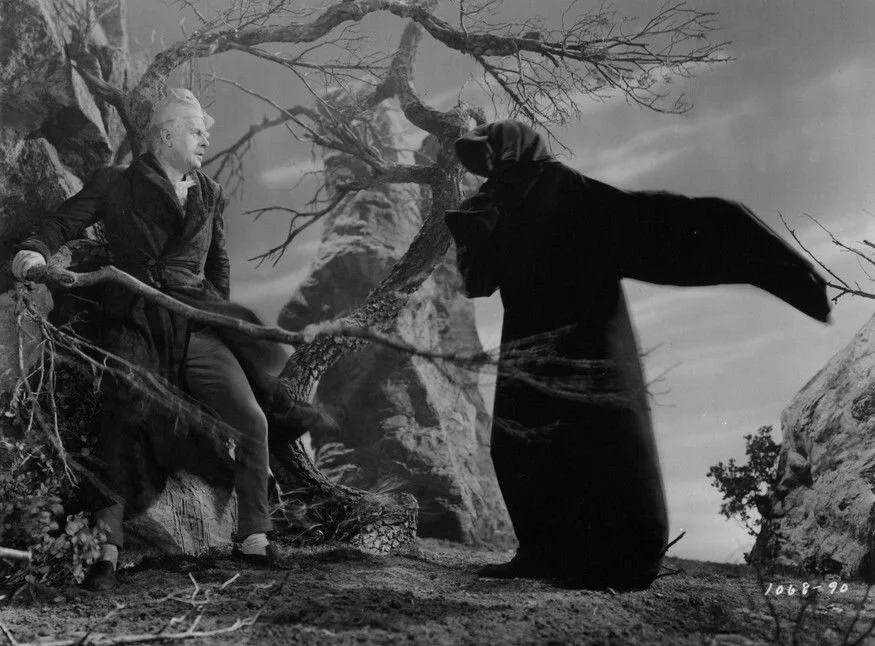
A Christmas Carol (1938) image via IMDB
No matter how this story is unfolded, whether as a drama, horror or even a child’s animation, a ghost story is a reason for visitation, especially around the Christmas season and begs us to ask, what it is about ghosts and the act of being haunted that inspires us to change our otherwise unruly ways? Is it the fate of the unknown afterlife? The uncertainty that we would spend an eternity of suffering to pay for our possibly evil deeds? Or for those who don’t believe in religion or the existence of Heaven or Hell, is it the past, present, or thoughts of the future that literally haunt us? Do we hold regrets, grudges, or fear about things in life that we have––or maybe don’t have the power––to change?
Whatever the question may be, or what an individual reflects about one’s self around these times of conducting traditionally selfless acts, answers can be found in hundreds of years of literature and folklore. In Haunting Fear: A Literary History of the Ghost from the Medieval to the Gothic Era, author Cassandra Whittem explores the representation of the ghost and how it changes throughout the time period, focusing on ghost encounters and the emotional discourse that arises from these encounters.
Whittem points out that as a literary device, ghosts and the key to their endurance is found in the intense and heightened emotion regarding the moment of encounter between living and dead. This is why A Christmas Carol has continually kept its success over the years and throughout any, maybe even all, of its adaptations. It is taking someone who genuinely has no regard for human life, nor does he seem to believe in the afterlife or paying for his actions on earth, and evoking a change or growth through ghostly encounters.
Being met face-to-face with a dead friend, and every ghost afterwards is a step towards redemption; a series of stand-alone lessons that induce an intense pain in both remembering harsh pasts and realizing the effects, and in some cases the same pains, acted onto others. It is that protean aspect of our ghostly trips through time that Parul Sehgal mentions in his New York Times essay, “The Ghost Story Persists in American Literature. Why?,” that they are able to emanate from specific fears and fantasies, even in Scrooge’s life, to have that lasting effect, or life-altering experience. Sehgal continues in his findings about ghosts that, “They emerge from their time, which is why Jacobeans saw ghosts wearing pale shrouds and Victorians saw them draped in black bombazine. It’s tempting to regard these apparitions as dark mirrors—Tell me what you fear and I’ll tell you who you are.”
Ghosts can transform and encompass what creates fear within an individual, whether it is something from within the being’s self or a physical property that scares someone. The purpose of that encounter is on the person experiencing it alone and finding out who they are, or in the case of A Christmas Carol, who they should be.
Article written by Destiny King
Destiny writes about true crime and thrillers. She likes movies and stories that make you question the world around you, more so than what makes you jump.

Other Articles You May Enjoy…


Filmmaker Bari Kang discusses Itch!, from its practical gore and zombie influences to filming in his own NYC store and directing his daughter.