
Review: Ghostwatch (1992)
Driven by the need to get in the Halloween spirit earlier every year and an undying love of found footage, this year’s celebration of Halfway to Halloween, though slightly delayed, was marked with a watch of Ghostwatch (1992). The film is just one of the well-remembered examples of the subgenre aired as a “live” TV special on Halloween night that year. Written by Stephen Volk, who is also known for his work in Ken Russell’s Gothic (1986) and The Awakening (2011), Ghostwatch proves foundational for found-footage horror in its use of camerawork, while also becoming something of a haunting itself when it was torn from the air after its first showing. Ghostwatch on air was reportedly met with more calls than the switchboard could handle.
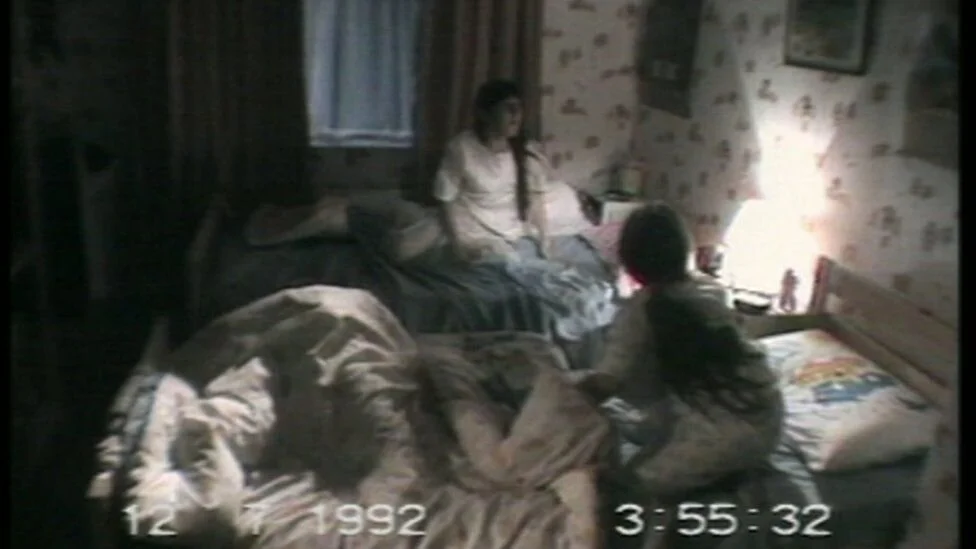
Image via the BBC
In the “live” television broadcast, directed by Lesley Manning, BBC reporters Sarah Greene, who played herself—someone who also hosted a Saturday morning children’s special in reality—and Craig Charles go to investigate reports of poltergeist activity at a house in Northolt, Greater London. Those back on set, including Michael Parkinson, who expresses doubt at these claims, and Dr. Lin Pascoe (Gillian Bevan), a paranormal expert and fervent believer, invite viewers to call in with their own stories. The line between reality and fiction is further blurred, as the phone number provided was reportedly the BBC’s actual call-in line. Between the family tormented by escalating scares, which included horrid face scratches, and footage of what threatens to debunk the entire event as a hoax, the sanity of those on set, out in the field, and the viewer themselves seems to be put at risk.
The initial response to Ghostwatch was one of outrage and fear, garnering the aforementioned phone calls from upset viewers. According to author and professor Murray Leeder, in his 2013 work “Ghostwatch and the haunting of media,” there were reportedly a few cases of PTSD in children caused by the TV program, and one suicide was attributed to the broadcast. Though the BBC took Ghostwatch from the air following the controversy and public upset, the film’s legacy has continued to live on in screenings in other countries, as well as a later BFI DVD release, among others.
Here, I imagine being a six-year-old kid, tuning in after a fun Halloween night and seeing one of the children’s presenters I’m familiar with, only to witness something deeply horrifying that is subsequently ripped from the air. Many of us likely have memories of something we saw when we were rather young, and it left some unique or potentially damaging mark. But memories are hazy, and Ghostwatch itself seeming to vanish from the air makes for a haunting legacy. With the Internet and the collective knowledge of humanity at our fingertips (for good or ill), we can find those haunting movies and TV shows that shaped us in our formative years. Yet these things becoming easily accessible once again, unmoored from their own times, serves to further erode our sense of time itself. The media that haunts us returns once again, like a revenant, further distancing us from our sense of the now.
“The media that haunts us returns once again, like a revenant, further distancing us from our sense of the now.”
Womanhood is also incredibly central to the story of Ghostwatch, with the director, head investigator, paranormal expert, and the affected family itself (a mother and her two daughters) all being women, or young girls. As Leeder notes in his work, in the history of the Spiritualist movement, women were considered to be at the intersection of the supernatural, and, as author Jeffrey Sconce notes in his book Haunted Media: Electronic Presence from Telegraphy to Television, in the role of medium, women were in a unique position to comment on society in a way they couldn’t otherwise. In the horror movies I’ve seen over the past handful of years, however, I’ve witnessed women treated as more likely to become possessed, like in The Exorcist (1973), rather than taking on the active role of medium. Something that was once, in its own way, empowering, has rendered a woman connected to the supernatural into an object.
Combining these frightful elements with groundbreaking camerawork that would prove to be foundational in shaping found-footage horror, Ghostwatch sets the stage for so much of what was to come later. As author Mary Beth McAndrews notes in their article “High Tension, Cheap Scares: How Lesley Manning’s Ghostwatch Shaped Found-Footage Horror,” in the February 2020 issue of Grim Magazine, movies like Paranormal Activity “may not pack such a terrifying punch—or even exist, let alone spawn a terrifying franchise.” McAndrews also highlights the more nuanced approach in Ghostwatch’s portrayal of men and women, rather than the staunchly doubtful boyfriend in Paranormal Activity. Ghostwatch largely uses two types of cameras in the afflicted house: security cameras and a large handheld camera. In the dynamism between static shots and the mobility of the handheld camera, Ghostwatch builds a unique sense of dread and claustrophobia that has also become foundational for found footage.
In one final, sweeping consideration of all these things, Ghostwatch escalates its haunting status through narrative and production connections to the unheimlich (the uncanny). The presenters, some of whom, like Greene, were known for appearing as hosts of children’s television, play themselves, leading many viewers to expect a fun, innocent broadcast for kids that year. But these hosts, who largely have the perceived respectability of the BBC—an institution that prides itself on defining the country in some ways—behind them, and something that defines the concept of “home” for many, become part of the eerie experience of the uncanny. As a television broadcast, Ghostwatch is itself something not-so-strangely familiar to all of us, but these presenters—people the viewers have come to trust—are rendered unsettling when they become part of a national séance.
Article written by Laura Kemmerer
Laura tuned into horror with an interest in what these movies and books can tell us about ourselves and what societies fear. She is most interested in horror focused around the supernatural, folklore, the occult, Gothic themes, haunted media, landscape as a character, and hauntology (focusing on lost or broken futures).

Filmmaker Bari Kang discusses Itch!, from its practical gore and zombie influences to filming in his own NYC store and directing his daughter.