
Watching ‘Nightborn’ After Having My Firstborn
It’s been a while since I’ve written an article for What Sleeps Beneath. I know, I’m upset, too. But in case you don’t know or are new here, I promise I have a good reason (well, a few of you might think it was a good reason): I had a baby.
Leading up to motherhood and adjusting to everything I thought I was prepared for and living through everything I wasn’t, I left the group with a three-part series on watching pregnancy horror films while pregnant. Looking back, those first weeks, then 20-week, 30-week, and 40-week milestones were a whirlwind of paying an incredible amount of attention to how much the fetus inside me was growing into a baby with each passing week and how much work my body was doing to keep him alive and healthy—and you know, preparing for his arrival. Then, the labor and his earthside debut happened (I’ll spare you the details), and those days also felt incredibly long, but somehow, also passed just as fast. And now here we all are—or, really, here I am—finally writing again after over a year.

So, what brought me out of my dormant writing state and plucked me from the craziness that is my life working full time and being a mom? The trailer for Hanna Bergholm’s Finnish maternity folk horror, Nightborn. Throughout my pregnancy, so much of labor and maternity care was still left to my imagination. Post-birth, postpartum, and 365+ days into motherhood, I was thrilled to see someone connecting the actual horrors of maternity to lore, and not some demonic possessed baby or literally any other form of distraction that forces the viewer to lose sight of the mother within the camera frame.
Starring Seidi Haarla (Saga) and Rupert Grint (Jon), the film opens to the two newlyweds arriving at Saga’s abandoned childhood home. Trading the busy city life for isolation in the Finnish forest, they hope that their future children can live closer to nature. After touring the home that requires much renovation, Saga takes Jon through the forest, eager to start building their family. Several trees look more like people or figures, stuck within the woodwork, and at one point Saga even points out that the forest talks back when you call to it. Despite the eeriness, it’s somehow the perfect spot to make Saga a mother.
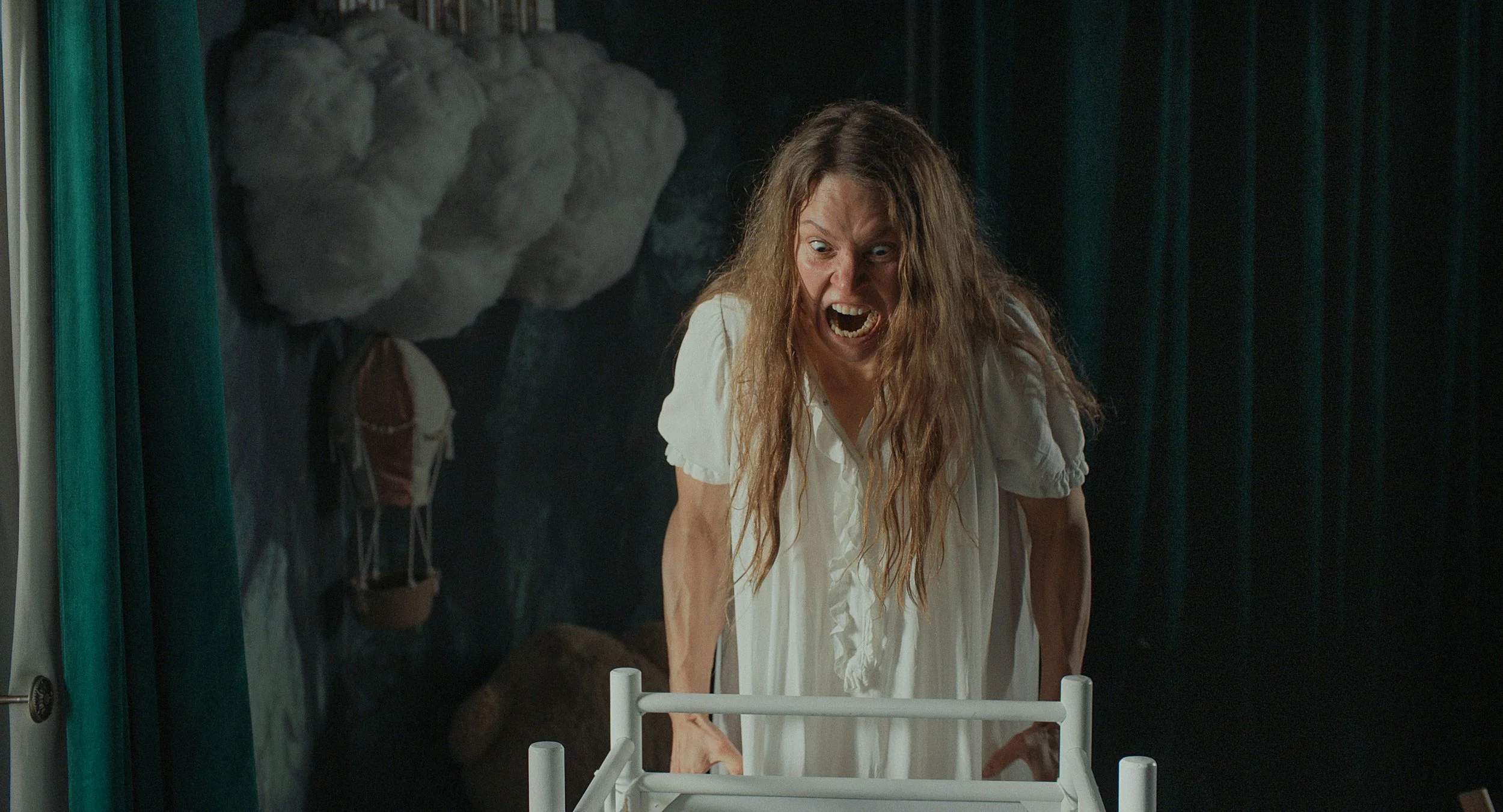
Seidi Haarla in Hanna Bergholm’s Nightborn. Courtesy of Pietari Peltola. An Independent Film Company Release.
After a traumatic labor, Saga wakes to the cries of her newborn son in his bassinet on the other side of the room. While most watching will likely pick up on baby Kuura’s negative reaction to sunlight—I couldn’t stop thinking about the pain it would have caused Saga to get up and gather her son herself. The irony of thinking about her struggles is further amplified by the cries and almost animalistic moans and later-described hairy body that are all chalked up as “normal” and that the couple has a perfectly healthy babe. After all, everyone insists that every baby and every pregnancy… is different. Before leaving the hospital, Saga is offered postpartum care, but refuses.
The days and weeks that follow are nothing short of torture for Saga. I winced at her moments in the bathroom, struggling to sit, changing pads soaked in blood. Breastfeeding is shown as a gory take on what otherwise would be cracked and bleeding nipples, or a result of biting, that some women will experience postpartum. If that isn’t enough, Jon’s insistent comments on what she could be doing better are enough to drive any new mom over the edge. In moments to herself, she runs through what would be normal conversations with her loved ones and what to say to her friends when she sees them, as if she’s already lost herself to this demanding lifestyle. Strong-willed and incredibly independent, she tries her best to put on the show that she is happy and thriving in motherhood. Of course, that couldn’t be further from the truth. But it doesn’t stop there. Bergholm’s attention to detail when it comes to motherhood is something I haven’t witnessed in other maternity horror films. Kuura has razor-sharp fingernails that clutch to Saga in bed, making her bleed. Saga’s clothes no longer fit, and her belly is ugly and transformed. At one point, Saga even gets a rash from being away from Kuura because she’s so anxious.
While most of the film shows real postpartum woes—some amplified for body horror elements and unease—Saga senses that something isn’t right with her son, which is where the lore ties in delicately, but in my opinion, just enough to keep the story interesting without placing an overcast on the maternal horrors. Kuura, or “It,” as Saga calls him, isn’t the healthy baby boy everyone is so set on convincing her of. When Saga shares these concerns, her support circle gaslights her into thinking that all her baby’s strange behaviors are in her head and that she’s not taking care of herself; that this is all likely postpartum depression. It’s one of the film’s most distinct callouts to the problem with women’s health: the utter dismissal and lack of conversation around what new mothers go through postpartum.
With time, Saga eventually figures out what “it” is and, to our surprise, as his mother, bonds with him. In rewatching the film, I actually found myself laughing at her ability to mimic sounds and grunts with Kuura, something parents do so naturally with their babies, only to be frowned upon later because of the challenges the couple has faced, seemingly alone. If I had to note anything negative about the movie, it would be that we don’t see a full flush of the folklore aspect play out. Bergholm deliberately keeps the clues minimal, but I didn’t mind doing the homework to put the pieces together afterward. Strangely, it was another nod to motherhood and figuring things out with just a few snippets of information—if any at all.
Nightborn debuts on Shudder on Friday, July 31, 2026.
Article written by Destiny King
Destiny writes about true crime and thrillers. She likes movies and stories that make you question the world around you, more so than what makes you jump.

Other Articles You May Enjoy…


The term “social horror” seeks to highlight and challenge real-life injustices and everyday violence. It moves away from the notion of the supernatural monster to emphasize the human being as the primary source of violence and cruelty against others.