
So, Happy ‘Together’?: A One-Year Retrospective on the Legal Battle over The Spice Girls
How a vinyl record, Plato’s Symposium, and the nightmare of IP law defined 2025’s most polarizing horror movie
How do you measure a year? By seasons? By your Spotify Wrapped? By litigation? I know a year is a long time, but do you remember that movie Together, the body horror starring Alison Brie and Dave Franco? It grossed $34.7 million globally, received a 91% “Certified Fresh” score on Rotten Tomatoes, and was lauded as a “triumph of original horror.”
Well, I bet you didn’t know (or, honestly, care) that the creators are currently locked in a multimillion-dollar federal plagiarism battle. The lawsuit, filed by indie production company StudioFest, alleges writer/director Michael Shanks, Brie, and Franco ripped off a 2023 indie film by Patrick Henry Phelan called Better Half, a comedy about a man and woman who wake up physically fused together after a one-night stand.

Phelan conceived the idea back in 2011, heavily inspired by Plato’s Symposium. For those who haven’t seen a middle school English room in years, Symposium is an ancient Greek text about various men debating love, including the idea that humans were once split in half to spend their lives searching for their missing counterpart. Hm … It’s a story about men defending their interpretation and depiction of love. Talk about life imitating art.
The legal claim? Together (allegedly) stole the premise: right down to the climactic needle drop of a vinyl of the Spice Girls’ “2 Become 1.” Using the same song over 30 years old (cries in millennial) is not the issue. The issue is using that particular song to highlight the absurdity of the couple’s fusion.
Additional alleged plagiarized plot elements include: a neurotic school teacher, a commitment-phobic artist, conjoined rodents, second-hand embarrassing public proposals, hiding the fusing of nether regions from a minor in a public bathroom, and severing with a chainsaw.
All apart from the genital joining, these details are individually benign; but to StudioFest, the combination of story beats was more than just a coincidence; it was a creative infringement. But how can you “own” an idea?
The unique case of Better Half and Together extends beyond movie reviews and filmmaking mechanics. This legal dispute highlights the black and white letter of copyright law, and the gray area representing the nuance of the independent artist.
The timeline of Together is messy. It overlaps in a way that oddly corroborates either case:
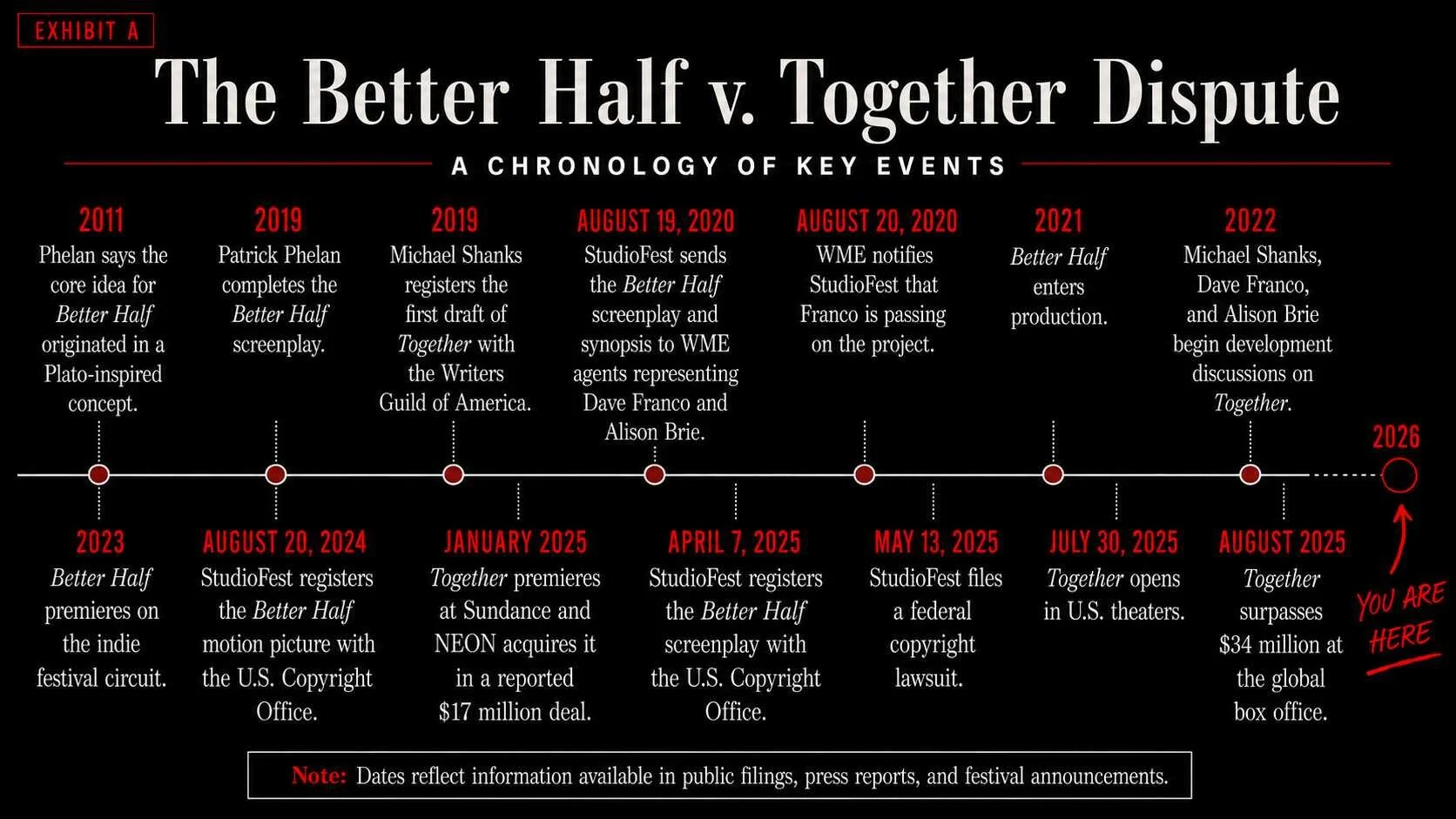
Figure 1. Timeline of the overlapping development and script registration dates for Better Half and Together, 2019–2025.
It’s easy to ask: “Why is this a discussion? Shanks registered his script, Together, in 2019; the other dude [Phelan] didn’t until 2025. That’s six years!” An objector would offer Phelan conceived the specific idea in 2011 and although the script was not registered, it was a completed film circling the festivals in 2023—two years before Together hit theaters.
The court of public opinion is, unfortunately, just that: an opinion.
A real court operates on copyright law, which consists of rigid standards that treat art as a commercial product rather than a personal expression. But to the independent artist, this theft feels like something much worse. Intellectual property expert Professor Jessica Silbey calls it a “personal trespass.” In her book, Against Progress, Silbey explains that when creators experience wrongful copying, they don’t view it simply as an infringement of copyright law, but as “...personal trespasses, professional injuries, and deceits that corrupt relationships and institutions…” (2022, 256).
Although devastating to the artist, the courts remain unemotional. Most times, these disputes are covered under “scènes à faire” which means generic tropes, stock ideas, or plot devices that inevitably or naturally occur within a specific genre do not belong to any individual. As many have said before: There are no new ideas.
The real kicker of this situation? We can’t find our Better Half. After its festival run in 2023, the film did not attract a distributor, condemning it to development limbo. Now, compounded with active litigation, it’ll be even longer before Better Half will see the light of day. Even then, it will not unregister Shanks’s 2019 screenplay, nor will it get a reparation from the $34 million box office. As one impervious Redditor observed: “Nobody in their right mind will believe that nonsense.”
For artists, I’ve got some good news, some bad news, and some tough love. First the bad news. The WME and NEON corporate machine won in the court of public opinion. Their box office and critical praise remain immutable and the discourse over the lawsuit remains skeptical at best.
The good news: The public records of this case serve as a play-by-play to protect one’s art, specifically screenplays. We can learn from StudioFest’s legal hurdles, which translate to protecting your idea at its inception. Before pitching it to agencies and studios, register it with the US Copyright Office. A $100 investment could prevent a much more expensive lawsuit, should you see your concept credited to another.
Finally, the tough love. To a creator, their projects are tantamount to their child. In her book, Eureka Myth, Professor Jessica Silbey writes, “The notion that creative or innovative output is like a child—it needs nourishment and protection and constant attention, and is perhaps inevitably spoiled—speaks directly to the tendency to overprotect the work with exaggerated legal claims including overbroad cease-and-desist letters” (2015, 157).
Protecting your art/“child” isn’t just not letting them out of the house, or hoping they’re treated with respect and won’t get kidnapped. It’s ensuring the law can protect you and your art by knowing it belongs to you.
Think about that project that is always “in progress,” or is never “ready yet!” What if you turned on your screen to see an advertisement for a product that looks an awful lot like the idea you’ve poured your heart and soul into for years? You would find yourself in a similar position as Patrick Henry Phelan.
Independent artistry is needed more than ever in the time of “requels.” Register your work. Finish your art. Remember what the Spice Girls said: “Set your spirit free, it’s the only way to be.”
All details and claims regarding the lawsuit and its milestones are based on public court records and are entirely alleged.
-
“Alison Brie and Dave Franco Face Copyright Suit Over $17 Million Sundance Hit ‘Together’: ‘A Blatant Rip-Off’.” 2025. Variety, 13 May 2025. https://variety.com/2025/film/news/alison-brie-dave-franco-together-copyright-lawsuit-wme-1236390539/.
Klein, Brennan. 2025. “New Horror Movie With 91% RT Score Hits First Major Box Office Milestone.” Screen Rant, 2 Aug 2025. https://screenrant.com/together-2025-movie-10-million-global-box-office-milestone/.
Miller, Daniel S. 2025. “Complaint for Copyright Infringement: StudioFest LLC v. William Morris Endeavor Entertainment, LLC, et al.” United States District Court, Central District of California, Western Division, 13 May 2025. https://deadline.com/wp-content/uploads/2025/05/Together-Lawsuit-Dave-Franco-Alison-Brie.pdf.
Plato. n.d. Symposium.
Silbey, Jessica. 2015. The Eureka Myth: Creators, Innovators, and Everyday Intellectual Property. Stanford, CA: Stanford University Press.
Silbey, Jessica. 2022. Against Progress: Intellectual Property and Fundamental Values in the Internet Age. Stanford, CA: Stanford University Press.
Spice Girls. 1996. “2 Become 1.” Spice. Virgin Records.
“Together.” 2025. Box Office Mojo. Accessed June 27, 2026. boxofficemojo.com.
ZombieLover01. 2025. “Nobody in Their Right Mind Will Believe That Nonsense.” Reddit comment, 12 June 2025. Comment on “Dave Franco, Alison Brie’s Together Lawyer Slams Plagiarism Suit: These Films Are Not Remotely Similar.” Accessed 17 July 2026. https://www.reddit.com/r/horror/comments/1l9w3kg/comment/mxfukw2/.
Article by Sam Hills
Sam Hills is a New England–based writer and critic drawn to the genre’s esoteric, overlooked, and underappreciated corners. Her work explores the intersection of art, technology, and commerce, specifically within horror. Now transitioning into data analytics, Sam brings the same curiosity to data that she brings to film: looking for the patterns, pressures, and human choices hiding beneath the surface.
Other Articles You May Enjoy…
![[Movie Review] Avalon Fast’s ‘CAMP’ is the Latest in the New Wave of Transgressive Filmmaking](https://images.squarespace-cdn.com/content/v1/5d3e481bc5a6e40001b215a8/1782401219629-WQRPE1S2P04BE4SNHMJ2/mPAUB3_Q.jpeg)
Petra finds a carnivorous plant and immediately starts thinking about medicine. I was mostly wondering how long it would take the thing to digest a person. Tatiana Schlote-Bonne builds What Feeds Below inside that gap. Her narrator is surrounded by organisms that eat, infect and rebuild human bodies, and she keeps wanting to get closer.