SMALL DARK WONDERS: “Holly’s House”
Monsters, Season 1, Episode 2
Air Date: 29 Oct. 1988
As a culture, we love horror stories: the abbreviated shudders endured by the light of Yuletide fire; the short yarns whispered over wavering flashlights; the brutal lives in minuscule enacted upon stage and screen. Yet, for all our ardent devotion, extended study and appreciation of these forms remains lacking. This column was created to give proper notice to the motion picture’s kith and kin: the television drama. Each installment, we’ll closely examine a stalwart story from the land of anthology horror. Why? Because as you’ll soon find out, they are all small, dark wonders unto themselves.
Tales from the Darkside
When Tales from the Darkside closed its doors in the summer of 1988, Laurel Productions was quick to rebound. The company had a brand-new series locked, loaded, and ready to air by Halloween of that same year. Although calling it “brand-new” is somewhat disingenuous, seeing as how the sister program was a very close relation indeed. It was another anthology delivering twenty-minute yarns of fantasy, science fiction, and horror, but the second program was a bit more direct about its selling points. It wasn’t called Monsters for nothing.
Broadly speaking, Laurel’s first show could be said to have been an earnest (but not joyless), homespun affair that made a real go at trying to become The Twilight Zone of syndicated television. Monsters, on the other hand, was a slicker package and pulpier by a country mile, delivering popcorn thrills on roughly the same shoestring budget as its predecessor, Dick Smith’s special makeup effects notwithstanding.
But just as there were times when Tales from the Darkside had its own dalliances with broad comedy and creature feature panache, so too did Monsters occasionally enter genuinely dark terrain. Places that, in the words of its predecessor, were not as brightly lit.
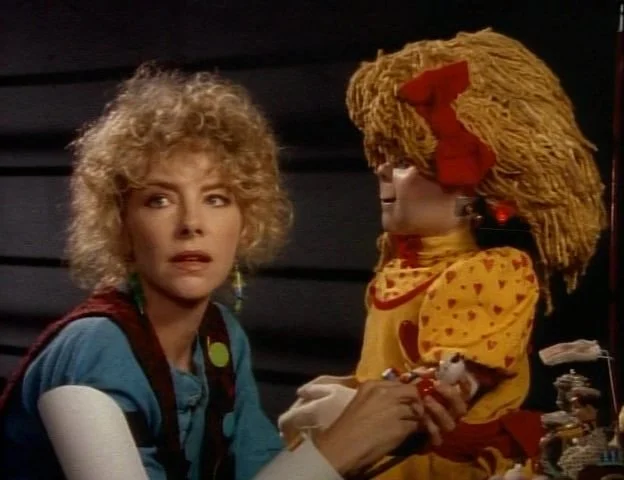
A drab studio where children’s dreams are manufactured on a threadbare set. This is the playhouse in which our drama unfolds. The house in question belongs, not to a suited man-child with an array of sentient furniture, but to Holly, a life-size robo-doll with none of M3gan’s gloss and all the cranking unease of a Chuck E. Cheese animatronic. Kathy (Marilyn Jones) is the actress piloting the little darling, Holly’s movements synced to the motion sensors that Kathy straps on for every episode.

(Although the design on Holly is clearly meant to echo the chubby-cheeked moppets from the Cabbage Patch and the Garbage Pail, one wonders if Jones’ appearance in this episode was intentionally modeled after Shari Lewis, the famed second fiddle to sock puppet Lamb Chop.)
We get the sense that this is Kathy’s show, her brainchild, her focus, her solace from the menacing threats of the real, adult world. Kathy is feeling those threats now more than ever. As she confesses to her paramour Lenny (Perry Lang), the actor who portrays Mike the Mailman on the show, she’s pregnant. In a twist on the stereotypical scene, it is Kathy who is squirming with indecision and worry. Lenny sees a future with a family beyond the dimly lit walls of the studio. Kathy has trouble seeing anything at all beyond them. The studio is home, and Holly is family.
Those already familiar with the genre will get a jump on where the story is headed from here. Hell, most fans will already have gleaned this at the first sight of Holly’s glimmering eyes. But anyone can bring a doll to life and let the uncanny valley do its work. What makes Holly in particular, and this story, so effective, so creepy, is why she’s coming to life. Why now? And for what purpose?
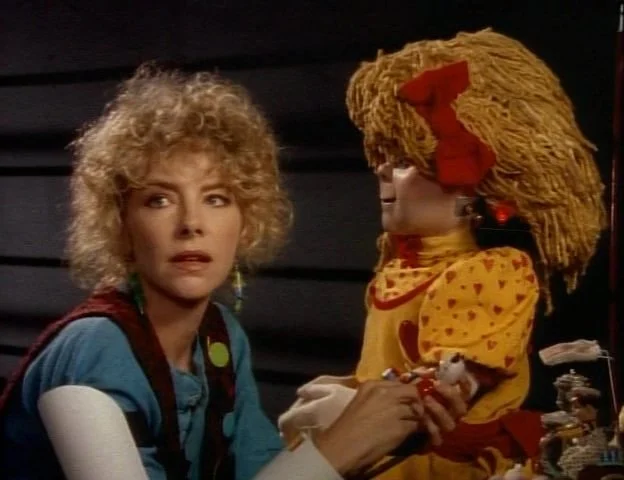
Image via IMDB
To the credit of screenwriters David Loucka, Jon Connolly and writer-director Theodore Gershuny, these questions and their answers never fully crawl forth from the shadows and into the spotlight. They play on our minds and worry our sleep in much the same way they do for Kathy. She’s pregnant with a child; but in a way, she’s already given birth to the perfect little girl. Parenthood is said to give purpose, but Kathy already has that, too. According to one of Holly’s increasingly frequent tantrums, Holly’s House is the top-rated children’s show on the air (if you can kindly suspend disbelief for a moment). A new baby doesn’t have any room in this picture. Because Holly says so.
When the doll begins to make her inevitable entreaties to Kathy, Gershuny and Co. let the implications hang where they may. Has Kathy poured so much of herself into her creation that Holly has developed a life of her own (a la Willy the Dummy from the great companion piece on The Twilight Zone)? Every time Holly whispers to and wheedles her mother, it’s always in the private quiet between takes. Or is it that Kathy is actively losing a sense of herself in real time, letting the Holly side of her personality step in and act as the ultimate answer to her prayers?
Thankfully, there is evidence for both interpretations. After Kathy attempts to reveal Holly’s insidious nature to a co-star, the robot heaves itself up from its table, glowering as the two walk away unaware. But later on, Holly has that aforementioned tantrum during a rehearsal. The robo-doll begins haranguing the show’s director (Neil Smith) and any target she can set her sights on. When the director addresses Kathy and tells her to stop, we never see Kathy in the same shot. The rest of the studio is cloaked in shadow. Is it really Kathy’s voice funneling through Holly’s mouth? Is she even still in her booth? But then, just as Holly’s rage reaches its zenith and she smashes a birthday cake to pieces on the set, we flash back to the booth and see that Kathy is doing the exact same thing.
Complications continue when a member of the show is attacked by Holly. It’s after hours, and Kathy has already stepped away from the set. There’s no indication she’s returned during the attack. But as Holly continues to show her proficiency with a pair of scissors—in a truly demented and inspired touch, she continues to mechanically stab her victim even after they twist her head around 180 degrees—we hear Kathy’s screams of “No! Stop!” overlaying the scene, only for her to then “return” to the set in the next moment, unaware of what has just happened. Supposedly.
For those expecting a slasher-esque denouement where we discover aha!, it was Kathy the whole time, they will quickly realize that Gershuny and Co. have their sights set on something higher. All this disorienting legwork has been done in service of achieving an effect with a more lasting impact than a trite twist.
It’s only by the final scene that we begin to understand that we have not been seeing this story from as distant a remove as we thought. It dawns on us that we have not just been with Kathy; we have been Kathy this whole time. Nothing has been what it has seemed. Or, rather, everything has been what it has seemed. Kathy’s disconnect and uncertainty are now ours to share.
Kathy’s final moments in her new residence throw everything that came before into doubt. Was there really a conflict of interest from the beginning at all? And exactly who, or what, is she cradling in her arms now? Whose voice is it that we hear speaking to us in lullaby tones? “Holly’s House” is a narrative achievement because it allows any of our possible answers to be met with a whispery “yes.”
For a series that promised Monsters and more than happily delivered on that promise with rubber and latex galore, we discover that the creature in this feature is not so easily discerned. Unless, of course, you’re willing to admit what can lurk in even the happiest of homes.
Article by Jose Cruz
Jose Cruz is an author and elementary school librarian. His journalism and short fiction have appeared in Rue Morgue, Dread Central, Nightmare Magazine, The Year's Best Hardcore Horror, and other venues. His writings on the intersections of librarianship, kidlit, and horror can be found on his Substack.

Other Articles You May Enjoy…
This column was created to give proper notice to the motion picture’s kith and kin: the television drama. Each installment, we’ll closely examine a stalwart story from the land of anthology horror. Why? Because as you’ll soon find out, they are all small, dark wonders unto themselves. This episode: Night Gallery’s “Pickman’s Model.”