
SMALL DARK WONDERS: “The Cheaters”
Thriller, Season 1, Episode 15
Air Date: 27 Dec. 1960
As a culture, we love horror stories: the abbreviated shudders endured by the light of Yuletide fire; the short yarns whispered over wavering flashlights; the brutal lives in minuscule enacted upon stage and screen. Yet, for all our ardent devotion, extended study and appreciation of these forms remains lacking. This column was created to give proper notice to the motion picture’s kith and kin: the television drama. Each installment, we’ll closely examine a stalwart story from the land of anthology horror. Why? Because as you’ll soon find out, they are all small, dark wonders unto themselves.
Per Thriller tradition, amiable host Boris Karloff acquaints us with the guest stars of this dark drama at the episode’s start. But what we do not immediately glean from this ominous intro is that “The Cheaters” is a story of encounters. The perplexed faces of the featured cast are as good a visual shorthand as any for the grim realization that will soon dawn on them and us. Namely, that they are all supporting players in the story of their own lives. The real star here is a pair of odd little spectacles with golden lenses.

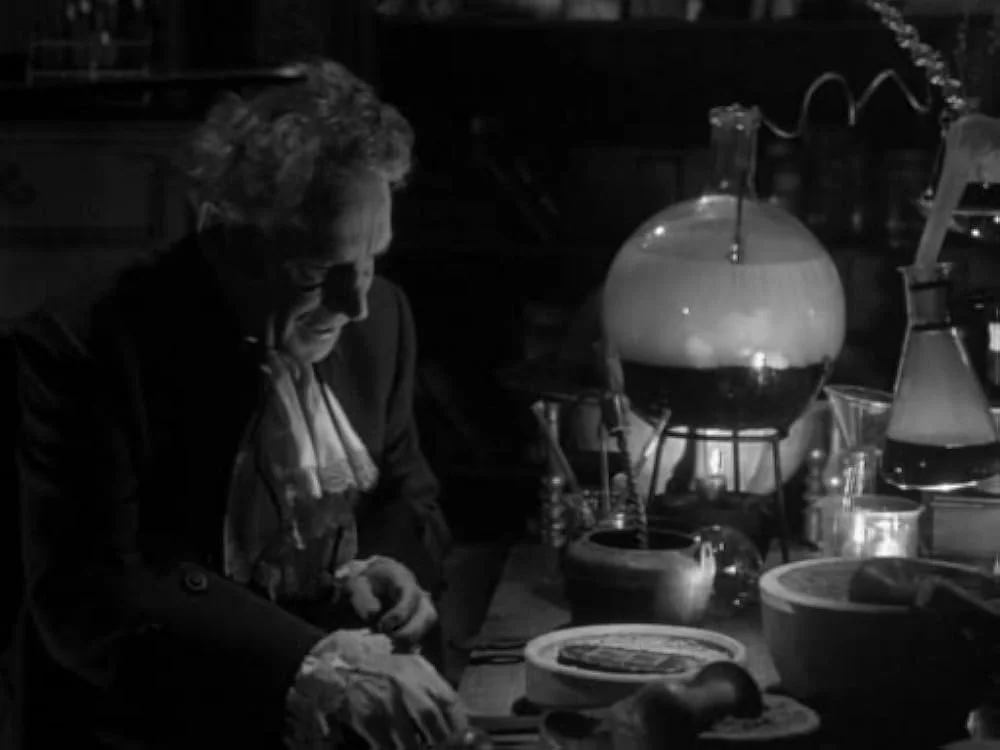
The spectacles are the invention of Dirk Van Prinn (Henry Daniell, looking like an infernal Keebler elf), a turn-of-the-century alchemist who discovers the means to create a kind of glass that enhances vision beyond any human ken. He has barely sported the glasses for a hot minute before the truth of who he really is drives him to the requisite death by hanging. (On a personal note, the strength of this eerie sequence is such that I have always assumed we see the strung-up corpse at the intro’s conclusion, but no such moment actually occurs. It’s either that, or it’s the brainrot talking.)
Image via IMDb.
From there the glasses are shuttered away for another half century before they fall into the hands of Joe Henshaw (Paul Newland), the owner of a second-hand shop. They don’t look like they’ll fetch much of a price, but they do satisfy a more personal need, allowing the aging wrecker the chance to see things a little more clearly. And that’s putting it mildly. Putting the cheaters on in the presence of others reveals their true nature and most hidden secrets to the wearer. Like the affair being entertained by Joe’s wife (Linda Watkins) and business partner (Ed Nelson). The same ugly reveal occurs to every subsequent owner. A wealthy matriarch (Mildred Dunnock) discovers that her friends and family are one murder plot away from earning her inheritance. Her social-climbing nephew (Jack Weston) finds out how fragile the masquerade he’s attempting really is.
When the cheaters end up in the hands of unpublished author Sebastian Grimm (Harry Townes), the cycle appears to be on the brink of destruction. But even with a little bit of research on his side, Grimm proves that the cycle is indeed just that. Whether the truth is being sought in the people around us or within ourselves, the result is ever the same.
These are the dominoes of fate that the glasses set in motion. They provide enlightenment, but only at the risk of isolation. Each wearer discovers that they are islands unto themselves, victims of a legion of plotters, and living in a world where trust is the greatest fantasy of all. If you come to this story looking for heroes, role models, or generally likable people, you are best to apply elsewhere. Those who fall prey to the cheaters meet tragic ends but are hardly sympathetic themselves. Their sins range from the mild (shoplifting) to the downright evil (see: murder plot).
In these instances, the cheaters reveal the thoughts of the people around them; Grimm later dismisses this usage as incorrect and lauds their original intent to reveal the truth of oneself directly to the wearer. But, when you get right down to it, reading the minds of the people around them is simply an indirect means of achieving the same effect.
Joe, Miriam Olcott, and her dear nephew Edward inevitably hear what their families and colleagues really think of them. Their noses are shoved into their own foibles and weaknesses via harsh underlighting and whispery condemnations. Whereas Van Prinn and Grimm gaze into literal mirrors to discern the secrets of their own souls, the three other characters consult the social mirrors that exist within their homes. None of the parties involved cares very much for the reflections that stare back at them.
In adapting Robert Bloch’s story for the small screen, Donald S. Sanford thankfully retains the author’s usage of multiple character perspectives throughout the episode. If the compulsion was felt to home in on any one narrative thread and “flesh out” that portion of Bloch’s tale to Thriller’s 60-minute runtime, it was blessedly suppressed. It further enhances the claustrophobic sensation of existential dread inherent in Bloch’s fiction.
Each wearer of the cheaters is a pin to be knocked down, their grasping, savage little lives capped by violent deaths. It’s as if the famous line from A Few Good Men had a supernatural keenness to it. They can’t handle the truth. It drives them mad, drives them to blood and fire and shadows and screams. But just as the horrifying outcomes were inevitable, so too was the desire to get there. They fucked around, and now they’re finding out.
There are other lauded episodes from Thriller’s tenure, ones that pit their characters against the big bads of the supernatural world. Perhaps it’s a living painting of the Grim Reaper. Or an immortal mad scientist. Maybe a flock of some seriously pissed pigeons. “The Cheaters” would appear to be another branch of that lineage, but the eponymous object is just a medium through which the real monsters can be glimpsed. The cheaters see us stumbling through the mess of shadows that our lives have become and then hand us a light. The truth is in there, it tells us. And it’s a helluva fright to see.
Article by Jose Cruz
Jose Cruz is an author and elementary school librarian. His journalism and short fiction have appeared in Rue Morgue, Dread Central, Nightmare Magazine, The Year's Best Hardcore Horror, and other venues. His writings on the intersections of librarianship, kidlit, and horror can be found on his Substack.

Other Articles You May Enjoy…
This column was created to give proper notice to the motion picture’s kith and kin: the television drama. Each installment, we’ll closely examine a stalwart story from the land of anthology horror. Why? Because as you’ll soon find out, they are all small, dark wonders unto themselves. This episode: Night Gallery’s “Pickman’s Model.”