
SMALL DARK WONDERS: “The Man in the Suitcase”
Creepshow, Season 1, Episode 3.2
Air Date: 10 Oct. 2019
As a culture, we love horror stories: the abbreviated shudders endured by the light of Yuletide fire; the short yarns whispered over wavering flashlights; the brutal lives in minuscule enacted upon stage and screen. Yet, for all our ardent devotion, extended study and appreciation of these forms remains lacking. This column was created to give proper notice to the motion picture’s kith and kin: the television drama. Each installment, we’ll closely examine a stalwart story from the land of anthology horror. Why? Because as you’ll soon find out, they are all small, dark wonders unto themselves.
Creepshow
One of the most delightful aspects of anthology horror is its variety. It’s like the figurative box of chocolates—you never know what you’re going to get (or what’s going to get you). Perhaps this, more than anything else, is what has drawn me back into its fold time and again over the course of my brief life. I come to it looking for diversity, freshness, and, if at all possible, maybe even a surprise.
It doesn’t always work out that way.
Depending on your mileage, this may not count as a point against horror anthologies. If, like me, you’re an irrepressible die-hard willing to forgive (most) missteps, you will find that even the most humdrum entry will still offer a kindling of warmth, a brief repast, just enough comfort to fuel the journey from here to the next story (and the next, and the next). But then again, sometimes one will come along and surprise you. A surprise like “The Man in the Suitcase.”

I have always been very clear regarding my adoration of the original Creepshow (1982). As a rule, it’s the go-to film I refer to anytime someone presses me with that dread-inducing question, “What’s your favorite horror movie?” Beyond a mere statement of preference, Creepshow is a handy metric to explain my vibe when it comes to all this stuff: I am Creepshow, and Creepshow is me. So, when news broke around 2018 that it would be receiving the television treatment with none other than fellow uber-fan Greg Nicotero at the helm, it’s safe to say I rejoiced.
From this distance, we can appreciate now what a tough road the show had. It tried to do a lot with precious few resources. (A point in its favor, if you ask me, one that puts it solidly in the lineage of Tales from the Darkside and Monsters, those two other offshoots of the seed sown by the original Creepshow.) Its production and release suffered from some inconsistency, and fans seemed a bit divided on the results whilst remaining enthusiastic over its existence. (As far as anthologies go, that’s pretty par for the course.)
And what about those stories? Well, they were all certainly enthusiastic. In true Creepshow fashion, you could feel the love beating like a heart underneath the floorboards the entire time. But as far as surprises go, there wasn’t necessarily a treasure trove. The episodes from the first season, derived from both original stories and teleplays adapted from short fiction, tended to stick to comfortable favorites or amusing combinations thereof. Nazis versus werewolves? You got it. Lake monsters punishing wicked stepfathers? Sure thing. A miracle weight loss treatment that turns out to be the work of parasites? Oh, this again?
So, when something like “The Man in the Suitcase” showed up in this neighborhood, it made you sit up a little straighter.
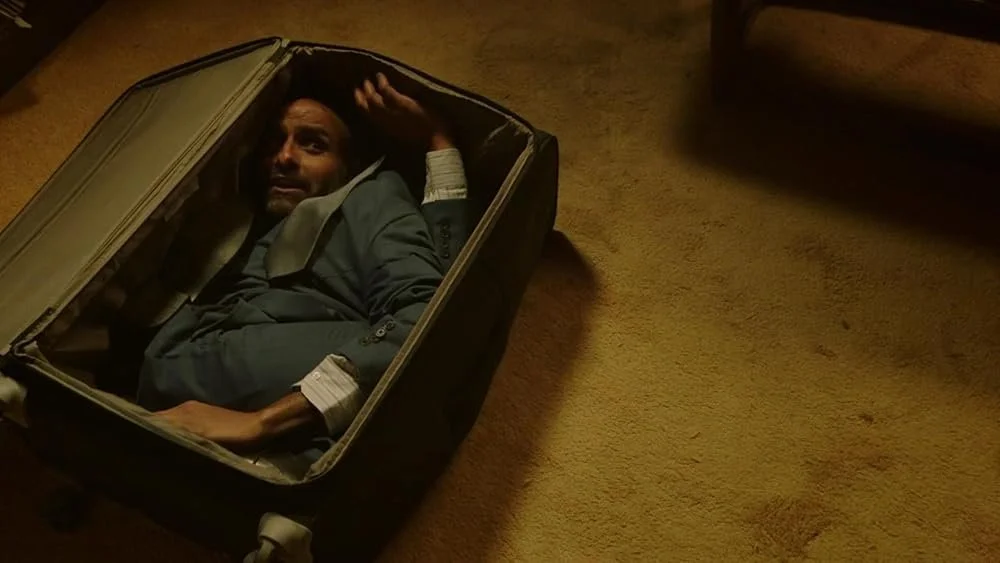
Image via IMDb.
Screenwriter Christopher Buehlman (Between Two Fires) employs and maintains a trick for the duration of this story that scarcely happens in anthology land: He keeps you completely uncertain as to what will happen next. When we open on stoner college student Justin (Will Kindrachuk) texting about his recent breakup and seemingly losing his baggage at the airport, we already feel like we’re in uncharted terrain. The sudden reappearance of the suitcase and Justin’s unawareness that his original baggage lies decimated on the conveyor only heighten the intrigue and strangeness of the situation. It isn’t much longer before we discover the title of this piece is no cutesy metaphor—Justin’s (new) suitcase comes equipped with a man (Ravi Naidu) stuffed inside and twisted seemingly beyond saving.
Already our antennae are pinging with questions. And questions are gold in the world of narrative entertainment. Questions mean that your audience is not yet hep to what you’re trying to pull. Questions mean that they will keep playing along until they are. It’s a fresh conceit that one can safely say they have never encountered before, and surely not told with the same flair for comedy and unease that Buehlman employs seemingly at will.
Another distinguishing feature of “The Man in the Suitcase” that its bedfellows cannot claim to have is its patient hand at developing character. Since Creepshow paid homage to the EC Comics of the 1950s, it carried over those magazines’ penchant for setting up a clearly defined villain, all the better to relish their ultimate downfall. This had a trickle-down effect on the episodes of the television show, so that some stories saw fit to costume their “protagonists” in gaudy shades of nastiness just to make sure that God couldn’t miss when he hurled his bowling ball at them. Not so with “The Man in the Suitcase” or, at any rate, not right away, which is already a vast improvement on the formula.
Once Justin discovers that any amount of pain inflicted upon the man results in the pitiful creature coughing up genuine gold coins from the late Ottoman Empire, his shifting morality is set in motion. It becomes even more exacerbated when he involves his opportunistic roommate Alex (Ian Gregg) and eager ex-girlfriend Carla (Madison Bailey) in the ordeal. To their credit, it’s really hard to say no to a literal money-making machine, especially one that produces so prodigiously when given the right forms of painful persuasion.
Buehlman draws these characters with a caricaturist’s steady hand. Not every single detail is there (nor should it be), but with the short amount of time granted to the story Buehlman shows us the few, precise details we need in order to fully enter the narrative. We know these people and what their deals are, and when things take a turn for more heightened forms of transgression, it makes sense and acts as a natural progression of the events that came before. There are no bowling pins being set up here. We have been watching the steady decline of these characters’ humanity (and their righteous self-reckonings) the whole time.
If “The Man in the Suitcase” surprises at the outset, it certainly manages the neat hat-trick of performing the same feat at the story’s climax. To say more would be to spoil it, and some pleasures are meant to be lived rather than examined. Suffice to say that it is, in this writer’s estimation, a truly delightful turn of events, from discovering the true nature of the central conflict to observing the ultimate fates of everyone involved. Even if one does not feel particularly warm towards this episode, there is one fact that remains irrefutable: You’ll probably never see anything quite like it again. And that just may be the surprise you were looking for.
Article by Jose Cruz
Jose Cruz is an author and elementary school librarian. His journalism and short fiction have appeared in Rue Morgue, Dread Central, Nightmare Magazine, The Year's Best Hardcore Horror, and other venues. His writings on the intersections of librarianship, kidlit, and horror can be found on his Substack.

Other Articles You May Enjoy…
This column was created to give proper notice to the motion picture’s kith and kin: the television drama. Each installment, we’ll closely examine a stalwart story from the land of anthology horror. Why? Because as you’ll soon find out, they are all small, dark wonders unto themselves. This episode: Night Gallery’s “Pickman’s Model.”