Review: The Villa and the Vortex: Supernatural Stories, 1916-1924
The Villa and the Vortex: Supernatural Stories, 1916-1924, by Elinor Mordaunt and edited by author and lecturer Melissa Edmundson, the latest book from Handheld Press, both beautifully continues the Press’s mission to bring forgotten weird fiction back to life, and makes for a wonderfully spooky read just in time for the Halloween season.
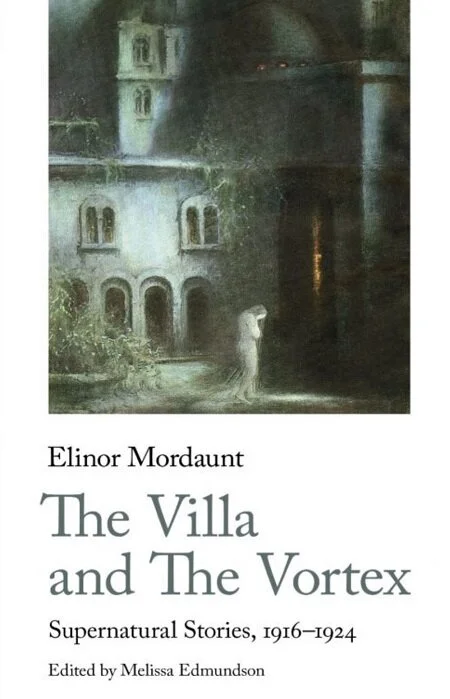
Mordaunt, who once contributed to the supernatural/weird literary traditions for nearly a quarter of a century, had been compared to H.G. Wells and Algernon Blackwood, and her work reviewed by Virginia Woolf herself. As an author and thinker, Mordaunt demonstrates a clear, compassionate grasp of human frailties and foibles, but also has a strong sense of what redeems us. Many of these stories—which range from a folk horror tale of a clergyman’s wife to a tale of a devastating storm of creative obsession that consumes all within its limits—detail very relatable fears, but with a compassionate, genre-blending skill that makes hauntings feel all the more evocative. Edmundson, a Lecturer in British Literature at Clemson University, paints a beautiful, vibrant portrait of Mordaunt, who traveled the world and survived both World War I and the Spanish flu, navigating difficult marriages and personal demons.
Comprised of nine of Mordaunt’s supernatural stories, The Villa and the Vortex begins with the story “The Weakening Point” (1916), the tale of a young man with all the wealth and privilege of his class before him, but he struggles with a hellish nightmare that occurs every birthday—an ongoing trauma that is gradually eating him alive. “The Country-side” (1917) is a personal favorite, as the protagonist, the wife of a rector, is summoned along with her husband to live in the countryside, where her husband thrives, but she struggles with loneliness. Things take a turn for the witchy, and with a folk horror approach, “The Country-side” delivers an incredibly impactful ending. “The Vortex” (1919) explores the life of a man who is continuously haunted by losses: struggling to make the great leap in his career and never finding the love he wanted. But due to a traumatic event, he authors a play that sweeps up the actors and writer himself into a tragedy that cannot be stopped. “Hodge” (1921) features a character that, as a being from prehistoric times, is not so much out of place, but out of time, drawing a much longer arc for the idea of what a haunting can be.
Among the rest of the collection, Mordaunt’s work takes a turn for science fiction, playing out the familiar tale of a scientist who looks to push the boundaries of knowledge while also falling prey to his own pride. Other stories also meditate on our connection to certain places, generational hauntings, and what happens when they backfire, making for a robust, well-rounded collection for horror enthusiasts to enjoy.
The Villa and the Vortex is a must-read for those who find themselves drawn to older weird fiction, and for those with a fondness for older supernatural and ghost stories. Though some of these stories tread familiar thematic ground in these genres, Mordaunt’s dedication to her craft, along with Edmundson’s thoughtful selections, showcase an author that should be as celebrated and highly read as any of the turn-of-the-century literary titans.
I received a copy of The Villa and the Vortex in exchange for an honest review.
Review written by Laura Kemmerer
Laura tuned into horror with an interest in what these movies and books can tell us about ourselves and what societies fear. She is most interested in horror focused around the supernatural, folklore, the occult, Gothic themes, haunted media, landscape as a character, and hauntology (focusing on lost or broken futures).


Filmmaker Bari Kang discusses Itch!, from its practical gore and zombie influences to filming in his own NYC store and directing his daughter.