
Cursed for Centuries: Reviewing the ‘Fear Street’ Trilogy
Recently, I binge-watched Netflix’s latest installation of teen horror, the Fear Street trilogy. Based on the books by American novelist R.L. Stine, the films take place over the course of three centuries, and center around a supernatural premise just interesting enough to make any age audience curious about what will happen next. While some have criticized that the collection should have been spread out over the course of a season, I feel that its combined six-hour runtime was most successful. Would I have felt differently having watched the movies as they were released (over the course of three consecutive Fridays)? Probably not. In trying to stay positive in this everlasting pandemic, a new binge-worthy collection of films felt just right.
Not only that, but given the beginning of the spooky holiday, I’ve been interested in only viewing horror classics, timeless tales, and engaging in all that is fall. I’m not sure it’s all my fault, though. Everywhere I go there are Halloween decorations and soon enough, television stations will be promoting all-day Halloween-themed movie marathons. (Can’t wait to watch Hocus Pocus at least five times.)
Okay, but seriously. I mention this all to only further my point in backing up director Leigh Janiak’s decision to film the collection as a trio of films versus what might have been a not-so-fast-paced, or exciting season(s). I say this mostly because Part One: 1994 starts off so strong and reminded me of a modern blend of '80s slashers and—partially due to its cast and setting—the streaming platform’s successful Stranger Things series. In opening up the series, we witness a slaughter take place in the Shadyside Mall, which includes the death of our very first character, Heather (Maya Hawke). After she’s killed by a presumed love interest, the local police chalk up the incident as another town resident who happened to “snap.”
However, the issue with this, besides some lazy police work, is that the “person just snapped” story has been occurring in Shadyside over and over for as long as town conspiracy theorists can remember. As old town rivalries go, Shadyside was always bad, possibly cursed and filled with troubled youth, while neighboring Sunnyvale was rich and pure. The few who believe that the killings weren’t just by some freaky coincidence seem to think that the murderers were actually possessed by 17th-century witch Sarah Fier, who cursed Shadyside centuries ago.
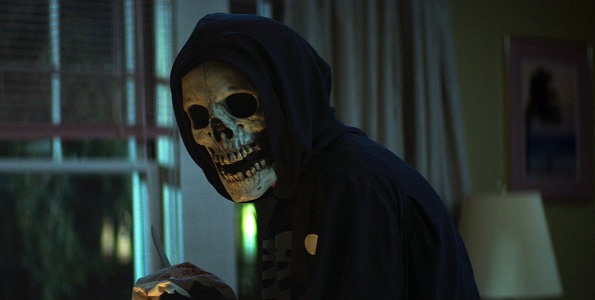
As the film balances all the action, viewers are introduced to the trilogy’s heroine, Deena (Kiana Madeira). While trying to get over a breakup with her girlfriend Sam (Olivia Scott Welsh), Deena is ultimately pulled back to her after a slew of zombies seems to have Sam in their sights. Joined by little brother Josh (Benjamin Flores Jr.) and friends Kate (Julia Rehwald) and Simon (Fred Hechinger), the crew vows to protect Sam and fight off whatever monsters or mayhem may follow them.
As the events that unfold take us through a whirlwind of nostalgia and gore, the screenplay and acting provide an abundance of playful genre tropes, making for a thoroughly enjoyable experience. Janiak’s strengths both in filming and as a co-writer only continue into Part Two: 1978, where '90s artifacts are swapped for a cliche, but appreciated Camp Nightwing setting. Decked out in late '70s and early '80s attire, the second installation recreates much of what the slasher genre first felt like in the very beginning of 1994.
Slasher vibes abound, but where will our killer appear in this story? While the installation has a much slower start than the previous film, I was equally as eager to see that the film focused on another misfit-like character, Ziggy (Sadie Sink), and her older sister and camp counselor Cindy (Emily Rudd). It should come as no surprise that although much of the gore is reserved for later in the film, that it just so happens to be another Shadysider gone mad.
Later, through confessed stories by neighbors and members of both the community and liberal-arts academia, Catherine discovers what really occurred in the home, and who was damned to protect women like her who also ended up there. You see, the house, though haunted by former residents and murdered female spouses, grows stronger with every soul gained to protect its abused inhabitants. However, the structure itself, a vessel for tragedy and death, condemns the ones still living within its walls to similar traumatic outcomes. Like a double-edged sword, the spirits push to help and protect Catherine in this round of tragic love stories, but they cannot stop what was already meant to happen—the endless cycle that the house has become home to failed marriages and death.
In the trilogy’s final installation, we are taken back centuries, long before the rivalries of Shadyside and Sunnyvale. It is in this early settlement that we are finally told the story of Sarah Fier—the true story. What was particularly fun about this film was the recycling of its cast from 1994 and 1978. Much like what fans of American Horror Story or The Haunting series have witnessed, Janiak also pulled off rather successfully. Although we don’t get nearly as much of the cherished nostalgia as seen in prior installations (and I mean, how could we?), I thoroughly enjoyed the change-up and the twist that really seemed to light a new fire for the trilogy’s end.
So, whether you’re in the mood for something new or a Halloween classic, I think that this collection of films manages to hit every mark! They were such an absolute joy to watch in kicking off the season, and while I hope to see more collections like it, I feel that directors will have a high benchmark to meet or beat.
Article written by Destiny Johnson
Destiny writes about true crime and thrillers. She likes movies and stories that make you question the world around you, more so than what makes you jump.


In The Buffalo Hunter Hunter, blood carries the violence of colonialism, while a settler’s journal controls whose story survives. This essay examines how Stephen Graham Jones uses vampirism and layered testimony to confront historical erasure.