
Things Heard & Seen: The Afterlife of Failed Marriages
In watching one of Netflix’s latest horror movies, Things Heard & Seen (2021), I was under the impression from its talented cast and directors Shari Springer Bernman and Robert Pulcini—both known for their work on the 2007 film The Nanny Diaries—that the film might bring something new to the Gothic horror realm, along with a love of picturesque haunted houses. Although this wasn’t entirely untrue, the movie seemed to be less about ghosts and more about a series of failed marriages and undoubtedly, murderous, psychopathic husbands.
Now, one could be reading this and instantly making comparisons to other, similar films, such as Stuart Rosenberg’s The Amityville Horror (1979) or maybe even Mary Harron’s American Psycho (2000). And honestly, you wouldn’t be too far off. Things is more of a mixture of the two. While the house itself doesn’t make the husband George Clare (James Norton) go mad with murderous intentions, the fear of losing his status among fellow academics and the small-town community pushes his limitations concerning morality.
Based on Elizabeth Brundage’s 2016 novel, All Things Cease to Appear, Things Heard & Seen focuses on the Clare family, composed of George, Catherine (Amanda Seyfried), and their daughter, Franny (Ana Sophia Heger). Prior to moving to the small town of Chosen in upstate New York, where George recently accepted a full-time position at a private university, the Clares lived in New York City, where George had been attending school and where Catherine worked as a successful art restorer. While the two don’t seem to be your typical lovebirds—George secretly longs to be successful like his deceased cousin (going as far as to read his private diary and proclaim his left-behind work as his own) while Catherine suffers from an eating disorder that nearly everyone already suspects (only George knows the truth)—they’ve only pushed to keep their commitments to one another with the birth of Franny. Unsure if they really loved one another and were unmoved to change, it would seem as though they instead, rushed into this life simply because it was the thing to do in the late '70s and '80s.
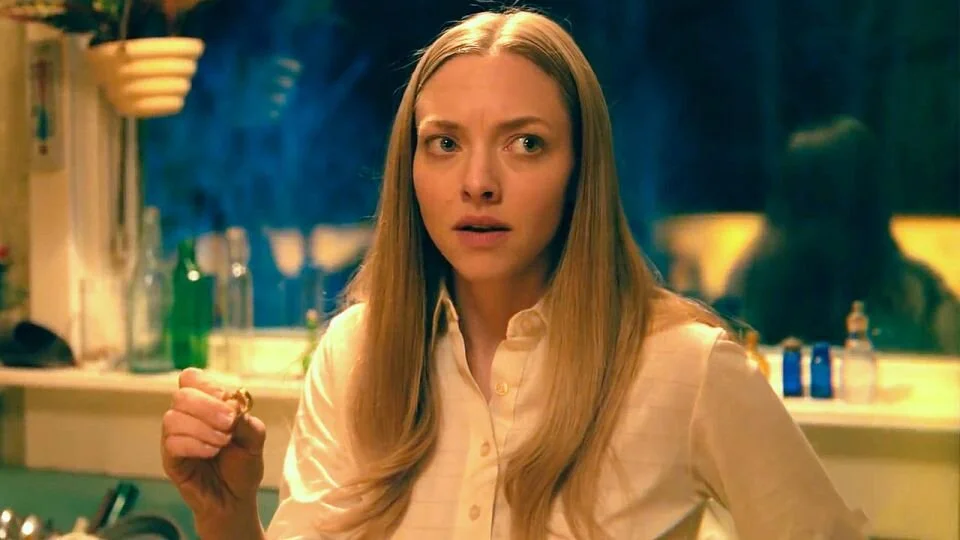
Those same commitments were only further tested as the family changed their pace from the bustling city to a quiet farmhouse lifestyle. To make their move for George’s new position, Catherine quits her own job on his behalf—as a means to make sacrifices for her husband (as we are told, but not shown that he’s made sacrifices for her in the past)—to become a stay-at-home mom. For those of us who were either stuck at home throughout the COVID-19 pandemic or were house-hunting during a time when interest rates plummeted, the transition portion of the plot seemed almost relevant in that, if you were to end up in a haunted home, it was simply what you were stuck with, and even stuck in it. Except, of course, for the Clare family’s lack of access to technology, further heightening the sense of isolation and need for human interaction, especially from Catherine’s newly adopted, lonesome lifestyle of staying at home in a small town while her husband works away, leaving her no space or opportunity to make friends or become involved in the community.
Before Catherine witnesses the ghost(s) in their home, or sees her daughter’s lights flicker, and even before the smell of gas lingers unexpectedly in the master bedroom, I feel as though Catherine has already become a ghost of herself. As dissociated as she is from her own life, besides her relationship with her daughter, Catherine doesn’t even bat an eye when she catches her husband cheating on her in their own home, nor does she seem to care about the helpful neighbors, and certainly not food or protein shakes. While the behavior could be attributed to her lack of nutrition or degrading husband, her additional tendencies toward self-inflicted isolation lead me to believe that when these secret residents begin to make themselves known, she’s already invited them.
Maybe it's the loneliness or the intuitive research Catherine conducts, but she begins to believe that the ghosts in her home are not evil spirits, but ones who yearn to help her with increasing instances where her husband grows more cynical or gaslights her. It is in these very moments that the ghost(s) seems to serve as some distraction from the situation, to derail an otherwise inevitable fate.
Later, through confessed stories by neighbors and members of both the community and liberal-arts academia, Catherine discovers what really occurred in the home, and who was damned to protect women like her who also ended up there. You see, the house, though haunted by former residents and murdered female spouses, grows stronger with every soul gained to protect its abused inhabitants. However, the structure itself, a vessel for tragedy and death, condemns the ones still living within its walls to similar traumatic outcomes. Like a double-edged sword, the spirits push to help and protect Catherine in this round of tragic love stories, but they cannot stop what was already meant to happen—the endless cycle that the house has become home to: failed marriages and death.
While there could be more to see and hear in this telling of the novel, I did appreciate the use of landscapes, as well as the heavily referenced Heaven and Hell by Emanuel Swendenborg. In short, the book (which was published in 1758) provides a detailed description of the afterlife and is used as an aid to both further connect Catherine to a prestigious member of George’s circle, as well as making the connection with those she can’t see in her own home. You see, it is in the book’s cover art that bridges these two visuals for me. In it, we are told the painting is that of a body transforming into a soul. Surrounded by what appears to be rock formations in darkness, only highlighted by a bright, beaming cross, we are presented with a unique landscape.
These landscapes work as a kind of constant echo, taking us back to the thought of our “life’s journey,” as a means of both where we have been and where we are going. I’ll admit, the last several minutes of this movie seemed rather pointless, but I feel as though I could see where the directors wanted to make this full-circle connection—between life, death, art, and tragic cycles both associated with the living Clares and the murderous stories of the deceased. Do we dare ask the question if our lives are indeed fated? Or if Heaven or Hell really exist? If there is one, and the belief of fate is true, this film fully embodied that notion. From ghosts, to literature and even real-life landscapes, we are shown what kinds of hell one might endure in a failed marriage and what glimpses of heaven look like in those same instances.
Article written by Destiny Johnson
Destiny writes about true crime and thrillers. She likes movies and stories that make you question the world around you, more so than what makes you jump.


Filmmaker Bari Kang discusses Itch!, from its practical gore and zombie influences to filming in his own NYC store and directing his daughter.