
bunnydeath: Jiibayaabooz and the De-christing of Indigenous Horror Amidst Fascist Hellscapes in ‘Reanimal’
What happens when a simple metaphor of innocence becomes corrupted?
Reanimal, Tarsier Studios’ latest near-wordless video game, shows players a hellscape steeped in fascism where five children journey into the maws of death. On the surface, it is about a boy finding his beloved sibling amongst the wreckage and reuniting them with friends. Yet, nothing is what it appears as these masked travelers traverse realms of watery nightmares. Instead of meeting animals along the way that might help the children navigate this lurid terrain, they are instead faced with monstrous, mutated, and utterly death-defying animals that appear within the ecosystem of this nightmare world.
With Tarsier Studios’ games, the complaint I often see about this game is that the dialogue is “too sparse” and things can feel open-ended where there should be closure. While the other games designed by Tarsier never shied away from horror and ambiguity with their child protagonists, noteworthy reviews still laud it as a piece to which one should “prepare to be confused” rather than to meditate upon (Harrold). However, as with many artistic conversations, the important things are not spelled out in trite dialogue but in the rhetoric of what we see—or rather, how we see it—and most importantly, how we feel about it.
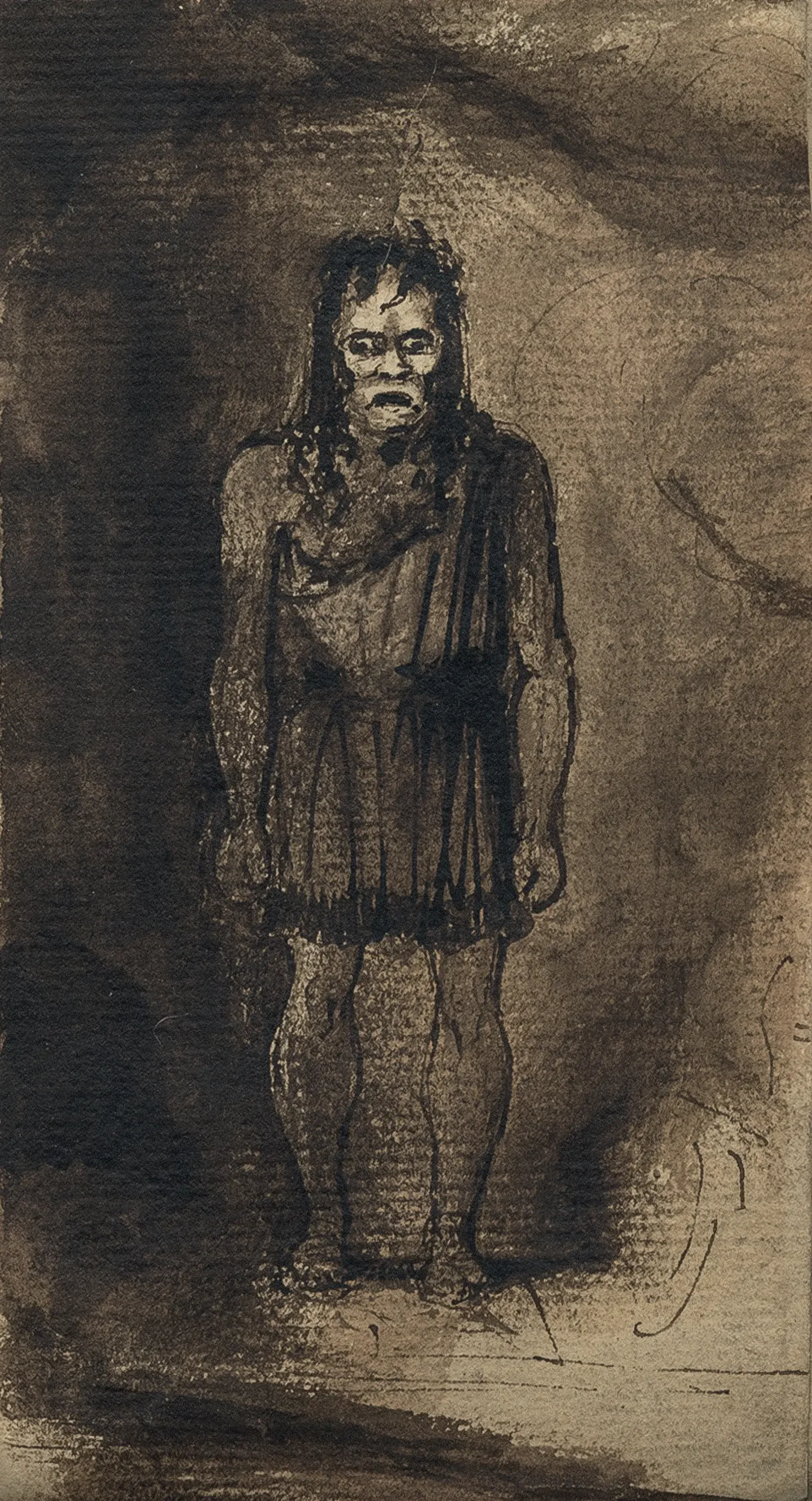
During the game, a rural landscape is littered with the following (but not limited to): bombed-out orphanages, train stations, and glowing cherry red cinemas rife with terrifying soldiers, and hair-raising creatures such as the bloated corpses of “Swimmers” and “the Sniffer” which tries on human skins and hunts the remaining children down (Rahman).
The standout element of this horror is undoubtedly the wide-scale and warped use of animals and animism to tell the narrative. Rather than try to guess at pieces, I will examine the subversive usage of the lamb in Reanimal as a “de-christing” of Indigenous horror, and instead use Indigenous beliefs and Indigenous horror to deconstruct the narrative.
On first play, it would be easy to look at the giant lamb as a way to subvert and revert Christianity in this text. So, let us do just that! Through the “opulent” fog filled with leviathan horses, pigs, spiders, whales, and other Odyssey-like creatures, the lamb is a symbol that is returned to again and again. Across the various landscapes, The Girl “vomits up a lamb that grows into a monstrously large, insatiable people-eater” (Byrd) and is then swallowed by it along with her companions.
Lambs in Christianity represent Christ; the “unblemished” lamb, the perfect sacrifice, and the innocence that wipes away all other sin. This is the knowable, dolefully willing sacrifice that believes its own death will save others and is necessary to some greater survival.
Why then does the game end, not with a perfect rebirth, but with more uncertainty?
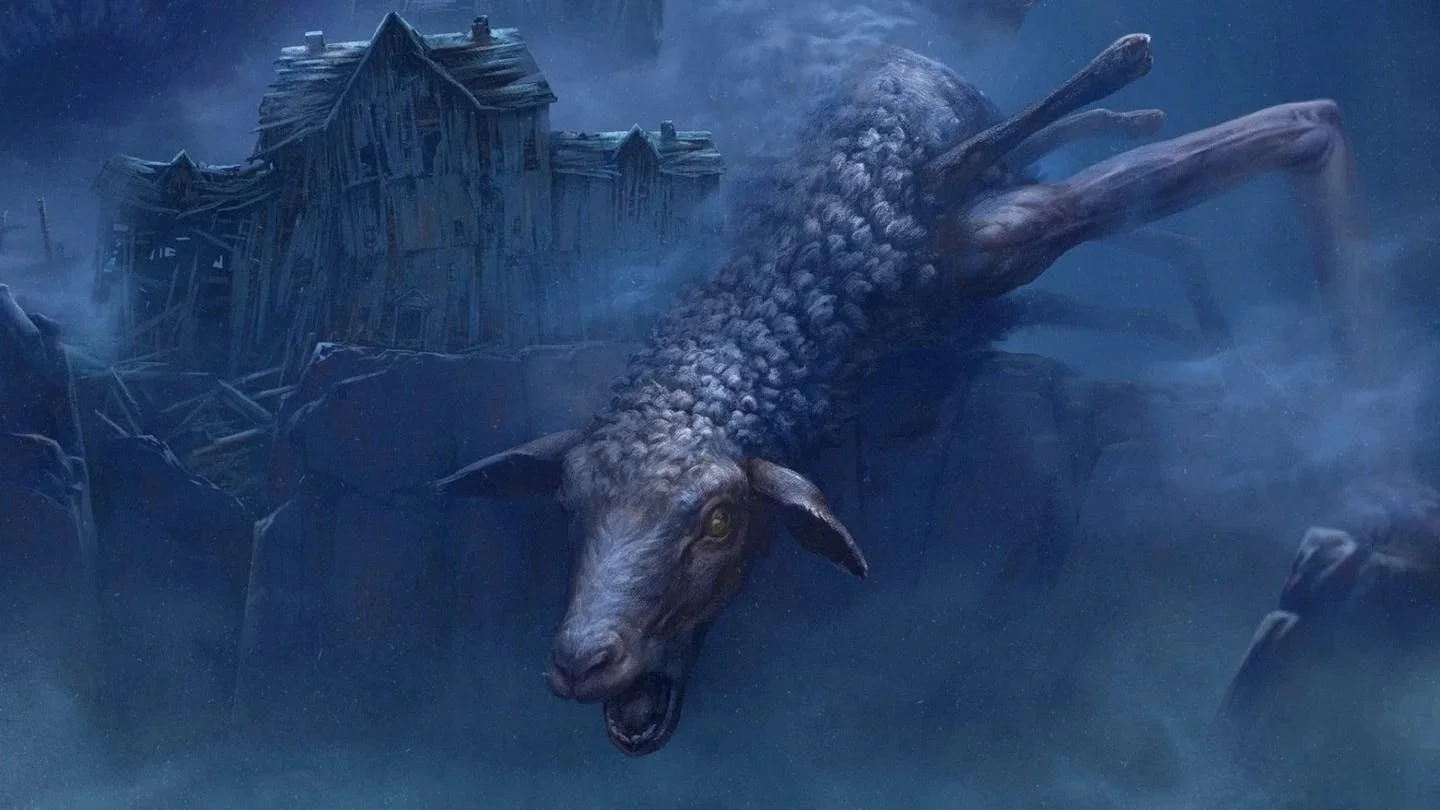
Reanimal cover image, Tarsier Studios.
Towards the end of the game, a giant lamb swallows the children whole in the style of Jonah and The Whale, or even Moby-Dick. Inside the lamb, there is an entire ecosystem of dread that is far worse than the landscapes they were previously in—this time, with no way to get out. The children agree to sacrifice The Girl in hopes of (possibly, as this is never made completely clear) getting out. Before they can, a group of lambs inside the giant lamb sacrifice all of them instead. The beginning of the game is harkened back to, doubled, but changed: It is not just one character looking up from the ominous, dreadful well, but it has now come full circle; all the characters are looking up with The Girl’s initial sacrifice. Surrounded by gushing well water and glowing, spectral shadows that appear with no relation to the deaths, the player must also contemplate their fate from the bottom of the well, surrounded by ambiguity.
There is not only one metaphor of innocence in this game, nor one animal of “acceptable” prey. Lambs may run amok, but they are a red herring. In fact, there is a literal frightening Trojan Horse before you enter the belly of the lamb—a particularly gruesome Easter egg for Classics majors and classic literature fans alike.
The Girl in the game wears a bunny mask. Each child wears one at the end of the game. In the story of Agamemnon, Iphigenia is sacrificed for good winds; it is possible that The Girl is similarly offered to another incomprehensible force for a bit of luck in a hopeless situation. Did they draw lots, or was such an equitable arrangement beyond the ken of these children, as it was for the Greeks?
Throughout the game, bunnies are scattered, scampering in the most unexpected moments; they appear on theatre screens in ominous circles, they hop out of coffins that you collect, they hang gorily in the background, they hop in eerie chalk circles that are reminiscent of The Dancing Men in Sherlock Holmes.
The rabbits do not morph or become monstrous—they simply are. They never attack anyone, nor are they seen doing anything that can be interpreted as strange in the already over-saturated and weird landscape. In fact, they act most like regular, unmutated animals throughout the whole game. Which, given the circumstances, is bizarre.
At its core, this is a story about a brother and sister reuniting with their friends. In Indigenous Ojibwe culture, Jibayaabooz is a “ghost rabbit” that had died because his brother pushed a bit too far, taunting him from a dare. Other versions of this story say the “ghost rabbit” was killed by water spirits that caused mass flooding and earthly destruction. In his grief, the ghost rabbit’s brother, Chibiabos becomes ruler of the underworld.
In the game, we are never given a motive as to why the children sacrifice The Girl in the beginning. We are never told it is out of cruelty or malice. But trails of clues suggest that it might be to escape, to restore water to the land, or maybe even save her…
In one particularly compelling scene, the children walk away from the murky cityscape and come upon a tulip field. The air above them is all smog—but the tulips are bright yellow and blooming (MKIceandFire 01:29:39). It is a notably bright moment in an otherwise miserable game. The tulips are the only ambiguously “pagan” and pre-Christian symbol in the game (Planet Drewpiter 00:13:10–40), leading to questions about what was there before; whose land and whose peoples?
In modern Indigenous horror, themes and tropes are all too reticent:
“...If the creators of Western horror believe Indigenous genocide only belongs in the national consciousness as a horror trope — the infamous ‘Indian burial ground,’ which for the record should be all of this continent — and that the people (often white) haunted by our ancestors’ ghosts are innocent victims, what do the descendants of those ghosts fear? What more is there to fear when you've already faced governments who have tried for centuries to wipe you out, who have used biological warfare and forced starvation to create apocalypse for your people?” (Elliott)
Being children in a world where adults are not present to guide you through an inhospitable, unnavigable landscape, one that is completely devoid of the nature you grew up in, is one that creates no clear understanding; maybe you are playing games, or maybe it can all look like a game and you think there is a solution to getting out; maybe it was never about getting out but helping each other get through.
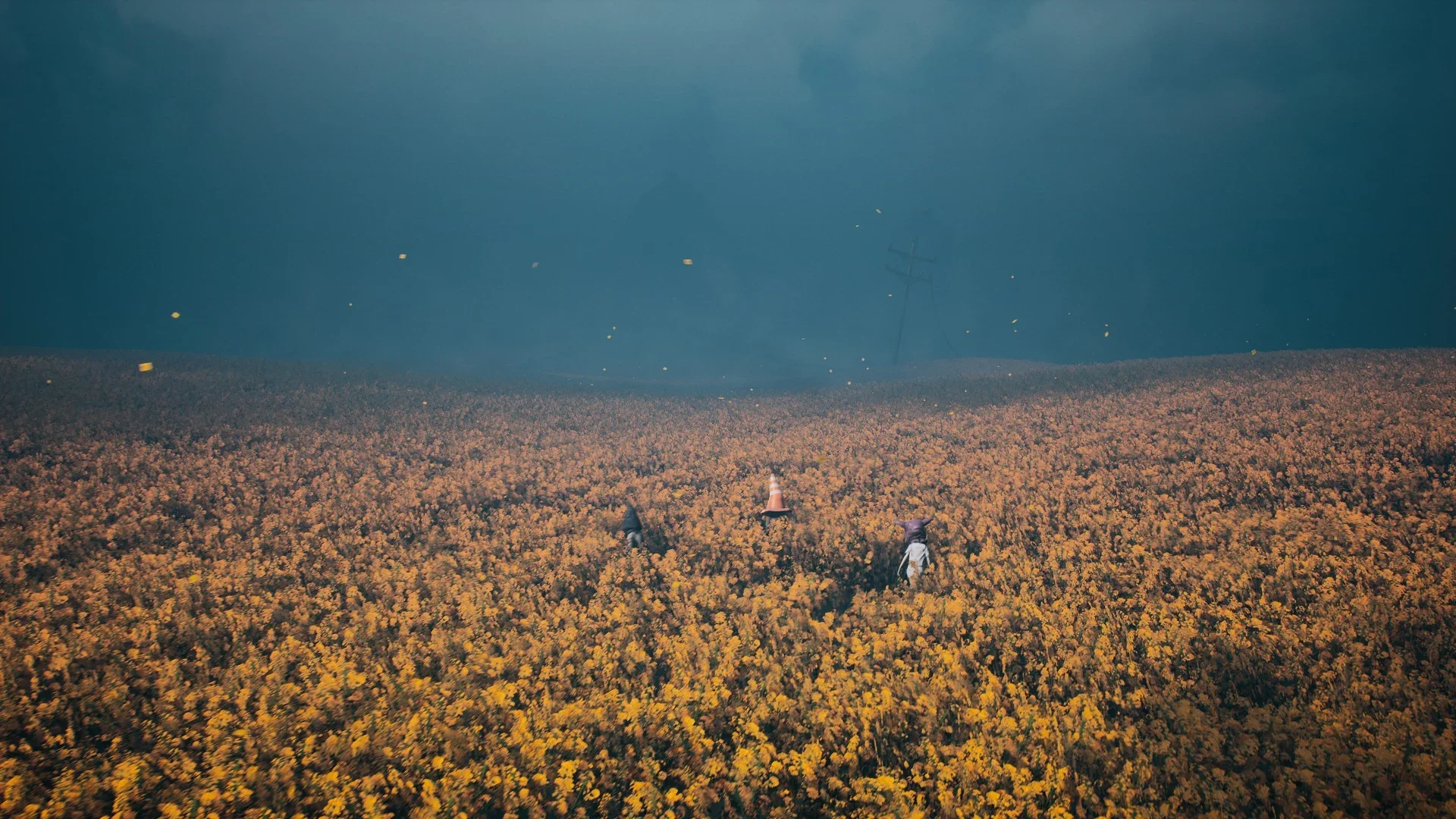
The Flower Field. Reanimal, Tarsier Studios.
This phenomena further reminds me of what author Waubgeshig Rice of Moon of The Crusted Snow discusses: “the milestones he now used to mark time were the deaths in the community…as people perished through sickness, mishap, violence or by their own hands…” (Rice 110) and that the results of “intergenerational trauma and genocide [become] magnified” (Elliott) in works of fiction to better represent Indigenous stories and not just tropes of primarily white, Western literature as we know it (Byrd).
There was no myth of a helpless lamb in Indigenous storytelling because it was brought over by colonizers; what kind of childhood does that reflect, and what kind does it silence?
Returning to the symbols of rabbits—rather than looking at them as inherently weak or innocent, one may interpret them merely as counterpoint.
The title of the game was originally to be Animal—a state of being before mutation and the multiplicity which the world itself holds (Stella). It seems more pressing then, to follow the animal that acts most like an animal diegetic to the world itself.
Rabbits appear on giant, dimly glowing cinema screens, but become symbols within the earth. Rabbits are the final death mask of the children and the scampering, undefinable symbols that most touch the land without changing it. In a recent New York Times article by Christopher Byrd, Reanimal’s narrative director Dave Mervyk said that “Reanimal’s setting reflects its core theme of cycles of trauma.” How this “cycle of violence persists” throughout mills and forests and orphanages might show an “acclimation to warfare” (Byrd). But it also shows a variety of ways in which the land, as well as the people on it, have been colonized by mass violence and war.
If there is something to take from Reanimal, perhaps it is this: the glitching bunny-masked children tremble. Now they are all at the bottom of the well with the dead girl, looking up. There is no resolution. No clean, neat metaphor of forgiveness or condemnation. No pointing fingers of riddled jealousy or greed. The lamb swallows them, and then more lambs sacrifice them before The Girl dies alone. Reanimal ends in a continuity glitch, with the band of children looking up at the sky. Maybe something else will happen, maybe not. Uncertainty is not brought on by the horrors around us, but by the gentleness that we are told to kill in every passing action of the day. The rabbit in Indigenous cultures is not weak or feeble, nor merely a symbol to be put on an altar and twisted into nightmare fodder. The rabbit is a spirit guide between death, deathful sightings, and another world; let us never lose our kindness and gentleness while we are all still here.
Of course, even outside of Indigenous knowledge, rabbits are not as easy a sacrifice as sheep appear to be. They’re flighty, willful, and often frightening in their own way; in their very different works, Jordan Peele and Richard Adams brought out a different side of the rabbit than the rootless philosopher and flâneur Bugs Bunny, who has some family resemblance to that irascible and sadistic trickster of yore, Br’er Rabbit. In Cherokee tales, a childlike Rabbit is at turns cunning and guileless, often gaining his coat and losing his tail on the same day. The children of Reanimal are similarly two steps behind and one step forward, watching their fortunes change at the turn of a knife. Regardless of who is sacrificed, they are still all prey animals.
Like the father and son in Stephen Graham Jones’s short story “Father, Son, Holy Rabbit,” prey status seems to open up other understandings of sacrifice, outside of predation. The knowledge of being eaten is more terrifying than the fate itself, and as an ostensibly commercial video game, Tarsier Studios seems to draw a line between creation, consumption, and childhood. Reanimal seems to illustrate and resist the story of Tarsier’s other children, those of Little Nightmares, a property sold to Bandai Namco and summarily cannibalized for the sake of an AI co-play gimmick and a quick buck. Stories that were meaningful to players so readily discarded for this new, slightly more pessimistic narrative make for interesting subtext. In a very abstract way, why are the stories that came before so easily forgotten for these new ones?
Video games are inherently consumable, promising an experience that is both general and specific. Reanimal contains a specific remove. Like Little Nightmares, the player does not work from the character’s point of view, but watches … as if in a dream. While one may control their character for the purpose of solving puzzles that seal the fate of recognition, the ending is not malleable. Regardless of the choices they make, the player will always be oriented back towards the beginning and the end—the first sacrifice and the last frame.
In Reanimal,one may solve the puzzles and dig deeper into a desperate situation. Upon leaving the boat, there is no way to double back into the endless ocean. Without a map or a compass or some other, more abstract method of navigation, the world becomes unknowable. Most environments in Reanimal are generated the moment they are perceived, like the Other World in Studio Laika’s benchmark film Coraline (2009), or perhaps the vast landscapes of Western Australia in Doris Pilkington Garimara’s 1996 semi-biographical novel Follow the Rabbit-Proof Fence. The world becomes bigger and simultaneously creates more isolation for the children at the center of the narrative, generating only puzzles of survival that must be solved without a promise of relief or safety.
Survival games have been typically dominated by a myth of individualism, of strength and mastery over the elements and other dangers in an inhospitable environment; overcoming is rewarded with a sense of achievement. Reanimal flips the script and shows the horror of survival, the transformation that comes from refusing prey status in a world of harm, and questions notions of agency and grit in the context of a fascist society. Friendship and kinship are both put on hold in Reanimal,and by consenting to play, the single player concedes these connections as well. The resonances this narrative has with the destabilization of First Nations family and community bonds in North America and elsewhere may be unintended, but nonetheless serve to trouble, reinvigorate, and color my own analysis for the storyline of Reanimal.
-
Byrd, Christopher. “A Modern-Day Fairy Tale About Cycles of Trauma.” The New York Times, 16 Feb. 2026.
Elliott, Alicia. “The Rise of Indigenous Horror: How a Fiction Genre is Confronting A Monstrous Reality” CBC, 17 Oct. 2019, www.cbc.ca/arts/the-rise-of-indigenous-horror-how-a- fiction-genre-is-confronting-a-monstrous-reality-1.5323428.
Harrold, Kate. “Reanimal Is a Worthy Little Nightmares Successor, but Prepare to Be Confused.” GAMINGbible, 11 Feb. 2026, www.gamingbible.com/reviews/reanimal-review- worthy-little-nightmares-successor-998801-20260211.
Jones, Stephen Graham. “Father, Son, Holy Rabbit.” The Ones that Got Away, Prime Books, 2010.
MKIceandFire. “REANIMAL Gameplay Walkthrough FULL GAME 100% [4K 60FPS PS5 PRO] - No Commentary.” Youtube, 13 Feb. 2026, www.youtube.com/watch?v=qZIz9guqJP8.
Native American Legends: Chibiabos (Jiibayaabooz). 1998–2020, www.native-languages.org/chibiabos.htm.
planet drewpiter. “REANIMAL Story Explained + Ending Theories.” Youtube, 16 Feb. 2026, www.youtube.com/ watch?v=zv6YtWr2XWM.
Rahman, Mahmud. “Reanimal: Story Explained.” Into Indie Games, 16 Feb. 2026, intoindiegames.com/features/reanimal-story-explained.
Rice, Waubgeshig. Moon of the Crusted Snow. ECW Press, 2018.
Stella, Marlows. “Reanimal devs unpack the meaning of the game’s title–and why it’s not ‘Orphans in a Boat.’” Polygon, 13 Feb. 2026, www.polygon.com/reanimal-interview-tarsier-studios/.
Article by West Ambrose
West Ambrose is a scrivener and performing artist. Check out his ever queer works at westofcanon.com. If you want anything published in The HLK quarterly or The Crow’s Nest, just ring for the masthead, and let them know.
Other Articles You May Enjoy…

The term “social horror” seeks to highlight and challenge real-life injustices and everyday violence. It moves away from the notion of the supernatural monster to emphasize the human being as the primary source of violence and cruelty against others.