
Movie Review: Draug
Directors: Karin Engman, Klas Persson
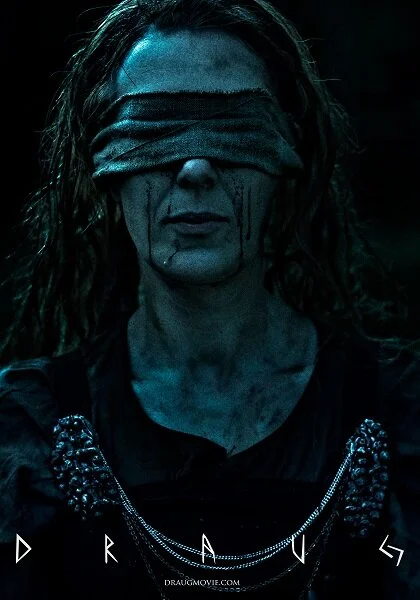
Draug (2018) is a period-accurate horror movie set in eleventh-century Sweden, when a group of warriors venture into an expanse of wild, dangerous forest to investigate why another escorted missionary has disappeared. Though the movie is easily one of my favorites to come out of the last two years, there were some issues with focus that took me a bit out of the flow of the story.
I’m also going to be completely honest: I feel that someone more educated in Scandinavian literature would be much better equipped to posit what I want to in this review, but here I am taking a crack at it anyway.
The group investigating what happened to the missionary includes fosterling Nanna (Elna Karlsson), who has been trained to fight by her warder Hakon (Ralf Beck). Nanna’s own barely remembered past raises questions and challenges by the end of the film.
As for that wild, dark, huge expanse of forest that terrifies the group? Populated by the movie’s titular draug, which are roughly a cultural equivalent of the risen dead. (If you’ve ever played Skyrim, you’ve encountered the draugr. Yeah, same dudes.) And just as a fun side note: Draugr are also known as aptrganga, or “again-walkers.” Metal as hell, right?
Upon first (and second) viewing, this story immensely read to me as a modern example of what is called a legendary saga, or fornaldarsaga. These are Norse sagas that are customarily set before the colonization of Iceland, and deals with the introduction of Christianity and supernatural themes. (Nanna is one of the only characters to openly wear a cross, and she is warned by another woman to not wear it out in the open.) The supernatural element—the draug specifically in this context—also lends itself to the fornaldarsaga idea.
The movie’s finer details are where things really start to shine. The close-up camerawork, paired with a somewhat gritty filming quality, helps visually drive home the intensity of some situations. Costuming is also incredibly accurate to the period, and the backdrops the film highlights only serves to underscore the severity of the landscape that the characters are dealing with. (Overwrought elements in either camp would not have done any favors for Draug.) The acting and character development are also high quality and internally consistent.
In the wider scope, what makes this film one of my favorites from the last two years is something that may very well have been a side note in developing the script, but really stuck out to me all the same: the persistent tension between the recent introduction of Christianity and what remains of old beliefs. (I think this is beautifully underscored in the relationship between Nanna and Hakon. At the beginning of the movie, Hakon speaks to Nanna of how visions were special in the old days, a starkly different view than what Christian beliefs would allow for now. He recalls the way things used to be, though it seems obvious he is now a convert himself. Nanna has more or less been proverbially born into this worldview.)
This is a theme that I find recurring in the films I love most: No matter how we might dismiss old ways of thinking, old beliefs will return from the dead. To me, humankind is really the ultimate haunted house—old ways of thinking, old beliefs, will eventually out, whether we wish them to or not.
On the downside, however, the catalyzing event—going in search of the missing missionary—feels largely forgotten in the final act. The story continues to be engaging, but the focus seems to lose its way as other things are encountered. To be fair, pacing may also be an issue for some viewers, but if you think about how myths and folktales unfold, there seems to be an echo of a similar storytelling logic here, too.
A strength of Draug is also what I love so much about Robert Eggers’ movies (The Witch, The Lighthouse): The supernatural elements are drawn directly from, or at least inspired by, beliefs from the story’s time period, and the buildup to the reveal of these elements is written to draw the viewer into an authentic experience of these beliefs. They are not so easily dismissed.
To put it bluntly: If you’ve seen and liked The 13th Warrior and/or Valhalla Rising, Draug is the next natural stepping stone. After watching Draug for the first time, I remember thinking that this was what 13th Warrior could have been if it had been written and directed in Scandinavia. There’s something that feels more authentic about this kind of story coming from the part of the world that birthed the sagas and the unique kind of poetry that is often found in them or adjacent to them.
Article Written by Laura Kemmerer
Laura tuned into horror with an interest in what these movies and books can tell us about ourselves and what societies fear. She is most interested in horror focused around the supernatural, folklore, the occult, Gothic themes, haunted media, landscape as a character, and hauntology (focusing on lost or broken futures).



In The Buffalo Hunter Hunter, blood carries the violence of colonialism, while a settler’s journal controls whose story survives. This essay examines how Stephen Graham Jones uses vampirism and layered testimony to confront historical erasure.