
Hagazussa: A Heathen’s Curse (2017) [Movie Review]
When I watched Hagazussa (directed by Lukas Feigelfeld) for the first time, I was enamored with it. The four-act structure and the subsequent slide of one woman, living alone, into the relentlessly grinding maw of social expectations, culture, and the Old High German titular “witch” (Hagazussa) concept was a deeply moving joy. So much of this movie is focused on style rather than story—previously I had seen this described as a mashup between The VVitch (Dir. Robert Eggers, 2015) and Mandy (Dir. Panos Cosmatos, 2018)—that upon second viewing, my opinion began to falter.
Support WSB and physical media by buying Hagazussa at our affiliate link with Movies Unlimited!
The scope of the movie follows the life of a young girl, Albrun (Celina Peter), living with her mother alone in the Alps several hundred years ago. The first act demonstrates the pair’s isolation from the rest of the village in two men, dressed in skins and furs aggressively intruding upon the pair, warning them that they are witches and that they should be burned. The act curdles into her mother becoming excessively sick, while Albrun’s own transition into womanhood is marred with trauma.
Albrun’s mistreatment by other villagers continues into the second act, in which she is a young woman (played by Aleksandra Cwen) with a child though no father is present. She is in turn befriended by another woman from the village—an interaction that makes the viewer feel immediately uneasy, as this woman is the first “outsider” Albrun interacts with past her mother. This friendship opens the doors of faith to Albrun, and she is gifted with her own mother’s skull, painted, to keep in her home as a form of penitence for her mother’s witch-like evil. But this friendship—this genuine moment of hope and connection with another woman—yields its own form of trauma, and Albrun kicks off a series of events that lead to a number of deaths in the village.
Act three sees the reassertion of the presence of death, and Albrun begins to unmoor herself from social anchors and expectations through the consumption of hallucinogenic mushrooms, resulting in her drowning her infant in the swamp. The fourth act features the final, ultimate, consummate act for which the movie is titled: Albrun consumes the flesh of her child, echoing the tales of witches from several hundred years ago. Realizing what she has done, she flees into the night, her mother’s spirit howling behind her. The new dawn brings her death: She goes up in flames as the sun rises.
An Ode to Folklore
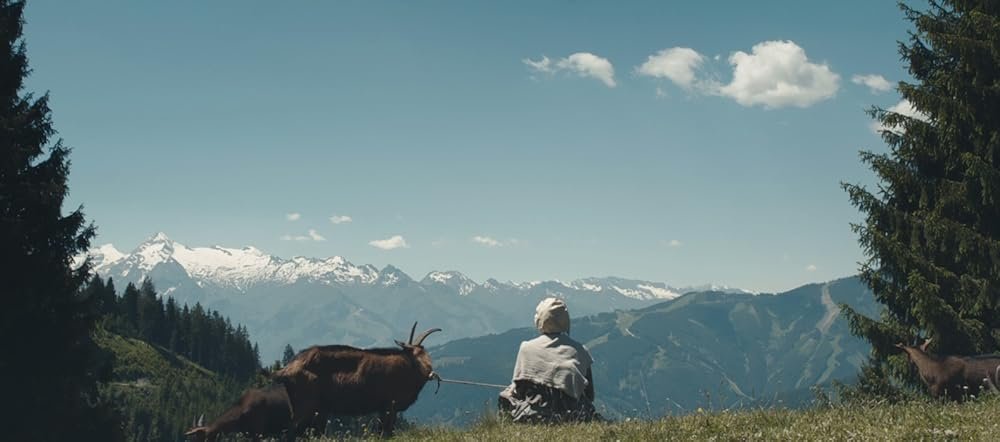
Hagazussa’s Alpine backdrop. Image via IMDb.
First, I have to give credit where it’s due: I adored Hagazussa when I first watched it. The first act is especially narratively concise and well-structured, and shots are framed in such a way that really illuminate just how alone Albrun and her mother are living in the Alps. The soundtrack, by MMMD, beautifully underscores the film with heavy, slow, existential-anxiety-inducing music. (Hagazussa is why I’m such an avid fan of MMMD now. I’ve described their sound as “if Sunn O))) did dark folk.”) Combined, the artistry of the movie seems to convey that what happens to Albrun is largely inevitable—we are mere bystanders who can only bear witness.
Reviews for Hagazussa were similarly divisive as Mandy’s were, and for good reason: This is a movie that thrusts its hand into your viscera, makes a fist, and holds you there, staring you in the eyes unblinkingly. There is very little narrative breathing space for the viewer, as even brief moments of seeming grace and goodness inevitably curdle toward betrayal.
While the intensity of the watch holds up over a handful of viewings, the hand-in-the-viscera feeling of dread began to slide toward a feeling of frustration for me: Albrun largely begins to read as a passive passenger on this inexorable voyage of misery. And while this seems to be one of the core structures of the story, I feel that this could have been more thoughtfully done. The first act—the strongest part of the movie, in my opinion—beautifully highlights how heavily Albrun and her mother rely on each other living out in the Alpine wilderness. This truly drives the betrayal of her mother’s abuse home for the viewer on an emotional level. If the narrative strength of act one had carried throughout the other three acts, my feelings may have changed. In later acts, Albrun’s persistent silence—while highly justifiable and explainable—resulted in me as a viewer emotionally checking out of the story past a certain point.

Like Mandy, Hagazussa is more viewing experience than story—this is something you sit with and digest for several days after. And while I don’t know nearly enough about movies to pose this as any kind of serious assertion, Feigelfeld’s directorial debut seems to be the latest installation in the kind of visual tone set by Eggers’ The VVitch, which isn’t a bad thing in and of itself, but since also watching Gwen (Dir. William McGregor, 2018), I worry that this kind of story will lapse into becoming something that uses the trauma of those seen as witches as a seemingly compelling crutch to stand with, rather than using that information to interrogate the culture that gave birth to these stories and beliefs.
My issues with this movie aside, since Perchta—a folkloric figure mentioned fairly early in the movie in a moment of warning—was said to enter homes during the days following Christmas to tell if children had been good or not, you could adopt Hagazussa as a Christmas movie. I know I probably will. (And spoiler alert: Good kids got a silver coin; bad kids got their insides taken out.)
Article Written by Laura Kemmerer
Laura tuned into horror with an interest in what these movies and books can tell us about ourselves and what societies fear. She is most interested in horror focused around the supernatural, folklore, the occult, Gothic themes, haunted media, landscape as a character, and hauntology (focusing on lost or broken futures).

Other Articles You May Enjoy…

Filmmaker Bari Kang discusses Itch!, from its practical gore and zombie influences to filming in his own NYC store and directing his daughter.