
The Nature of God in Andrzej Żuławski's ‘Possession’
“Therefore the Lord himself shall give you a sign; Behold, a virgin shall conceive, and bear a son, and shall call his name Immanuel.” —Isaiah 7:14
Immanuel (Hebrew: עִמָּנוּאֵל ‘Īmmānū’ēl, meaning, "God is with us")
In the introduction of her book, House of Psychotic Women, Kier-La Janisse says of Andrzej Żuławski’s 1981 controversial masterpiece, Possession, that “there was something terrible in that film, a desperation I recognized in myself, in my inability to communicate effectively, and the frustration that would lead to despair, anger and hysteria” (9), a sentiment which perfectly captures my swirling, jumbled thoughts that followed my first viewing of the film. Failure to communicate is a key driving force through much of Possession: between spouses, between lovers, between states, and perhaps most intriguingly, between God and man. It takes a rather cynical view of humanity’s relationship with its deities, and its nihilistic theology is best explored through its two main characters, Mark and Anna.
Support What Sleeps Beneath by purchasing Possession (1981) and other Blu-Rays and DVDs using our affiliate link with Movies Unlimited!
At its core, Possession is a tale about a crumbling marriage. Mark (Sam Neill) returns to his West Berlin home after a lengthy assignment across the Wall only to find his wife Anna (Isabelle Adjani) asking for a divorce. Mark appears to be blindsided by the request, as if his extended absences in Soviet Berlin as a spy, and the emotional buffer he put between himself and his wife and child would have no lasting impact on his relationship. But it is this sense of bewilderment that drives Mark’s story throughout the film. He begs Anna to help him understand and she spurns him.
What makes Possession so harrowing, however, isn’t just the on-screen drama between Anna and Mark. Instead, the breakup serves as a vehicle to deliver one of the most puzzling, but thoroughly horrifying turns in cinematic history—one that demands that you question and dissect it, but by doing so, the turn only further complicates itself. The deeper you fall into the rabbit hole of Possession, the closer you are to being enveloped by that deep, aching dread that only comes from questioning your very existence.
One of the more bizarre elements of Possession is its otherworldly mise-en-scène. Sure, the film is located right up against the Berlin Wall, the physical manifestation of two competing ideologies (Niblett), and this setting lends its considerable weight to the story, but the nightmarish qualities of the film come more from Żuławski’s manipulation of space in almost every scene. From the uncomfortably cramped kitchen in which Mark and Anna have one of their bloodier shouting matches to the comically large (and empty) office where Mark is debriefed by his employers, space and motion are integral in Żuławski’s ability to convey the dreamlike world in which Mark and Anna live (Restall). There is a profound tension between spaces and the actors that occupy them, a tension that is only amplified by the exaggerated movements of each character.

Mark, for instance, has a particularly fraught relationship with chairs. In one scene, he violently rocks in a rocking chair, almost to the point of tipping over, as he waits for Anna to come home. In the office of a private investigator, he swivels ceaselessly in wide, arcing motions while he explains his desire to have Anna followed. In a public argument with Anna in a near-empty cafe, he throws and breaks chairs as he chases her around the dining area. These melodramatic, almost parodical expressions extend to nearly all of the main players, except perhaps Mark and Anna’s young son, Bob.
For example, Heinrich, Anna’s balletic, worldly lover, for whom she leaves Mark, literally dances through his scenes with wide, sweeping gestures, mimetic of the airy, harmonious nature he works so hard to exude. His mannerisms are suggestive of his belief that God can be found through hedonistic pleasure. Early on, Mark finds a postcard from Heinrich inside a book on tantra. Postmarked from the Taj Mahal, Heinrich tells Anna, “I’ve seen half of God’s face here. The other half is you…” His expressions, both physical and verbal, all center around a tangible interaction. Heinrich’s feigned enlightenment torments Mark throughout the film, but when his ideology is put to the test for the first time, he crumbles, revealing himself to be completely ill-equipped to deal with the dangers he’s found himself in. His mother, bless her soul, doesn’t fare much better. To her, God can only be found in her family, which, noble as it is, is taken to its extreme when, upon learning she’d have to continue her life without Heinrich, chooses to take her own life instead. As Heinrich worships Anna, his mother worships him.
Mark, on the other hand, is the first character to take a distinctly darker tone of God. In conversation with Heinrich, Mark isn’t being flippant when he says that, “God is a disease.” Several times throughout the narrative, Mark describes a memory of his dog crawling under the porch to die, and in a resigned exchange with Anna, he tells her that God is still under the porch with that dog, and even later reveals that he followed the dog so that he could “see what it was that made him crawl under there.” Even as a boy, Mark sought God in death, and just as he now yearns for understanding from Anna, he seeks answers to the unanswerable.
Meanwhile, Helen, Bob’s teacher and Anna’s doppelganger (played by Adjani, as well), cryptically describes the concept of evil as a physical manifestation: “I come from a place where evil seems easier to pinpoint because you can see it in the flesh. It becomes people, so you know exactly the danger of being deformed by it.” Where is this place from which evil becomes people? Where is Helen from, and why is she identical to Anna, save for her striking green eyes? Sorting out the answer to these questions could be the key to unknotting the whole film.
All of these characters stay relatively steadfast compared to the more malleable Anna, though. Like everyone else, Anna’s movements are expressive of her changing beliefs. She is much more punctuated and aggressive than anyone else in the film. She thrashes about with full-body motions, indicative of the savage internal struggle of philosophies she deals with. Her quest for meaning can most readily be summed up in a monologue that occurs roughly two-thirds through the film. In it, she describes two sisters: Faith and Chance. Faith, she says, can’t exclude Chance, but “my Chance can’t explain Faith. My Faith didn’t allow me to wait for Chance, and Chance didn’t give me enough Faith.” In his essay, Possession: A Marriage of the Natural and the Supernatural (which goes miles toward helping me parse out and understand this particularly inaccessible section of the film) on The Twin Geeks, David West understands Anna’s Faith and Chance to be two competing agents of her morality. Faith is her hope that she can resolve her marital problems—it is her optimism that she and Mark can once again be as happy as they once were and can live as they ought to. Chance, though, represents the uncompromising chaos of the universe. Chance led her to Heinrich; it gave her reason to doubt Faith, which Chance could call naivety; and it is Chance that guides her actions over the course of the film.
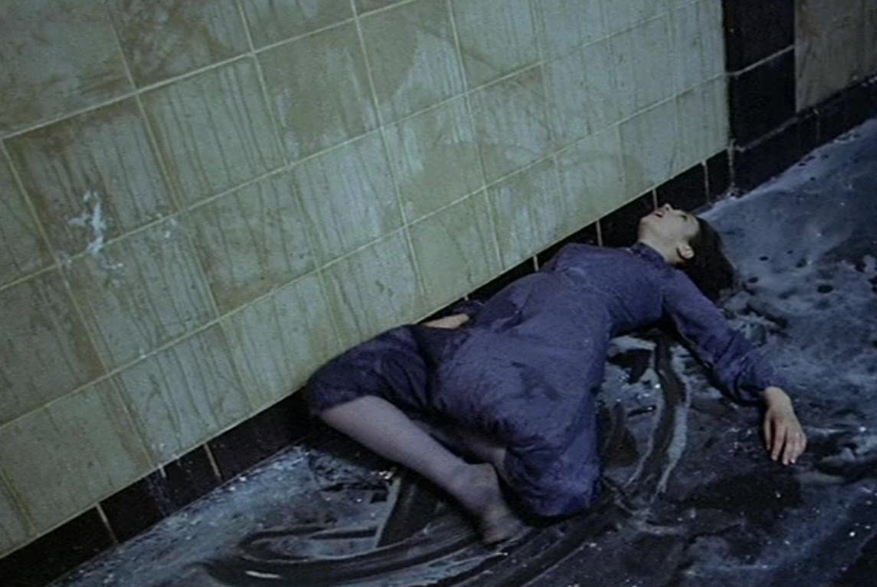
As Anna’s struggle with Faith and Chance comes to a head, she recounts an episode where, as she stands before a crucifix at a church, she whimpers and moans at the foot of Christ, apparently a last-ditch effort at communicating with God (Janisse, “Psychotronic Tourist”). As even these pleas go unanswered, Anna leaves the church unfulfilled, leading her to the most recognizable scene in the film, and one of the most enduring in the history of horror cinema.
As Anna walks through the German U-Bahn, she is seized by fits, in a prolonged display that culminates with an oozing piece of body horror which she describes to Mark as the miscarriage of Sister Faith. “And what was left,” she says, “is Sister Chance. So I had to take care of my faith, to protect it.” This miscarriage of faith is Anna’s purging of her existing beliefs—as West puts it: “Anna has rejected God as a source of meaning, and she turns to other methods, her new lack of faith apparently allowing her the moral freedom to carry out her gruesome work.” In fact, her miscarriage doesn’t kill her faith; rather, it acts as a sort of perverted birth, a bastardized virgin birth in which her faith is born anew as Anna’s new god.
In an essay included with the Mondo Vision release of the film, Daniel Bird writes: “Traditional theology holds that God is both in and transcends the visible world. Anna ‘expels’ the creature—a product of her tortured thinking. Outside in the world, her ‘thought starts thinking for itself’—which is how Aristotle defined God” (12). Anna emerges from her ordeal in the U-Bahn with a new purpose. She rents an apartment across town where she begins nurturing her creation to health. This is the event, we learn, that drives the majority of Anna’s actions in the film. Her absences, including long stretches where she left her young son home alone, had until this point been understood to be spent with Heinrich. But as Mark and his private investigator discover, Heinrich, too, is unaware of Anna’s activities. With this development, we can recontextualize all of the arguments between Mark and Anna. Mark is never quite able to call Heinrich by his name—he is always referred to as him: “You were with him, weren’t you?” Only now, we realize that Mark and Anna are talking about two different “hims.” In fact, throughout the film, they are arguing over two completely different issues. At another point, Anna cries out, “I’ve been a cheat, a liar, completely alone, wounded. And you think I’m immoral shit. I think so too but not for the same reasons.” Mark is hung up on Anna’s infidelity, whereas Anna is wrestling with a complete rejection of traditional morality, a fact that she articulates when she theorizes, “Goodness is only some kind of reflection upon evil,” which as West notes, “is a reversal of the common Western perception of evil being a corruption of good.” With her new philosophy, Anna understands the driving force behind the universe to be chaos, not order. To her, evil is not a corruption of that which is good, but rather, goodness is a rebellion against the natural chaos of the universe. And if the creator of the natural order must reflect its creation, then God must not be a benevolent being, but Chaos incarnate.

This brings us back to Helen. While Anna fosters her abomination, and is being corrupted by its influence, Helen speaks of a place where evil is made flesh. It seems like Helen has firsthand knowledge of the sort of being living in Anna’s apartment. As a matter of fact, Helen seems to be the antithesis of the creature, and by extension, of Anna. Helen acts as the goodness that Anna loses throughout the film and, more importantly, slowly becomes the kind, attentive, motherly figure that Bob needs as his own mother fades further into darkness. Alternatively, as Anna’s creature takes shape, it becomes an exact replica of Mark, except, like Helen, its electric green eyes. As each character loses more of themselves to their conflict, they increasingly find what they were missing in the other’s doppelganger, creating a sort of binary star system, in which the four orbit around each other, draining each pair of its energy until their cataclysmic collision. The revelation of the creature’s final form arguably makes Helen the most important character of the film. We are finally able to see the permanent emotional separation of Mark and Anna as they literally lose themselves, effectively being replaced by their counterparts.
Possession was an incredibly personal film for Żuławski. Many of the characters were famously based on his own contentious breakup, and some dialogue was even lifted directly from his own arguments with his ex-wife (Gissy). Compounded by its Cold War setting, which reflects Żuławski’s de facto expulsion from his native Poland several years prior, the film could easily have become a quasi-autobiography for Żuławski, but what he delivered was a horrifying meditation on existence—a contemplation on the nature of god(s) and their creation, and the terror of witnessing the birth of such a god. As Mark’s private detective exclaims, upon seeing the creature, just before he meets his demise, “Immanuel. Immanuel!”
This essay was updated on 7/16/2024 to include references and works cited.
-
Bird, Daniel. “God Figured as a Public Whore Gone Crazy: Notes on Andrzej Żuławski’s POSSESSION (1981).” Mondo Vision, 2014.
Gissy, Sharon. “[Going Deep] Possession (1981).” Daily Grindhouse, 8 Oct. 2015, dailygrindhouse.com/thewire/going-deep-possession-1981/. Accessed 28 May 2021.
Janisse, Kier-La. House of Psychotic Women. Expanded Edition, Fab Press, 2022.
Janisse, Kier-La. “The Psychotronic Tourist: ‘Possession’ (1981).” Spectacular Optical, 20 Feb. 2014, www.spectacularoptical.ca/2014/02/the-psychotronic-tourist-possession-1981/. Accessed 28 May 2021.
Niblett, Robin. Interview by Gitika Bhardwaj. “Why We Build Walls: 30 Years After the Fall of the Berlin Wall.” Chatham House, 8 Nov. 2019, www.chathamhouse.org/2019/11/why-we-build-walls-30-years-after-fall-berlin-wall.
Restall, Johnny. “Finding Meaning In ‘Possession.’” We Are Cult, 14 May 2021, wearecult.rocks/finding-meaning-in-possession. Accessed 28 May 2021.
West, David. “Possession: A Marriage of the Natural and the Supernatural.” The Twin Geeks, 12 Oct. 2018, thetwingeeks.com/2018/10/12/possession-a-marriage-of-the-natural-and-the-supernatural/. Accessed 28 May 2021.
Article written by Ande Thomas
Ande loves the intersection of sci-fi and horror, where our understanding of the natural world clashes with our fear of the new and unknown. He writes about monsters and foreign horror and can also be found over on Letterboxd.

Other articles you may enjoy...


The term “social horror” seeks to highlight and challenge real-life injustices and everyday violence. It moves away from the notion of the supernatural monster to emphasize the human being as the primary source of violence and cruelty against others.