
[Movie Review] Full Moon Features Presents: ‘Quadrant’
One of the most prolific brands in the cult horror market is Full Moon Features which, in its various iterations, is responsible for direct-to-video classics like Puppet Master (1989), Demonic Toys (1992), and Castle Freak (1995). Charles Band, the company’s founder, has forged a career that, whether you’re a fan of his films or not, has left an indelible mark on the genre. Never afraid to take risks or to swing for the fences, Band’s approach to making entertaining films on a shoestring budget has weathered innumerable shifts in markets and distribution methods, constantly working to adjust his business model. And now, Band is set to release Full Moon’s 400th feature film, Quadrant, under Full Moon’s brand-new label, Pulp Noir, which promises a focus on “edgier, weirder, darker horror and dark fantasy films.”

Starring Emma Reinagel, Christian Carrigan, Shannon Barnes, and Rickard Claeson, and written by C. Courtney Joyner, Quadrant follows researchers Harry (Claeson) and Meg (Reinagel), who seem to have invented a revolutionary way to help patients overcome their deepest fears. The technology, “Quadrant,” acts as a sort of VR headset on steroids, transporting users into a world where all of their fears become real, tangible nightmares. But things take an unexpected turn when a volunteer participant named Erin (Barnes) uses Quadrant, not to battle her phobias, but to actualize her forbidden desires, and her obsession with Jack the Ripper makes the jump from the virtual world to the real one.
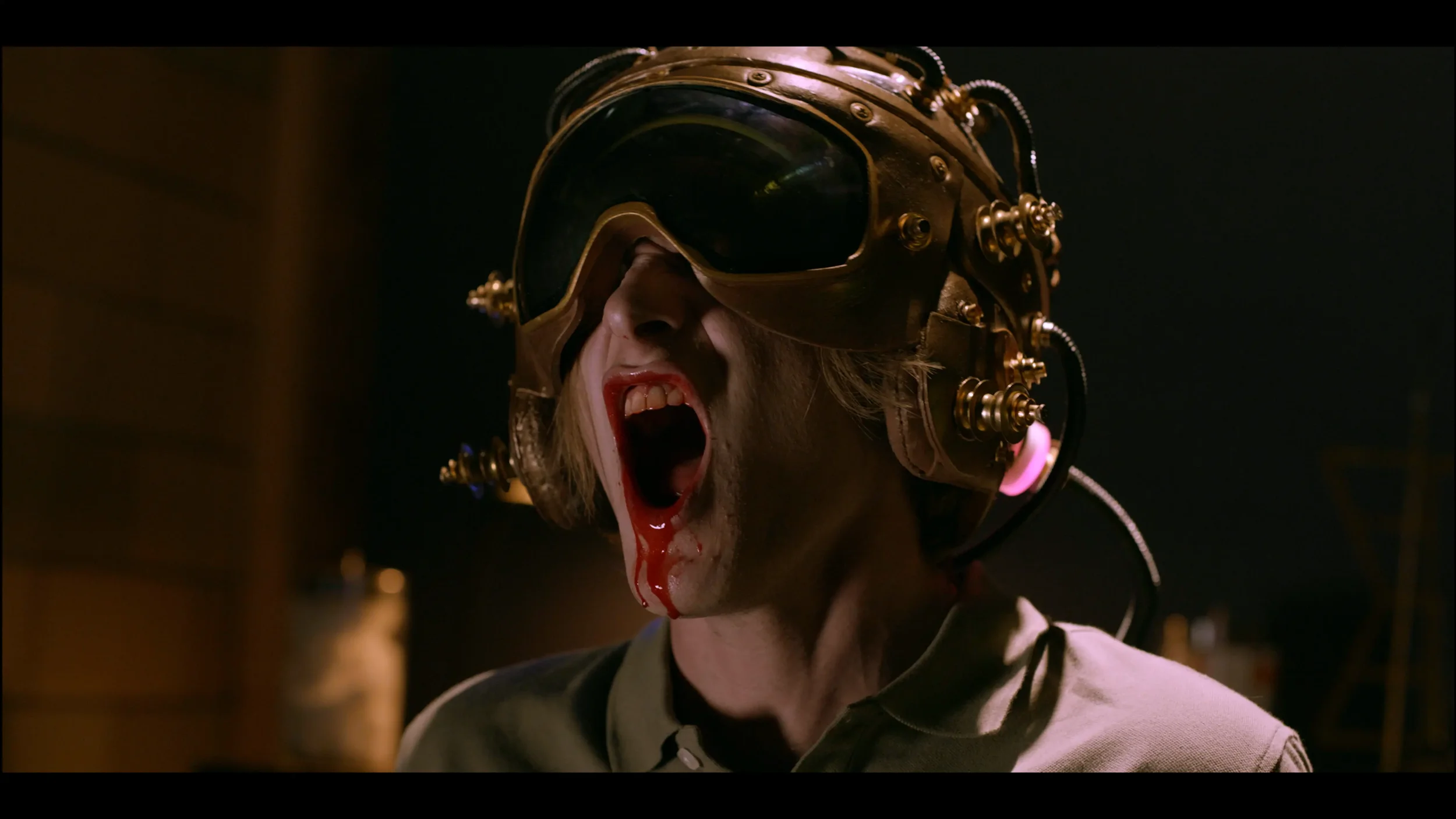
Image Courtesy of Scandal Co-Active
Since the earliest days of its conception, people have speculated about virtual reality’s therapeutic potential, but recent advances in the tech have begun to make that vision even more feasible, giving Quadrant a timely edge to its cyber-punk trappings. Another timely topic—one that’s far more controversial among artists and writers—is the use and exploitation of generative AI. Quadrant uses generative AI to create the virtual worlds of the Quadrant helmet, along with all of the creatures contained within them. It’s an audacious move, though this isn’t even Band’s first film to deal with artificial intelligence. Last year’s AIMEE: The Visitor proudly advertised itself as having the first ever “AI femme fatale,” whose lines were entirely written by AI. It’s an admittedly creative use of the burgeoning new field, though its announcement and release suffered from its proximity to the writer’s strike, of which this same topic was a point of contention between the writer’s guild and the studios.
With Quadrant, however, the use of AI, rather than contributing to the ethical dilemma of replacing writers with machines, comes at the issue from the direction of animators. On one hand, as an independent production company, it’s unlikely that Full Moon would have it in their budget to hire a full animation studio for the elaborate scenes inside Quadrant, so without generative AI, the film would have likely had to shift strategies completely, calling into question just how many jobs the technology “replaced.” On the other hand, it’s still very much a slippery slope—any larger studio could make the same claim, despite having funding sources and distribution channels orders of magnitude larger. Given the current iterations of AI’s failure to attribute the sources it draws from to complete its prompts, we still have a long way to go before it can be considered an ethical form of creation.
Setting the ethical argument aside, though, solely in order to judge Quadrant on its own merits, as it exists, I have to admit that the AI worlds shown in the film are shockingly appropriate. The hallucinatory uncanniness that AI images often exhibit makes for the perfect backdrop for the actualization of the patients’ imaginations. Plenty of other films have explored the inside of the mind, normally adopting surreal imagery and sets, like Dreamscape (1984), Zack Snyder’s Sucker Punch (2011), or even Tarsem Singh’s The Cell (2000). Quadrant’s solution stands out because no one person or department can truly take credit for the final result, making the effect more nightmarish than perhaps any other before it. Even the familiar hallmarks of AI generation—garbled text on signs, subtle parallax motion, strange anatomies—add to the dreamlike quality we’d expect to see from a virtual world created from someone’s imagination. The result is eerie in a way that has never, in my experience, been seen.
Beyond this, the film does have issues with pacing. The plot moves forward, almost at a breakneck pace. It takes only a couple of sessions with Quadrant before Erin appears to master it, wrenching control of the technology away from the researchers who have apparently been developing and tuning it for years. Before the audience is even fully introduced to the concept, things have already begun to go haywire, making it difficult to engage with the stakes of the film. Without having established the rules and limits, there’s no way to feel emotionally invested when those limits are challenged.
In a similar vein, much of the dialogue can come off as stiff and unconvincing. At one point, Erin greets fellow Quadrant patient and lover Robert (Carrigan) when he stops by her apartment unexpectedly, saying, “I thought I was going to contact you about coming over.” Granted, this takes place fairly far into the film, well after her turn as antagonist, so it could be attributed to her increasing feelings of grandeur or her disconnection from reality, but other strange turns of phrase and word choices are peppered throughout the film, drawing audience attention away from the events on screen.
Still, Shannon Barnes is the clear standout as Erin. From the moment she’s introduced, Barnes gets plenty of opportunities to show off Erin’s ever-growing mania, and it’s fun to watch. She’s also got the best wardrobe change in the film, as her obsession brings her closer to fully recreating the Ripper’s crimes in the real world, cape and tophat included. Her transformation is genuinely impressive, and Barnes fills the role with just the right amount of pomposity the character calls for.
It’s a shame that the film doesn’t allow for the same transformation for Erin’s eventual foil, who ostensibly has more power and control over Quadrant than even Erin’s endgame potential, but doesn’t get near the same upgrade as Erin’s Jack the Ripper evolution. It makes for a visually one-sided climax—had their struggle played out more on-screen, it would have made for a flashier, more impressive finale.
Quadrant is available now on Amazon Prime, Full Moon Features, and Tubi, as well as for purchase on Blu-Ray, DVD, and VHS.
Article Written by Ande Thomas
Ande loves the intersection of sci-fi and horror, where our understanding of the natural world clashes with our fear of the new and unknown. He is an independent member of the Society for Cinema and Media Studies and a supporting member of the Horror Writers Association. He writes about monsters and foreign horror and can also be found over on Letterboxd.

Other Articles You May Enjoy…
Filmmaker Bari Kang discusses Itch!, from its practical gore and zombie influences to filming in his own NYC store and directing his daughter.