
Hope in ‘The Long Walk’
The world feels heavy. It has been just over one month since the start of 2026, and in that time, the United States has experienced an uptick in state-sanctioned violence that reeks of authoritarian deceit. The brutal, public murders of Renee Good, Alex Pretti, and Keith Porter Jr., along with the 32 individuals who have died in ICE custody in 2025 alone are vile reminders of the injustices that are the bedrock on which our country stands.
In times like these, we turn to art. People have protested through the act of creating and engaging in various forms of art since there has been something to protest. From the Ghost Dance Movement in 1890 by the Native American resistance to the graffiti artists at the forefront of the Arab Spring, we have never stopped pushing back. All forms of art participate in this, but in the film world it is most visible in the genre that is uniquely positioned to tackle these abhorrences head-on: horror. What is disgusting, painful, confusing, gruesome, cruel, and strange can be pried open and examined through these screens. It is not a callous indulgence of the taboo, but a mirror in which our societal wrongdoings can be reflected outward; a catharsis that exposes truths too hard to bear alone. In horror, it is possible to hold multiple realities at one time. Some that are unimaginable, and some that are joyful. So it is here, during this time, when I and so many others turn to horror.
The Long Walk (directed by Francis Lawrence) debuted in theaters in the fall of 2025, grossing $63 million and cementing its place among other beloved Stephen King film adaptations like Stand By Me and The Shawshank Redemption. It is a military-esque film, singular in its plot and complex in its delivery. The realness and closeness of the characters, and the subsequent recognizable landscape, push it to the forefront of protest films. Misleading by way of box office numbers, The Long Walk is subversive, maybe even overtly so.
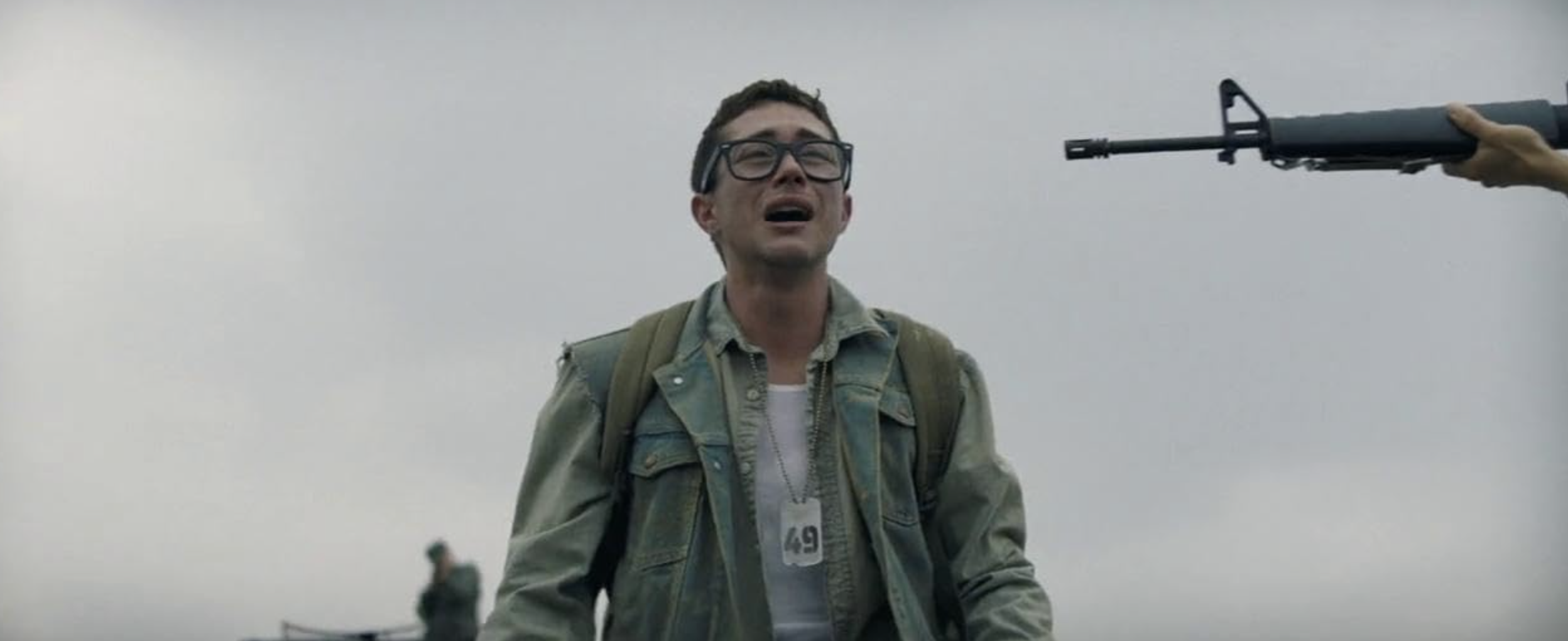
Jordan Gonzales in The Long Walk, image via IMDB
The story is simple: Boys are selected to compete in “The Long Walk.” The last participant walking is granted one wish. Stop for any reason, or fall beneath the designated three mph pace—and you die. We follow Ray Garraty (Cooper Hoffman) befriend fellow walker Peter McVries (David Jonsson) as they struggle to the finish line. The film opens with Garraty’s mother (Judy Greer) dropping him off at the starting line of the walk. She is nearly inconsolable about his participation, hinting at the death of his father. The boys wear dog tags with their participant number, like a twisted version of a marathon, and within the first section of the walk, two boys die: One from youthful ignorance, the other from a health condition that seems to have been overlooked. All of it is an obvious nod to the Vietnam War.
Like other journey narratives (Mad Max Fury Road, The Hitcher), it really is one long, continuous walk on screen. However, don’t be fooled, The Long Walk is anything but boring. And it is bloody. Kills are full screen, suffering, and all. It is difficult to watch these scenes without remembering that these characters are teenagers, groomed on a promise. There is so much brutality in the way that the boys die, that everyone (the boys, the military escort, we the audience) knows that they will die, and that there is only walking to be done about it. The act of dying, and the act of being alive is laid bare. It will make you recognize the conveniences we take for granted, and remind you to drink a glass of water.
Lawrence is no stranger to dystopian stories, having directed The Hunger Games: Mockingjay and The Hunger Games: Catching Fire. His attention to detail on the boys is acute, and tells a deeper story than other films in this realm. Shots that linger on the mundane parts of life signal a director who understands the kind of corrupt normalcy that a fascist regime depends on. How a thing that is so absurdly wrong can twist its way under your clothes, into your skin, feast in your mind and make you believe that you are helpless. This is held together by the invisible line of the three mph walking pace, enforced by a formidable character called The Major, played by Mark Hamill. The Major and his small military escort are outnumbered by the boys, but they keep them in line, keep the machine moving, kill them.

Despite the duress of the walk, the boys retain their individuality and pieces of their lives are revealed mile by mile. The relationships that form in the group are beautiful, intricate, complicated, and thoroughly teenage. Outstanding performances by every single cast member are what make this film so believable. Each character is built with so much meaning and authenticity that the deaths never settle into a numbness that can be ignored. For brief moments, we can play with the boys, laugh with them as they tease each other, indulging with them in tiny joys. They all share the wish they will ask for if they win, except for Garraty, who keeps his tight to his chest. The humanity between them reveals the unnaturalness and fragility of the system under which they are trapped. Yet, every time there is a glimpse of life beyond the walk, we are jolted back into the harsh reality of their situation. The Major makes sure of it.
Garraty and Pete start the walk as kindred spirits who become fast friends, which soon turns into a brotherly bond that keeps them both alive longer than either of them would have survived alone. When Garraty’s mental state begins to decline, Pete lifts him up, reminding him that even the blueness of the sky is enough to live for. When Pete confesses his troubled past, Garraty reminds him that survival in the face of horrendous circumstances is something to be celebrated. Garraty reveals his secret wish to Pete, a risky action that he thinks will be a catalyst for dismantling the system.
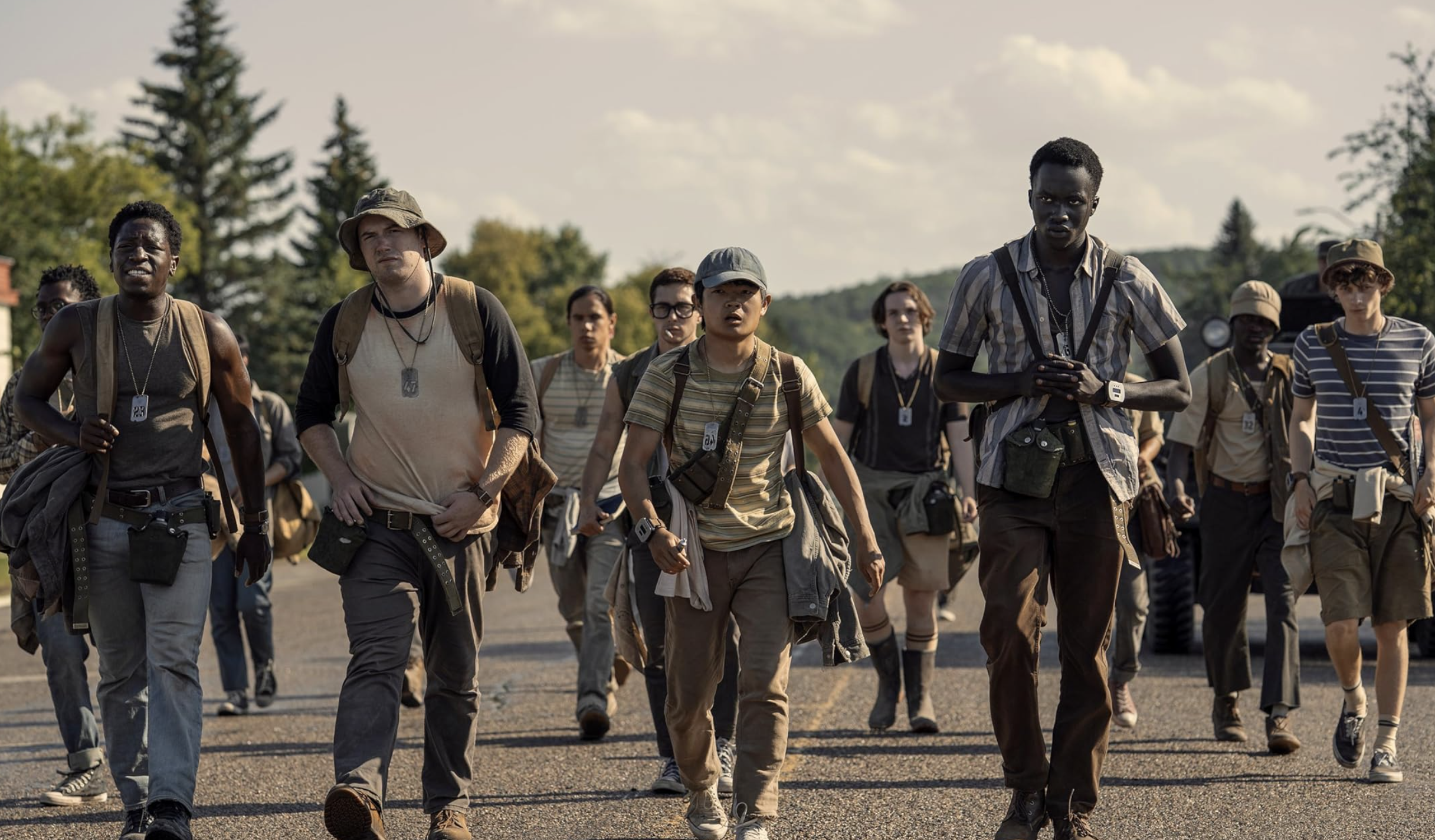
Cooper Hoffman, Ben Wang, Teagan Stark, Emmanuel Oderemi, Thamela Mpumlwana, Jordan Gonzalez, Tut Nyuot, and David Jonsson in The Long Walk (2025), image via IMDb.
The Long Walk is grim. Every mile we witness unearths conflicting emotions: dread and amusement, anguish and gratitude. But the undercurrent that never diminishes is hope. When one of the boys falls, the others rush in to pick him up, physically, mentally, and emotionally. The facade that upholds the cruelty begins to crack, leading us to believe that there is another way. As if worried he’ll be discovered as a fraud, The Major shuts down their camaraderie, directing an onslaught of violence and fogging over the lens of clarity in the face of injustice each time the boys gain a small victory.
And yet, the boys continue to advocate for one another. Underresourced, traumatized, and afraid, they walk side by side with growing resentment, not towards each other who they are competing against, but instead towards the individuals and system that designed the competition. For each of them, the naive hope of winning an unwinnable race grows into an understanding of the world that values life over cruelty, friendship over disparity, and courage over complacency. With every step, we are asked what it would take to stop such a machine in its tracks. Although scary, The Major’s strategy is thin; the only tool available to him is violence. The boys, however young and ill-equipped, have the only thing that is required to win: a future that can be imagined where the walk no longer exists.
Article written by Theresa B
Theresa writes about the intersection of art & anthropology and gendered horror. She loves demonic possession, satan, and can be found on Letterboxd.

Other Articles You May Enjoy…
![The Critics are Wrong: Long Live ‘The Bride!’ [Movie Review]](https://images.squarespace-cdn.com/content/v1/5d3e481bc5a6e40001b215a8/1773068326629-0WHV3NUESLFG23YV4800/Screenshot+2026-03-09+at+10.57.10%E2%80%AFAM.png)


Never graphically violent, [Cat People] is nonetheless shocking, especially in the stalking and pool scenes. Never graphic sexually—not the barest inch of customarily hidden skin is exposed—it’s nonetheless erotic. The heart of the film is the fear of female sexuality, the sense that, if women were to give in to their carefully repressed urges, they would throw society itself into chaos.