A Flowering of Hellebore: An Interview with Founding Editor Maria Pérez Cuervo
At this stage, my love of folk horror has become rather defining in what subgenres of horror I connect with and what outside reading material I engage with. When I saw the announcement for Hellebore, a new print magazine focused on folk horror, I was immediately sold. As the magazine summary puts it best: “HELLEBORE is a collection of writings and essays devoted to British folk horror and the themes that inspire it: folklore, myth, history, archaeology, psychogeography, witches, and the occult.”
I recently had the chance to talk with magazine founding editor Maria Pérez Cuervo about what inspired the creation of the magazine, plans for the future, and how folk horror inspires her.
Cuervo, who has her degree in journalism and an MA in Archaeology for Screen Media from the University of Bristol, has written for Mental Floss, The Order of The Good Death, The Daily Grail, Spirits of Place, The Ghastling, and Folklore Thursday.. Her interests largely focus around history, archaeology, and myth.
I had previously encountered your work through the Spirits of Place anthology. What initially drew you to writing? By extension, what compelled your interest in folklore? Was there a specific book or event that had an impact on both/either?
I grew up in a fairly bookish home and I don’t remember not writing. As a child I used to make my own magazines, with comics I drew and articles I wrote. My dad was into ancient history and mythology, and my mum has always been a bit of an anglophile, and it probably rubbed off on me. My mum told me a lot of fairy tales, and what really fascinated me was the magic. You know, the witch, the magic mirror, the curses. A bit later I became obsessed with Enid Blyton’s Famous Five books, partly because of the settings (the moors, the Cornish coast, the ancient ruins), and with Sherlock Holmes.
I’ve always enjoyed listening to people telling me about stories of the past, and most of the books I was drawn to had that pull of the past. I used to look at my dad’s history and art encyclopaedias and read about depictions of ancient deities. I also remember being fascinated by Brian Froud and Alan Lee’s Faeries, and by Angela Sömmer-Bodenburg’s Die Moorgeister, which I don’t think has been translated into English, but it’s about a little boy who encounters spirits and fairies in a swamp. And obviously Jim Henson’s The Storyteller, with John Hurt, and Labyrinth.
What was the leading inspiration behind Hellebore? (And how much of an influence was Folklore, Myths and Legends of Britain?)
Perhaps the leading inspiration was the dark folklore community I regularly talk to on Twitter, and of course, we’re all into that almost legendary Reader’s Digest book. I bought it in Glastonbury about a decade ago and I had no idea it’d been such a touchstone. It wasn’t there when I was growing up, but I love it anyway.
The design of the materials released so far is very emblematic of a very particular time in the UK. What made you want to harken back to that period of '60s and '70s almost surreal design? What was that development process like?
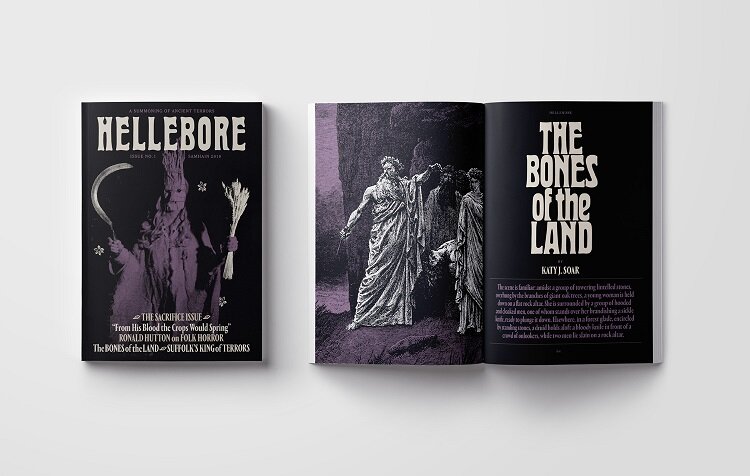
My brief for Nathaniel Winter-Hébert, the designer and art director, was that I wanted the aesthetics to evoke that particular era, the late '60s and '70s, grabbing inspiration from Czech film posters, with a touch of psychedelia, and an old-school fanzine finish. It conveys the content pretty quickly: the '60s and '70s saw a folklore and occult revival, and I like the countercultural spirit of fanzines and the irreverence and surrealism of Czech film posters.
I’m a huge admirer of Nathaniel’s work. He’s very intuitive, and also a self-confessed old goth, like me, so he understood where I was coming from very quickly. We worked with a secret Pinterest board where I had pinned all my aesthetic influences for Hellebore, and Nathaniel gathered some typefaces that appeared in these. The one he chose for the Hellebore masthead is actually an Edwardian typeface, which is really fitting, as the roots of literary folk horror go back to the late 19th and early 20th century. He designed the cover first, with Paul Watson’s haunting photograph “Come Unto The Corn”, and came up with two different colour schemes. I loved the violet, black, and cream one so much I asked him to keep it throughout the whole issue.
What kinds of work did you want to publish in Hellebore? What do you think is the core spirit of the magazine?
I’m looking for essays and writings that are well-researched, with an academic flair, but that preserve the mystery and enchantment of the themes we’re dealing with. We’re looking at how people have interacted with these themes throughout history, but we don’t necessarily know more than they did. That sense of awe is essential.
From a publishing perspective, why did you choose to keep the magazine print-only? I personally love this idea, especially when so much of the material we engage with every day really does not have that physical, tactile component. What also guided the decision to make this a limited print run?
Yes, that’s exactly it. So much of the content we consume these days is digital that print feels like a small luxury. And I wanted to make a beautiful object for everyone who loves these themes, because there wasn’t anything quite like it. Making it limited-run was partly a practical decision, but also, I think, reminiscent of a time when you didn’t have constant access to information. And you could be a little girl, catch a film halfway through on TV, and not know the name of it, but be haunted by it for life. And somehow this invests the film, or the book that you borrowed from the library but never found in any shops, with an almost mythical quality. Maybe in a few years there’ll be people saying “oh, do you remember that little zine?” Who knows?
Could you detail a little bit about the author/works lineup you have for the first issue? What do you have planned for future issues?
Katy Soar has written a piece about stone circles and megaliths and the legends we tell about them, stories about human sacrifice, transgression, and petrification. We met at a conference on Monstrous Antiquities, in the ladies’ bathrooms, and it was friendship at first sight. It makes sense, because we’re obsessed with the same things (the irruption of the past, ancient evils, etc.). She calls me her cosmic gothic twin.
Verity Holloway has written about a Medieval Doom in a remote corner of East Anglia. When I asked her to write for Hellebore, she’d recently come out of heart surgery, but I really wanted her to be part of this, and luckily she was thrilled and ready to go back to writing.
You’ll probably know Dee Dee Chainey as the co-founder of Folklore Thursday. She’s a living encyclopedia of folklore, and she’s compiled a series of dark curiosities for our gallery.
John Reppion has written about bog bodies and the fascination they hold over us. I’ve known him for years, though not in person. We write in the same sites, and obviously he edited Spirits of Place, which you mentioned earlier.
David Southwell is a living legend, and a truly lovely man. I met him earlier this year at a Folk Horror conference, and he’s so kind and generous. I love his work (who doesn’t love Hookland?) and I asked him to write a piece with a political angle, because I really appreciate that commitment of his, and I wanted Hellebore to be a voice against fascism.
Mercedes Miller has written about the occult tradition in M.R. James’s “Lost Hearts”. She’s an old friend who works as a ghost writer and hopefully she’ll finish her damned novel soon.
There is art by Paul Watson, who created the incredible cover image, and Eli John, whose illustrations of M.R. James are obsessive and eerie.
And there’s also a piece by me, and an interview with Ronald Hutton, who is the coolest historian alive and probably also the kindest. That he’s in the first issue of Hellebore makes me incredibly proud. I’m hoping the next issue will come out in April or May, and the following one in October. I have ideas for both of them, but I’m not ready to share them yet.
What movies and/or books would you say inspired Hellebore? (And if a reader were interested in engaging with similar material, what book and/or movie would be your immediate recommendation to start with?)
I like the classics. People always mention Machen, James, and Blackwood, but I’d recommend Eleanor Scott’s Randall’s Round, which has a couple of stories—“Randall’s Round” and “The Cure”—that are pure folk horror.
And I’m always talking about how much I love The Devil Rides Out, possibly my favorite Hammer film. It’s the thrill of solving a mystery in 1920s England, with Devil worshippers in the English countryside, and Christopher Lee taking care of everything while wearing the best suits.
Article Written by Laura Kemmerer
Laura tuned into horror with an interest in what these movies and books can tell us about ourselves and what societies fear. She is most interested in horror focused around the supernatural, folklore, the occult, Gothic themes, haunted media, landscape as a character, and hauntology (focusing on lost or broken futures).

Other Articles You May Enjoy…

In The Buffalo Hunter Hunter, blood carries the violence of colonialism, while a settler’s journal controls whose story survives. This essay examines how Stephen Graham Jones uses vampirism and layered testimony to confront historical erasure.