
A Master in the Making: Mike Flanagan's ‘Absentia’
This past weekend, we finally saw the release of The Fall of the House of Usher, Mike Flanagan’s fifth (and final) limited series with Netflix. Beginning with The Haunting of Hill House in 2018, Flanagan has quickly become known for his characters' complex family dynamics and layered, difficult themes—not to mention the terrifying (if loose) adaptations of the source material he’s drawn from. Following 2020’s The Haunting of Bly Manor, adapted from Henry James’s The Turn of the Screw (1898), Flanagan took a breather from classic horror tales to deliver his own creation, Midnight Mass in 2021, before returning to adaptations with 2022’s The Midnight Club. While he promises to explore yet another iconic Gothic mansion this Halloween season, I wanted to turn the spotlight back to one of Flanagan’s first films—a small, Kickstarter-funded supernatural horror called Absentia, which was released over a decade ago in 2011.
In Absentia, Callie (Katie Parker) is a recovering addict who moves in with her pregnant sister Tricia (Courtney Bell) as she works to get back on her feet. Tricia, meanwhile, is still dealing with the long-ago disappearance of her husband, Daniel (Morgan Peter Brown), whom she is in the process of having declared dead in absentia. As one might expect, the decision weighs heavily on Tricia and becomes even more taxing when Daniel suddenly reappears—with significant signs of abuse and malnourishment from his seven-year absence.

A Different Kind of Haunting
Although not exactly a ghost story, one thing that really stands out in Absentia, and is apparent in all of Flanagan’s work, is his innate understanding of the ghost movie subgenre. For him, ghosts generally don’t exist to be an external force or an easy source of jump scares—though they certainly can fill those roles—instead, they primarily serve as an anchor for characters' pain. In The Haunting of Hill House, for instance, many of the ghosts of Hill House attach themselves to specific characters, becoming conduits through which we, the audience, can more deeply understand the traumas of each. The same can be said in Bly—specifically when it comes to Eddie, Dani’s dead fiancé—and even in Midnight Mass (another non-ghost story), in which Riley is ceaselessly haunted by the ghost of the girl he killed.
In Absentia, the ghost in question is the not-yet-dead Daniel, whose continued presence over his wife’s shoulder represents her own thoughts and struggles with her circumstances, more so than any actual spirits reaching out from beyond the grave. It’s in this way that Daniel’s haunting may be the most important in Flanagan’s filmography, because, since he turns up alive, we don’t need to be preoccupied with the terror we expect from a ghost’s appearance. It’s far easier to accept as a manifestation of the hole Tricia feels in her life since Daniel’s disappearance, and the guilt she feels at signing his death certificate. His ghost is still scary, but it isn’t fear that he’ll do Tricia or Callie or even Tricia’s unborn child harm. Rather, it’s fear that by finally moving on, Tricia is leaving open the possibility that he’ll no longer haunt her thoughts. Sometimes that can be scarier than the haunting itself.
Still another influence that has carried through to Flanagan’s more recent works is one likely borne of necessity, when his special effects budget was mere pennies compared to what Netflix can offer. None of Flanagan’s ghosts share the translucence (or complete transparency) that ghosts on film so frequently exhibit. Instead, Flanagan prefers to shoot his ghosts out of focus or cloaked in shadow (or both) to separate them from the physical realm. Not only does this set them apart from other films and television shows, but it more accurately captures the peripheral nature that real ghostly encounters often have, but which are so difficult to describe. Rarely do you hear personal anecdotes of bluish, translucent librarians in tattered dresses hovering in the stacks. In my experience, you’re far more likely to hear someone tell tales of the shadow that moved out of the corner of their eye, or the shape that they couldn’t quite focus their eye on, or the figure that vanished when they turned to look. These ghosts may not be as visually spectacular as their bigger budget counterparts, but the fact that Flanagan’s specters have more or less stayed the same shows his tapping into—and commitment to—a deeper understanding of what gives ghosts their impact in the first place.
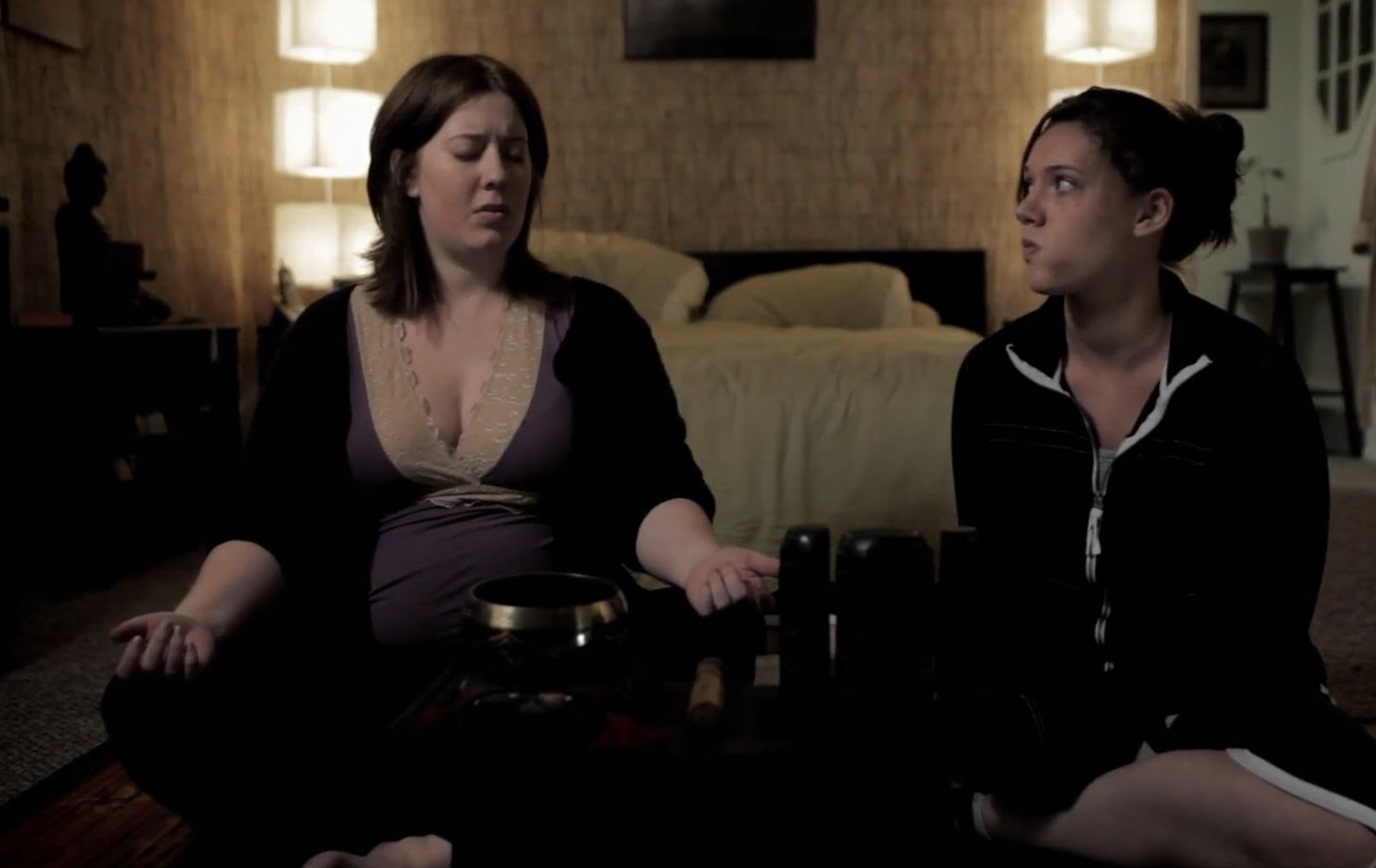
Courtney Bell and Katie Parker in Absentia, image via IMDB
And yet, as previously stated, Absentia isn't about a ghost. In fact, can any of Flanagan’s works be considered to be about any of their villains or spooks? What makes Absentia such an easy film for me to return to time and time again is its characters and their groundedness. Flanagan has become known—particularly in his shows—for his stable of flawed characters, whose ability and tendency to self-reflect and articulate their own troubles might be the most unrealistic thing about them. Still, it’s those same long, often spiritual, strings of prose that ground the characters and make them relatable in an almost literary way, using melodramatic monologues to give viewers a means to substitute their own experiences for the supernatural happenings in the lives of the characters. Though dialed back here compared to The Haunting series or Midnight Mass, Absentia still manages to pit the sisters’ somewhat competing beliefs against one another in a tender, respectful way—a trait that far too many ideological conversations today (real or fictional) lack.
Human moments like these aren’t restricted to religion, either. So many of the interactions between characters in Absentia feel so genuine, so lived, despite the short time we’re able to spend with each of them. If it weren’t such a common occurrence throughout his oeuvre, I’d be willing to chalk it up to a single, well-written script, but it’s not just a case of relatable, realistic characters. In Absentia, as in the rest of Flanagan’s canon, characters serve as stand-ins for ourselves—communicating thoughts and ideas that we haven’t been able to form words for. Even though none of us (or most of us, at least) will ever encounter vengeful spirits or undead creatures of the night, we can all empathize with familial estrangement, addiction, guilt, or regret. Every one of us tries to do our best with this single life we’ve been given and very rarely does it turn out how we thought it would. “I think you had the right idea sometimes,” Tricia tells Callie, as they tearfully grapple with the upheaval of Daniel’s disappearance, his reappearance, and the implausible explanations for both, “You just point yourself toward some unknown horizon and just try to get untangled … It’s just so night and fucking day from what I set out for. I mean how the hell was I supposed to know it would end up like this? How the hell are we supposed to know?”
Article written by Ande Thomas
Ande loves the intersection of sci-fi and horror, where our understanding of the natural world clashes with our fear of the new and unknown. He writes about monsters and foreign horror and can also be found over on Letterboxd.

Other Articles You May Enjoy…
Revenge asks very little of the reader. Establish a wound. Point the wounded party toward whoever made it. We handle the rest quickly because the arithmetic feels good, and we have been practicing it since we were old enough to be treated unfairly. Scott Hawkins gives you that arithmetic early in Blacktail, then spends the rest of the book taking the calculator apart on the table in front of you.