Actors have their trademark mannerisms. Tom Cruise runs, Sam Rockwell dances, Brad Pitt eats, Sean Bean dies.
Sam Neill observed.
Following Neill’s death on July 13, 2026, I was inspired to revisit his most iconic horror roles, and for the first time, I realized how often they turn looking into part of the plot. These movies frequently touched upon themes of sight, blindness, and even the eyes themselves, and Neill played characters for whom the act of seeing was central to the story. Thus Sam Neill became an avatar for the spectator, the bystander, and the watcher. As his career progressed, his relationship with sight became increasingly complicated, until eventually the act of seeing itself became a source of horror.
Possession and Dead Calm: Watching Without Control
Andrzej Żuławski's Possession (1981) gives Neill a spy’s eyes. He plays Mark, an intelligence operative returning to a marriage he can no longer read. He questions his wife Anna, follows her, and discovers her doppelganger, whose only distinguishing feature is her bright green eyes. What’s more, Neill’s character, a voyeur by nature, even hires another detective to shadow his wife—a voyeur commissioning voyeurism. None of what Mark uncovers gives him the explanation he wants. The entire film is rooted in what’s being seen and the eyes that see it, and one man’s inability to comprehend it.
1989’s Dead Calm separates knowledge from action when a major reveal about the villainous nature of Billy Zane’s character Hughie Warner comes in the form of Neill’s John Ingram discovering video footage of Hughie murdering the other passengers on his schooner. Unfortunately, he sees the footage aboard the sinking schooner while his wife remains stranded with Hughie on their yacht. John has the proof he needs when what he needs most is a way to intervene. This also introduces another recurring theme in Neill’s filmography: plot revelations delivered through media, be it video footage, a feature film, or even a book.
In the Mouth of Madness: Investigator Becomes Audience
In John Carpenter’s In the Mouth of Madness (1994), Neill’s John Trent is an insurance investigator tasked with looking into stories and finding the fraud. Following clues in Sutter Cane’s reality-warping eldritch novel, fiction and reality begin to merge unsteadily. In the film’s final moments, Trent watches a cinematic adaptation of the novel, laughing maniacally as his sanity finally slips away entirely. And it should be noted that even though it’s not a horror film, Neill’s other collaboration with John Carpenter—1992’s Memoirs of an Invisible Man—hinges on mocking the very idea of observation. Neill, placed in the role of observer once more, can watch everyone except the man he is meant to catch.
Event Horizon: When Seeing Becomes Unbearable
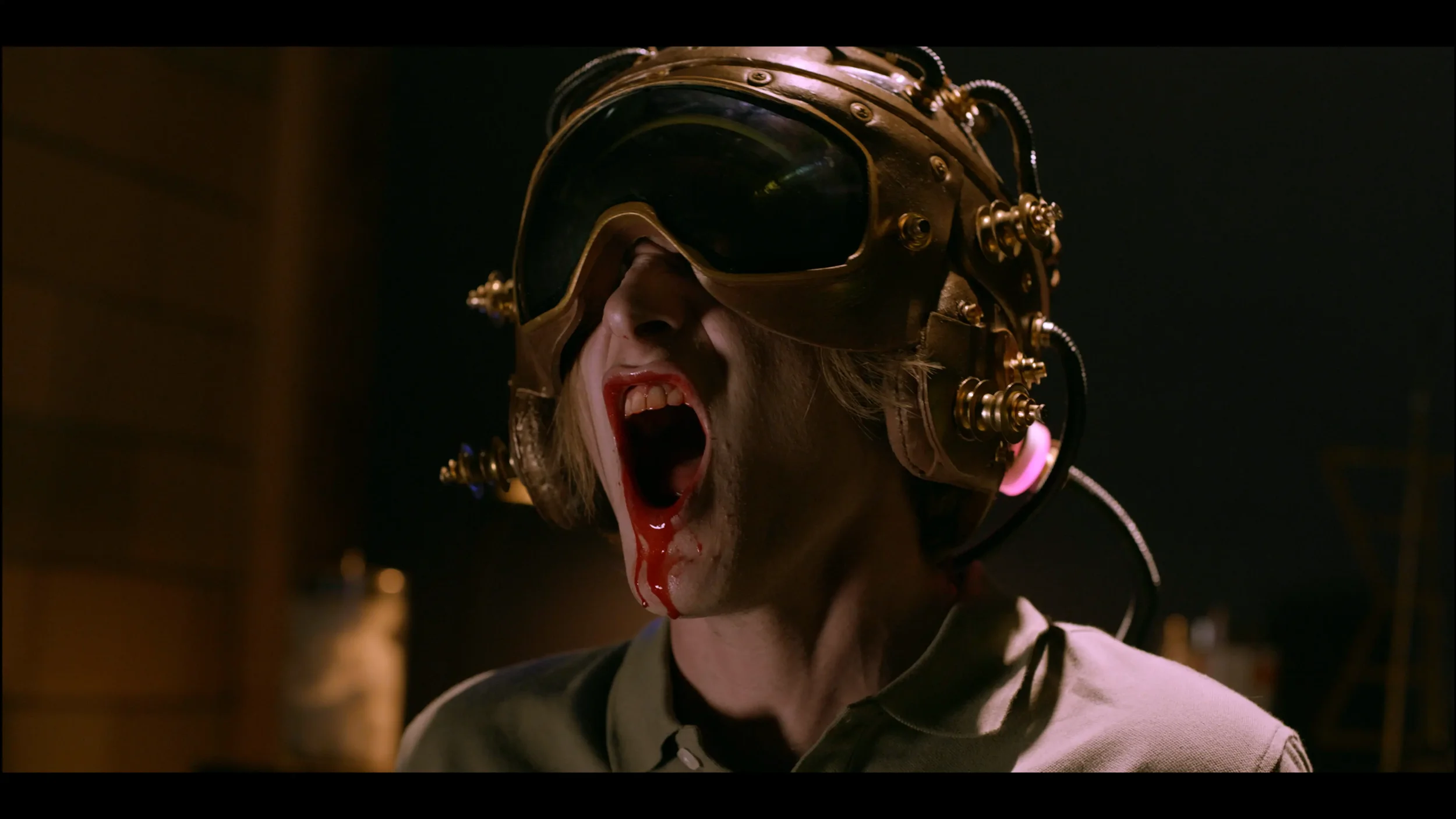
But no film hinges more on the role of eyes, vision, and sight in Sam Neill’s filmography than 1997’s Event Horizon, directed by Paul W. S. Anderson. Neill plays Dr. Weir, the designer of a spacecraft that has become haunted after passing through a dimension of unimaginable terror as it traveled faster than light. Before Weir is even aboard the Event Horizon, we are treated to a vision of one of the corpses of its former crew missing its eyes, a shot which transitions into a close-up of Weir’s own eye. Then the haunting begins with the discovery of a scrambled video depicting the horrors inflicted on the ship’s previous crew, which of course includes the removal of their eyeballs. Another crew member is trapped in an airlock without his space suit and his eyes bleed from the decompression. The rest of the crew begin seeing hallucinations of their greatest fears, including Weir hallucinating his dead wife with her eyes gouged out, all culminating with Weir himself clawing out his eyes and proclaiming that “Where we’re going, you won’t need eyes to see.”
Each of these characters in Neill’s filmography depicts how something seen can alter a person forever. It can change how you see your lover, it can reveal the hopelessness of a world taken over by insanity-inducing media, and if what you see is traumatic enough, it may make you wish to never see anything ever again. Neill’s quiet concentration makes each character believable in their own way. He can look around a room and suggest that he has already begun sorting the evidence, even as the films then deny him control over its interpretation.
Neill’s home country of New Zealand has its own beliefs surrounding eyes and blindness. In one Māori pūrākau, the god Tāwhirimātea plucked out his own eyes, crushed them, and threw them into the heavens to create the constellation Matariki. The name Matariki is an abbreviation of Ngā Mata o te Ariki Tāwhirimātea (‘The eyes of the god’).
So here is the late Sam Neill, a man from a country where the sky above glittered with the eyes of the god, who worked in a medium that demands to be seen, that requires an audience to watch it. In the stories he told, he reminded us that the eyes are the window to the soul. The things his characters saw affected them deeply, whether he was screaming at a world turned to the color blue or shaking as he took off his sunglasses to stare at a dinosaur.
Now that Neill has left us, we can still see him full of life on our screens, where he will live forever. See you later, Sam.
Article by Magill Foote
Magill Foote defies classification by writing about vintage horror collectibles for Rue Morgue magazine, producing the true crime podcast The Trail Went Cold, creating games and art for Taiga Interactive, and having memorized a seemingly endless number of one-liner jokes. He lives on Prince Edward Island with his wife and a small menagerie of pets. His favorite cryptid is the Squonk.
Other Articles You May Enjoy…



Sam Neill’s characters often make a living by looking closely: spies, investigators, scientists. But in Possession, In the Mouth of Madness, and Event Horizon, seeing more rarely means understanding more. Magill Foote traces how Neill’s watchful performances turn the search for answers into a source of horror.